

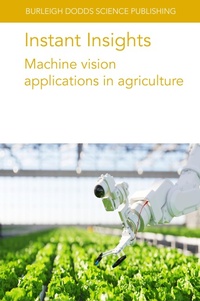
Instant Insights: Machine Vision Applications in Agriculture
Published on 29. October 2024
190 pages
978-1-83545-009-3 (ISBN)
Description

This book features five peer-reviewed reviews on machine vision applications in agriculture.
The first chapter examines recent advances in machine vision technologies for the measurement of soil texture, structure and topography. The chapter also provides an overview of the basic principles of machine vision technologies, focussing on areas such as 3D surface modelling.
The second chapter considers the use of machine learning methods to classify multiple diseases across several different crop types. The chapter also explains how deep learning for image analysis and classification works.
The third chapter presents an overview of the use of machine learning for agri-robotics, including the main trends of the last decade. It also discusses the use of machine learning for data analysis and decision-making for perception and navigation.
The fourth chapter addresses the prospects of machine vision application in plant factories with artificial lighting. The chapter also summarises recent research utilising this technology, including plant growth monitoring, robot operation assistance and fruit grading.
The final chapter reviews advances in computer vision-based technologies for precision livestock farming. The chapter also reviews how automation in image analysis can promote smart management of livestock to improve health and welfare.
The first chapter examines recent advances in machine vision technologies for the measurement of soil texture, structure and topography. The chapter also provides an overview of the basic principles of machine vision technologies, focussing on areas such as 3D surface modelling.
The second chapter considers the use of machine learning methods to classify multiple diseases across several different crop types. The chapter also explains how deep learning for image analysis and classification works.
The third chapter presents an overview of the use of machine learning for agri-robotics, including the main trends of the last decade. It also discusses the use of machine learning for data analysis and decision-making for perception and navigation.
The fourth chapter addresses the prospects of machine vision application in plant factories with artificial lighting. The chapter also summarises recent research utilising this technology, including plant growth monitoring, robot operation assistance and fruit grading.
The final chapter reviews advances in computer vision-based technologies for precision livestock farming. The chapter also reviews how automation in image analysis can promote smart management of livestock to improve health and welfare.
More details
Series
Language
English
Place of publication
Cambridge
United Kingdom
Target group
College/higher education
Professional and scholarly
Researchers in crop, soil, environment and computer science, farmers, growers, agricultural professionals offering specialist advice and services, as well as government and other private sector agencies supporting sustainable agriculture
Product notice
Reflowable
Illustrations
Color tables, photos and figures
File size
34,63 MB
ISBN-13
978-1-83545-009-3 (9781835450093)
DOI
10.19103/9781835450093
Copyright in bibliographic data and cover images is held by Nielsen Book Services Limited or by the publishers or by their respective licensors: all rights reserved.
Schweitzer Classification
Other editions
Additional editions
Various Authors | Jean-Marc Gilliot | Ophelie Sauzet
Instant Insights: Machine Vision Applications in Agriculture
Machine vision applications in agriculture
Book
10/2024
Burleigh Dodds Science Publishing Limited
€70.80
Shipment within 3-4 weeks
Persons
Contributions by: Jean-Marc Gilliot, AgroParisTech Paris Saclay University, France; and Ophélie Sauzet, University of Applied Sciences of Western Switzerland, The Geneva Institute of Technology, Architecture and Landscape (HEPIA), Soils and Substrates Group, Institute Land-Nature- Environment (inTNE Institute), Switzerland; Megan Long, John Innes Centre, UK; Polina Kurtser, Örebro University and Umeå University, Sweden; Stephanie Lowry, Örebro University, Sweden; and Ola Ringdahl, Umeå University, Sweden; Wei Ma and Zhiwei Tian, Institute of Urban Agriculture, Chinese Academy of Agricultural Sciences, China; C. Arcidiacono and S. M. C. Porto, University of Catania, Italy
Content
Chapter 1 - Advances in machine vision technologies for the measurement of soil texture, structure and topography: Jean-Marc Gilliot, AgroParisTech Paris Saclay University, France; and Ophelie Sauzet, University of Applied Sciences of Western Switzerland, The Geneva Institute of Technology, Architecture and Landscape (HEPIA), Soils and Substrates Group, Institute Land-Nature- Environment (inTNE Institute), Switzerland;
1 Introduction
2 Basic principles
3 Case studies
4 Conclusion and future trends
5 Where to look for further information
6 Acknowledgements
7 References
Chapter taken from: Lobsey, C. and Biswas, A. (ed.), Advances in sensor technology for sustainable crop production, Burleigh Dodds Science Publishing, Cambridge, UK, 2023, (ISBN: 978 1 78676 977 0)
Chapter 2 - Using machine learning to identify and diagnose crop diseases: Megan Long, John Innes Centre, UK;
1 Introduction* 2 A quick introduction to deep learning
3 Preparation of data for deep learning experiments
4 Crop disease classification
5 Different visualisation techniques
6 Hyperspectral imaging for early disease detection
7 Case study: identification and classification of diseases on wheat
8 Conclusion and future trends
9 Where to look for more information
10 References
Chapter taken from: Lobsey, C. and Biswas, A. (ed.), Advances in sensor technology for sustainable crop production, Burleigh Dodds Science Publishing, Cambridge, UK, 2023, (ISBN: 978 1 78676 977 0)
Chapter 3 - Advances in machine learning for agricultural robots: Polina Kurtser, OErebro University and Umea University, Sweden; Stephanie Lowry, OErebro University, Sweden; and Ola Ringdahl, Umea University, Sweden;
1 Introduction
2 Applications of machine learning in agri-robotics
3 Challenges
4 Integration and field-testing use-cases
5 Conclusion
6 Where to look for further information
7 References
Chapter taken from: van Henten, E. and Edan, Y. (ed.), Advances in agrifood robotics, Burleigh Dodds Science Publishing, Cambridge, UK, 2024, (ISBN: 978 1 80146 277 8)
Chapter 4 - Application of machine vision in plant factories: Wei Ma and Zhiwei Tian, Institute of Urban Agriculture, Chinese Academy of Agricultural Sciences, China;
1 Introduction
2 Plant growth monitoring
3 Robot operation assistance
4 Fruit grading
5 The application of deep learning in the plant factory
6 Challenges faced by machine vision in plant factories
7 Conclusion
8 Declaration of competing interest
9 Where to look for further information
10 Acknowledgements
11 References
Chapter taken from: Kozai, T. and Hayashi, E. (ed.), Advances in plant factories: New technologies in indoor vertical farming, Burleigh Dodds Science Publishing, Cambridge, UK, 2023, (ISBN: 978 1 80146 316 4)
Chapter 5 - Machine vision techniques to monitor behaviour and health in precision livestock farming: C. Arcidiacono and S. M. C. Porto, University of Catania, Italy;
1 Introduction
2 Devices for data acquisition in computer visionbased systems
3 Animal species and tasks analysed in computer vision systems for precision livestock farming
4 Key elements of computer visionbased systems: initialisation
5 Key elements of computer visionbased systems: tracking image segmentation
6 Key elements of computer visionbased systems: tracking video object segmentation
7 Key elements of computer visionbased systems: feature extraction
8 Key elements of computer visionbased systems: pose estimation and behaviour recognition
9 Case studies of precision livestock farming applications based on traditional computer vision techniques
10 Advances in computer vision techniques: deep learning
11 Case studies of precision livestock farming applications based on deep learning techniques
12 Conclusion
13 References
Chapter taken from: Berckmans, D. (ed.), Advances in precision livestock farming, Burleigh Dodds Science Publishing, Cambridge, UK, 2022, (ISBN: 978 1 78676 471 3)
1 Introduction
2 Basic principles
3 Case studies
4 Conclusion and future trends
5 Where to look for further information
6 Acknowledgements
7 References
Chapter taken from: Lobsey, C. and Biswas, A. (ed.), Advances in sensor technology for sustainable crop production, Burleigh Dodds Science Publishing, Cambridge, UK, 2023, (ISBN: 978 1 78676 977 0)
Chapter 2 - Using machine learning to identify and diagnose crop diseases: Megan Long, John Innes Centre, UK;
1 Introduction* 2 A quick introduction to deep learning
3 Preparation of data for deep learning experiments
4 Crop disease classification
5 Different visualisation techniques
6 Hyperspectral imaging for early disease detection
7 Case study: identification and classification of diseases on wheat
8 Conclusion and future trends
9 Where to look for more information
10 References
Chapter taken from: Lobsey, C. and Biswas, A. (ed.), Advances in sensor technology for sustainable crop production, Burleigh Dodds Science Publishing, Cambridge, UK, 2023, (ISBN: 978 1 78676 977 0)
Chapter 3 - Advances in machine learning for agricultural robots: Polina Kurtser, OErebro University and Umea University, Sweden; Stephanie Lowry, OErebro University, Sweden; and Ola Ringdahl, Umea University, Sweden;
1 Introduction
2 Applications of machine learning in agri-robotics
3 Challenges
4 Integration and field-testing use-cases
5 Conclusion
6 Where to look for further information
7 References
Chapter taken from: van Henten, E. and Edan, Y. (ed.), Advances in agrifood robotics, Burleigh Dodds Science Publishing, Cambridge, UK, 2024, (ISBN: 978 1 80146 277 8)
Chapter 4 - Application of machine vision in plant factories: Wei Ma and Zhiwei Tian, Institute of Urban Agriculture, Chinese Academy of Agricultural Sciences, China;
1 Introduction
2 Plant growth monitoring
3 Robot operation assistance
4 Fruit grading
5 The application of deep learning in the plant factory
6 Challenges faced by machine vision in plant factories
7 Conclusion
8 Declaration of competing interest
9 Where to look for further information
10 Acknowledgements
11 References
Chapter taken from: Kozai, T. and Hayashi, E. (ed.), Advances in plant factories: New technologies in indoor vertical farming, Burleigh Dodds Science Publishing, Cambridge, UK, 2023, (ISBN: 978 1 80146 316 4)
Chapter 5 - Machine vision techniques to monitor behaviour and health in precision livestock farming: C. Arcidiacono and S. M. C. Porto, University of Catania, Italy;
1 Introduction
2 Devices for data acquisition in computer visionbased systems
3 Animal species and tasks analysed in computer vision systems for precision livestock farming
4 Key elements of computer visionbased systems: initialisation
5 Key elements of computer visionbased systems: tracking image segmentation
6 Key elements of computer visionbased systems: tracking video object segmentation
7 Key elements of computer visionbased systems: feature extraction
8 Key elements of computer visionbased systems: pose estimation and behaviour recognition
9 Case studies of precision livestock farming applications based on traditional computer vision techniques
10 Advances in computer vision techniques: deep learning
11 Case studies of precision livestock farming applications based on deep learning techniques
12 Conclusion
13 References
Chapter taken from: Berckmans, D. (ed.), Advances in precision livestock farming, Burleigh Dodds Science Publishing, Cambridge, UK, 2022, (ISBN: 978 1 78676 471 3)
