

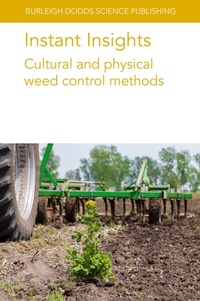
Instant Insights: Cultural and Physical Weed Control Methods
Published on 31. March 2026
108 pages
978-1-83545-558-6 (ISBN)
Description

This book features five peer-reviewed reviews on the range of cultural and physical weed control methods.
The first chapter summarises the range of cultural techniques used to control weeds in Conservation Agriculture systems. The chapter also discusses the effects of these practices on weed seedbanks, space occupation, competition for resources and weed population density.
The second chapter provides an overview of physical weed control (PWC), focussing on its aims, principles and mechanisms of mortality. The chapter also highlights the influence of tool choice on the efficacy and selectivity of PWC practices.
The third chapter reviews flame weeding requirements, the mechanism by which it reduces weeds and the potential uses of the technique. The chapter also considers the advantages and disadvantages of flame weeding, including its potential environmental impacts.
The fourth chapter explores the variety of thermal weed control techniques, such as hot water/steam treatment and laser technology. The chapter also evaluates their efficacy, energy consumption and impact on soil health and crop safety.
The final chapter highlights recent advancements in mechanical weed control technologies, focussing on novel inventions and the development of mechanical devices for full-width cultivation, inter-row cultivation and intra-row cultivation.
The first chapter summarises the range of cultural techniques used to control weeds in Conservation Agriculture systems. The chapter also discusses the effects of these practices on weed seedbanks, space occupation, competition for resources and weed population density.
The second chapter provides an overview of physical weed control (PWC), focussing on its aims, principles and mechanisms of mortality. The chapter also highlights the influence of tool choice on the efficacy and selectivity of PWC practices.
The third chapter reviews flame weeding requirements, the mechanism by which it reduces weeds and the potential uses of the technique. The chapter also considers the advantages and disadvantages of flame weeding, including its potential environmental impacts.
The fourth chapter explores the variety of thermal weed control techniques, such as hot water/steam treatment and laser technology. The chapter also evaluates their efficacy, energy consumption and impact on soil health and crop safety.
The final chapter highlights recent advancements in mechanical weed control technologies, focussing on novel inventions and the development of mechanical devices for full-width cultivation, inter-row cultivation and intra-row cultivation.
More details
Series
Language
English
Place of publication
Cambridge
United Kingdom
Target group
College/higher education
Professional and scholarly
Weed scientists, researchers in crop protections, agronomists, farmers, pesticide companies, government and private sector agencies supporting sustainable agriculture.
Product notice
Reflowable
Illustrations
Color tables, photos and figures
File size
12,53 MB
ISBN-13
978-1-83545-558-6 (9781835455586)
DOI
10.19103/9781835455586
Copyright in bibliographic data and cover images is held by Nielsen Book Services Limited or by the publishers or by their respective licensors: all rights reserved.
Schweitzer Classification
Other editions
Additional editions
Various Authors | Francisco Skora Neto | Eric R. Gallandt
Instant Insights
Cultural and physical weed control methods
Book
03/2026
Burleigh Dodds Science: Instant Insights
€65.60
Shipment within 3-4 weeks
Persons
Content
Chapter 1 - Cultural techniques to control weeds in Conservation Agriculture systems: Francisco Skora Neto, No-till Brazilian Federation (FEBRAPDP)/ formerly Agronomic Institute of Parana (IAPAR), Brazil;
1 Introduction
2 Cultural methods: occupation of space
3 Cultural methods: reduction of the presence of competing species
4 Organic agriculture
5 Case study
6 Conclusion and future trends
7 Where to look for further information
8 References
Chapter taken from: Basch, G., Gonzalez-Sanchez, E., Geraghty, J., Eslami, S. V., Duiker, S. W., Mkomwa, S. and Bartz, M. (eds.), Weed management in Conservation Agriculture systems, Burleigh Dodds Science Publishing, Cambridge, UK, 20125 (ISBN 978 1 80146 784 1)
Chapter 2 - Developments in physical weed control: Eric R. Gallandt, University of Maine, USA; Daniel Brainard, Michigan State University, USA; and Bryan Brown, University of Maine, USA;
1 Introduction
2 Tillage
3 Physical weed control: overview
4 Tools, weeds and soil conditions
5 Weed-crop selectivity
6 Fundamental problems with cultivation
7 Future research priorities
8 Where to look for further information
9 References
Chapter taken from: Zimdahl, R. L. (ed.), Integrated weed management for sustainable agriculture, Burleigh Dodds Science Publishing, Cambridge, UK, 2017, (ISBN 978 1 78676 164 4)
Chapter 3 - Flame weeding techniques: Stevan Z. Knezevic, University of Nebraska-Lincoln, USA;
1 Introduction
2 Flaming specifications, effectiveness and equipment
3 Weed response to heat
4 Uses of flame weeding
5 Advantages, disadvantages and environmental impacts
6 Future research and practical recommendations
7 Where to look for further information
8 References
Chapter taken from: Zimdahl, R. L. (ed.), Integrated weed management for sustainable agriculture, Burleigh Dodds Science Publishing, Cambridge, UK, 2017, (ISBN 978 1 78676 164 4)
Chapter 4 - Thermal weed control in Conservation Agriculture systems: Bernhard Streit and Martin V. Bauer, Bern University of Applied Sciences, Switzerland;
1 Introduction
2 Thermal weed control: general aspects
3 Flame weeding
4 Electrical weed control
5 Hot water or steam used for weed control
6 Laser-based weed control
7 Conclusion
8 References
Chapter taken from: Basch, G., Gonzalez-Sanchez, E., Geraghty, J., Eslami, S. V., Duiker, S. W., Mkomwa, S. and Bartz, M. (eds.), Weed management in Conservation Agriculture systems, Burleigh Dodds Science Publishing, Cambridge, UK, 20125 (ISBN 978 1 80146 784 1)
Chapter 5 - Advances in mechanical weed control technologies: Bo Melander and Margaret R. McCollough, Aarhus University, Denmark;
1 Introduction
2 The mechanisms of mechanical weed control
3 Full-width cultivation
4 Inter-row cultivation
5 Intra-row cultivation
6 Future trends and conclusion
7 Where to look for further information
8 References
Chapter taken from: Kudsk, P. (ed.), Advances in integrated weed management, Burleigh Dodds Science Publishing, Cambridge, UK, 2022, (ISBN 978 1 78676 745 5)
1 Introduction
2 Cultural methods: occupation of space
3 Cultural methods: reduction of the presence of competing species
4 Organic agriculture
5 Case study
6 Conclusion and future trends
7 Where to look for further information
8 References
Chapter taken from: Basch, G., Gonzalez-Sanchez, E., Geraghty, J., Eslami, S. V., Duiker, S. W., Mkomwa, S. and Bartz, M. (eds.), Weed management in Conservation Agriculture systems, Burleigh Dodds Science Publishing, Cambridge, UK, 20125 (ISBN 978 1 80146 784 1)
Chapter 2 - Developments in physical weed control: Eric R. Gallandt, University of Maine, USA; Daniel Brainard, Michigan State University, USA; and Bryan Brown, University of Maine, USA;
1 Introduction
2 Tillage
3 Physical weed control: overview
4 Tools, weeds and soil conditions
5 Weed-crop selectivity
6 Fundamental problems with cultivation
7 Future research priorities
8 Where to look for further information
9 References
Chapter taken from: Zimdahl, R. L. (ed.), Integrated weed management for sustainable agriculture, Burleigh Dodds Science Publishing, Cambridge, UK, 2017, (ISBN 978 1 78676 164 4)
Chapter 3 - Flame weeding techniques: Stevan Z. Knezevic, University of Nebraska-Lincoln, USA;
1 Introduction
2 Flaming specifications, effectiveness and equipment
3 Weed response to heat
4 Uses of flame weeding
5 Advantages, disadvantages and environmental impacts
6 Future research and practical recommendations
7 Where to look for further information
8 References
Chapter taken from: Zimdahl, R. L. (ed.), Integrated weed management for sustainable agriculture, Burleigh Dodds Science Publishing, Cambridge, UK, 2017, (ISBN 978 1 78676 164 4)
Chapter 4 - Thermal weed control in Conservation Agriculture systems: Bernhard Streit and Martin V. Bauer, Bern University of Applied Sciences, Switzerland;
1 Introduction
2 Thermal weed control: general aspects
3 Flame weeding
4 Electrical weed control
5 Hot water or steam used for weed control
6 Laser-based weed control
7 Conclusion
8 References
Chapter taken from: Basch, G., Gonzalez-Sanchez, E., Geraghty, J., Eslami, S. V., Duiker, S. W., Mkomwa, S. and Bartz, M. (eds.), Weed management in Conservation Agriculture systems, Burleigh Dodds Science Publishing, Cambridge, UK, 20125 (ISBN 978 1 80146 784 1)
Chapter 5 - Advances in mechanical weed control technologies: Bo Melander and Margaret R. McCollough, Aarhus University, Denmark;
1 Introduction
2 The mechanisms of mechanical weed control
3 Full-width cultivation
4 Inter-row cultivation
5 Intra-row cultivation
6 Future trends and conclusion
7 Where to look for further information
8 References
Chapter taken from: Kudsk, P. (ed.), Advances in integrated weed management, Burleigh Dodds Science Publishing, Cambridge, UK, 2022, (ISBN 978 1 78676 745 5)
