

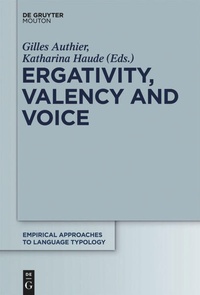
Ergativity, Valency and Voice
1st Edition
Published on 29. May 2012
VIII, 387 pages
978-3-11-022773-4 (ISBN)
Description

This volume is a collection of articles concerned with the typology of valency and valence change in a large and diversified sample of languages that display ergative alignment in their grammar. The sample of languages represented in these descriptive contributions covers most of the geographical areas and linguistic families in which ergativity has been known to exist jointly with well-developed morphological voice, and some languages belonging to families in which ergativity or voice were not previously recognized or adequately described up to now.
Reviews / Votes
"In conclusion, the book reviewed is essential reading for everyone interestedin ergativity, voice alternations and valency-changing mechanisms. This booktargets a very large audience: it is of interest not only to researchersworking on ergativity, but also to undergraduates, who can learn whatergativity is, how it can be related to other phenomena found in differentlanguages, and how one can work with understudied languages that require notonly the interpretation of raw linguistic material, but also an accuratedescription of it."Adina Dragomirescu in: Linguist List 24.609More details
Series
Language
English
Place of publication
Berlin/Boston
Germany
Publishing group
de Gruyter Mouton
Target group
Professional and scholarly
US School Grade: College Graduate Student
Illustrations
61 s/w Tabellen, 5 Abbildungen
5 ill., 61 tbl.
File size
1,76 MB
ISBN-13
978-3-11-022773-4 (9783110227734)
Schweitzer Classification
Other editions
Additional editions
Gilles Authier | Katharina Haude
Ergativity, Valency and Voice
Book
05/2012
1st Edition
De Gruyter Mouton
€189.95
Shipment within 7-9 days
Persons
Gilles Authier, Institut des Langues Orientales, Paris, France; Katharina Haude, University of Cologne, Germany.
Content
1 - List of contributors [Seite 7]
2 - Introduction [Seite 9]
3 - Ergativity and voice in Mayan languages: a functional-typological approach [Seite 23]
4 - Ergativity and the passive in three Mayan languages [Seite 59]
5 - A tale of two passives in Cavineña [Seite 119]
6 - The detransitive voice in Kryz [Seite 141]
7 - Laz middle voice [Seite 173]
8 - Argument demotion in Japhug Rgyalrong [Seite 207]
9 - The Katukina-Kanamari antipassive [Seite 235]
10 - Undergoer orientation in Movima [Seite 267]
11 - Case patterns and verb classes in Trumai [Seite 297]
12 - Ergativity in the Adyghe system of valency-changing derivations [Seite 331]
13 - The evolution of transitive verbs in Basque and emergence of dative-marked patients [Seite 363]
14 - Index of subjects [Seite 389]
15 - Index of languages [Seite 395]
2 - Introduction [Seite 9]
3 - Ergativity and voice in Mayan languages: a functional-typological approach [Seite 23]
4 - Ergativity and the passive in three Mayan languages [Seite 59]
5 - A tale of two passives in Cavineña [Seite 119]
6 - The detransitive voice in Kryz [Seite 141]
7 - Laz middle voice [Seite 173]
8 - Argument demotion in Japhug Rgyalrong [Seite 207]
9 - The Katukina-Kanamari antipassive [Seite 235]
10 - Undergoer orientation in Movima [Seite 267]
11 - Case patterns and verb classes in Trumai [Seite 297]
12 - Ergativity in the Adyghe system of valency-changing derivations [Seite 331]
13 - The evolution of transitive verbs in Basque and emergence of dative-marked patients [Seite 363]
14 - Index of subjects [Seite 389]
15 - Index of languages [Seite 395]
