

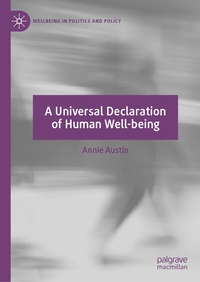
A Universal Declaration of Human Well-being
1st Edition
Published on 22. November 2019
XI, 112 pages
978-3-030-27107-7 (ISBN)
Description

"This book makes a vital contribution to the current literature on human well-being. Through a condensed but incisive analysis of a wide range of sources, from ancient philosophy to the political constitutions of modern nation states, Annie Austin builds a strong case for a universal core of human well-being. Her identification of the vital importance of an "infrastructure of sociality" should be noted by academicians, politicians and policy-makers who are seeking to use well-being as a means of rethinking how we are to meet the challenges of the 21st century."
-Allister McGregor, University of Sheffield, UK
This book examines the differing policy implications of the different conceptions of wellbeing across the world. There is an ongoing debate, in both philosophical and policy circles, about the legitimacy of universal frameworks of wellbeing. Who should decide what it means to live a good life? Is it possible to arrive at a shared definition, or is there simply too much individual and cultural diversity in conceptions of the good life? By devising an 'overlapping consensus' on wellbeing, the book represents a starting point for political negotiation and public deliberation about the kinds of societies we (as collectivities) wish to create, and the kinds of lives we (as individuals embedded in those societies) want to live. The book provides philosophically-informed public policy insight, making it a valuable contribution to interdisciplinary wellbeing scholarship.
-Allister McGregor, University of Sheffield, UK
This book examines the differing policy implications of the different conceptions of wellbeing across the world. There is an ongoing debate, in both philosophical and policy circles, about the legitimacy of universal frameworks of wellbeing. Who should decide what it means to live a good life? Is it possible to arrive at a shared definition, or is there simply too much individual and cultural diversity in conceptions of the good life? By devising an 'overlapping consensus' on wellbeing, the book represents a starting point for political negotiation and public deliberation about the kinds of societies we (as collectivities) wish to create, and the kinds of lives we (as individuals embedded in those societies) want to live. The book provides philosophically-informed public policy insight, making it a valuable contribution to interdisciplinary wellbeing scholarship.
More details
Series
Language
English
Place of publication
Cham
Switzerland
Publishing group
Springer International Publishing
Target group
Professional and scholarly
Product notice
Reflowable
Illustrations
XI, 112 p. 1 illus.
File size
1,61 MB
ISBN-13
978-3-030-27107-7 (9783030271077)
DOI
10.1007/978-3-030-27107-7
Schweitzer Classification
Other editions
Additional editions
Annie Austin
A Universal Declaration of Human Well-being
Book
12/2019
Palgrave Pivot
€58.84
Shipment within 7-9 days
Person
Annie Austin is Research Fellow at the Centre for Social Ethics and Policy at the University of Manchester, UK.
Content
Chapter 1. Well-being in Politics and Policy.- Chapter 2. Theories of Well-being: The Foundations.- Chapter 3. The Constituents of Well-being: Overlapping values.- Chapter 4. Well-being in Europe.- Chapter 5. Well-being in North America.- Chapter 6. Well-being in Latin America.- Chapter 7. Well-being in Asia.- Chapter 8. Well-being in Africa.- Chapter 9. Well-being: A reflective equilibrium.
