

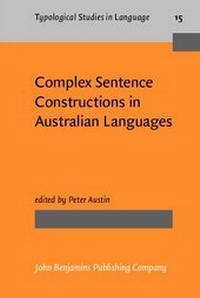
Complex Sentence Constructions in Australian Languages
1st Edition
Published on 1. January 1988
VII, 289 pages
978-90-272-7861-6 (ISBN)
Description

Over the past fifteen years, descriptions of Australian Aboriginal languages have provided important data for the typological study of morpho-syntactic phenomena. The present volume presents descriptions of complex sentence phenomena in ten Australian languages and provides important new material in this area of current concern in linguistics. Complex sentences are described either from a syntactic or from a semantic (discourse-functional) point of view. The papers draw on data from widely distributed and, in some instances, previously undescribed languages. Among others descriptions of the (so-far) poorly known non-Pama-Nyungan languages of northern Australia, as well as Pama-Nyungan languages central and northern Australia are included in this volume.
More details
Other editions
Additional editions
Book
01/1988
John Benjamins Publishing Co
€127.20
Shipment within 10-15 days
Content
- COMPLEX SENTENCE CONSTRUCTIONS IN AUSTRALIAN LANGUAGES
- Editorial page
- Title page
- Copyright page
- Table of contents
- PREFACE
- INTRODUCTION
- REFERENCES
- FIGURE AND GROUND IN REMBARRNGA COMPLEX SENTENCES
- 1. Introduction
- 2. Outline of Data
- 2.1 Morphology
- 2.2 Use of REL subordinate clauses
- 3. Hale's Adjunction Analysis
- 4. Logical Features of REL Subordination
- 4.1 Entailment
- 4.2 Problems for the entailment analysis
- 5. The Figure and Ground Analysis
- 5.1 Figure and ground
- 5.2 Background and entailment
- 5.3 Negative sentences with mulak
- 5.5 Perception verb complements
- 5.6 Case-marked REL subordinate clauses
- 5.4 Subject matter complements
- 6. Conclusion
- FOOTNOTES
- REFERENCES
- MOOD AND SUBORDINATION IN KUNIYANTI
- 1. Introduction1
- 2. Mood
- 2.1 Subjunctive mood
- 2.1.1 Future subjunctive
- 2.1.2 Irrealis subjunctive
- 2.1.3 Meaning of the subjunctive
- 2.1.4 Past subjunctive
- 2.1.5 Present subjunctive
- 2.2 Factive mood
- 3. Clause Complexes
- 3.1 Parataxis
- 3.1.1 Clausal expansion
- 3.1.2 Constituent expansion
- 3.2 Hypotaxis
- 3.2.1 Clausal expansion
- 3.2.2 Constituent expansion
- 3.3 Linguistic significance of the types
- 4. Relationship of Mood and Subordination
- 5. Conclusion
- FOOTNOTES
- REFERENCES
- PARTICIPLE SENTENCES IN WAKIMAN
- 1. Introduction
- 2. Wakiman Verb Structure
- 2.1 Participles
- 2.2 Prefixes and finite verb complexes
- 3. Participle Constructions
- 3.1 Simple participle constructions
- 3.2 Multiple participle constructions
- 3.3 Participle imperative clauses
- 3.4 Further participle constructions
- 4. Verb Particle + Auxiliary Analysis
- 5. Participle Constructions as Complex Sentences
- 6. Participles as Verbal Dependents
- 7. Conclusion
- FOOTNOTES
- REFERENCES
- COMPLEXSENTENCESIN MARTUTHUNIRA
- 1. Introduction
- 1.1 The Martuthunira language
- 1.2 Switch-reference in linguistic theory
- 1.3 The data
- 2. Subordinate Clauses
- 2.1 Finite relative clauses
- 2.2 Perfect subordinate clauses
- 2.3 The lest construction
- 3. Subordinate Clauses with Switch-Reference
- 3.1 Non-finite relative clauses
- 3.1.1 Same-subject clauses
- 3.1.2 Different-subject clauses
- 3.2 Purpose clauses
- 3.2.1 Purpose same-subject
- 3.2.2 Purpose different-subject
- 4. Summary of Subordinate Clause Patterns
- 4.1 Relative clauses
- 4.1.1 Non-finite relative clauses
- 4.1.2 Finite relative clauses
- 4.2 Purpose clauses
- 4.2.1 Purpose clauses
- 4.2.2 Lest clauses
- 5. Switch-Reference and Passives
- 5.1 Active and passive clauses
- 5.2 Subordinate clause passives
- 5.2.1 -PASS-RELss
- 5.2.2-PASS-RELds-ACC
- 5.2.3 -PASS-RELds(-LOC)
- 5.2.4 -PASS-PURPs=o
- 5.2.5 -PASS -PURPds
- 5.2.6 -PASS-PURPss
- 6. Conclusions
- FOOTNOTES
- REFERENCES
- SWITCH-REFERENCE IN MPARNTWE ARRERNTE(ARANDA): FORM, FUNCTION, AND PROBLEMS OF IDENTITY
- 1. Introduction
- 1.1 General
- 1.2 What is switch-reference?
- 2. Switch-Reference in Mparntwe Arrernte
- 2.1 Grammatical preliminaries
- 2.2 Switch-reference in Mparntwe Arrernte
- 2.3 Relative tense
- 2.4 Switch-reference on negatives
- 2.5 Discourse realisation of switch-reference
- 2.5.1 Subject NP ellipsis
- 2.5.2 Trans-sentential switch-reference
- 3. System Versus Morphology
- 3.1 The level and nature of switch-reference clause linkage
- 3.2 -me-le versus -mele
- 3.2.1 Manner adverbs
- 3.2.2 Seriation
- 4. Problems of Identity
- 4.1 General discussion
- 4.2 Inclusion
- 4.3 Part-whole relations
- 4.4 Split personality?
- FOOTNOTES
- REFERENCES
- 5. Conclusion
- VERB SERIALISATION AND THE CIRCUMSTANTIAL CONSTRUCTION IN YANKUNYTJATJARA
- 1. Serial Verb Constructions
- 1.1 Loose serialisation
- 1.2 Tight serialisation
- 1.3 Periphrasis
- 2. Verb Serialisation or Relative Clauses?
- 3. The (different-subjects) Circumstantial Construction
- FOOTNOTES
- REFERENCES
- SOME FEATURES OF MANJILJARRA NOMINALISED RELATIVE CLAUSES
- 1. Introduction
- 2. Aspect and Time Reference
- 2.1 -TENSE -CONT verbs
- 2.2 -TENSE, + CONT verbs
- 2.3 +TENSE PAST - CONT verbs
- 2.4 +TENSE PAST +CONT verbs
- 2.5 +TENSE FUTURE -CONT verbs
- 2.6 +TENSE FUTURE + CONT verbs
- 3. Case-marking
- 4. Backgrounding: Prior Condition
- 5. A Possible History
- 6. Conclusion
- FOOTNOTES
- REFERENCES
- CASE AND COMPLEMENTISER SUFFIXES IN WARLPIRI
- 1. Introduction
- 2. Morphological Similarities
- 3. Similarities of Function
- 3.1 Functions of case-suffixes
- 3.2 Functions of complementiser suffixes
- FOOTNOTES
- REFERENCES
- ODD TOPIC MARKING IN KAYARDILD
- 1. Introduction
- 2. Grammatical Background
- 2.1 Modal case marking
- 2.2 Grammatical relations
- 2.3 Subject, topic, and juncture type
- 2.4 Tight juncture types
- 2.4.1 Serialized verbs
- 2.4.2 Nominalized complements
- 2.4.3 Movement purpose clauses
- 2.4.4 Tight juncture types: summary
- 3. Finite Subordinate Clauses and Odd Topic Marking
- 3.1 Range of meaning
- basic characteristics
- 3.2 Odd topic marking: morphosyntax
- 3.2.1 Basic morphosyntax
- complementizing case
- 3.3 Productivity of complementizing case
- 3.4 Complementized IMMEDiate clauses
- 3.5 Exceptions to full clausal case marking
- 3.6 Embedding
- 3.7 Summary of morphosyntax of complementized clauses
- 4. Syntactic Conditions Requiring Complementizing Case
- 4.1 Topic is a subordinate non-subject
- 4.2 Topic is a matrix non-subject
- 4.3 No argument is common
- 4.4 Syntactic conditions: possible generalizations
- 4.5 Comparison between odd topic and switch-reference marking
- 4.6 Two problematic juncture types
- 4.6.1 Jussive clauses
- 4.6.2 -THarrba 'precondition' clauses
- 4.7 Parenthetical clauses
- 5. Odd Topic Marking in Main Clauses
- 5.1 Introduction
- 5.2 Thematically neutral discourse conditions in Kayardild
- 5.2.1 Topic elaboration chains
- 5.2.2 Passives
- 5.3 Discourse conditions on complementizing case
- 5.3.1 Object and instrument topics
- 5.3.3 Contrastive focus on subjects
- 5.3.4 Information questions and unmarked topics
- 5.3.5 Summary of 'odd topic' conditions in discourse
- 5.3.2 Object elaboration chains
- 5.4 Comparison of odd topic marking in complex sentences and in discourse
- 5.4.1 Different triggering conditions
- 5.4.2 Differences in morphological realization
- 5.4.3 Which is historically prior?
- 6. Complementized Clauses in Yukulta
- 7. Conclusion
- FOOTNOTES
- REFERENCES
- AFFIXESOF MOTION AND DIRECTION IN ADNYAMATHANHA
- 1. Introduction
- 2. The Phenomenon in other Australian Languages
- 3. A Hypothesis for Adnyamathanha
- 4. The Affixes as a Category of Verb Specification
- 5. The Adnyamathanha Verb Complex
- 6. The Affixes of Motion and Direction
- 6.1 Event in direction of speaker
- 6.2 Motion prior to event
- 6.3 Motion during which the event occurs
- 6.4 Motion subsequent to event
- 6.5 Summary
- 7. The Development of the Affixes
- 7.1 Lexical ítems
- 7.2 The -ndha constructions
- 7.3 Affixes not incorporating -ndha-
- FOOTNOTES
- REFERENCES
- 8. Conclusions
- INDEXOF LANGUAGES
- INDEXOF NAMES
