

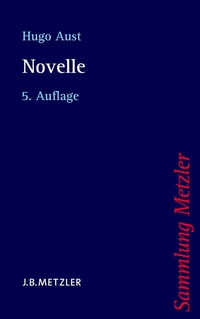
Novelle
5th Edition
Published on 17. August 2016
XIII, 263 pages
978-3-476-01490-0 (ISBN)
Description

Vom "Erdbeben in Chili" bis zur "Entdeckung der Currywurst". Von Kleist bis Timm diese Einführung in die Gattung erläutert die deutschsprachige Novellenliteratur von ihren Anfängen in der Nachfolge Boccaccios über ihre besondere Entfaltung im 19. Jahrhundert bis zu den Novellen der Gegenwartsliteratur. Hugo Aust zeigt, dass es schon vor Goethe eine beachtenswerte Novellentradition gab. Die 5. Auflage wurde aktualisiert und um die wesentliche Novellenliteratur der letzten Jahre erweitert. Mit neuen Inhalten zur Didaktik und zur frühen deutschen Novelle.
More details
Series
Edition
5. Aufl. 2012
Language
German
Place of publication
Stuttgart
Germany
Publishing group
J.B. Metzler, Part of Springer Nature - Springer-Verlag GmbH
Illustrations
XIII, 263 S.
File size
1,52 MB
ISBN-13
978-3-476-01490-0 (9783476014900)
DOI
10.1007/978-3-476-01490-0
Schweitzer Classification
Other editions
New editions
Additional editions
Previous edition
Person
Hugo Aust, Professor für Deutsche Sprache und Literatur sowie deren Didaktik, Universität Köln
Content
1 - Cover?? [Seite 1]
2 - Title?? [Seite 4]
3 - Copyright?? [Seite 5]
4 - Inhalt?? [Seite 6]
5 - Abkürzungen [Seite 9]
6 - Grundlegende, wiederholt zitierte Literatur [Seite 10]
7 - Vorwort [Seite 12]
8 - 1. Zugänge [Seite 15]
8.1 - 1.1 Gattungstheoretische Voraussetzungen [Seite 15]
8.2 - 1.2 Situative Bedingungen der Novelle [Seite 17]
8.2.1 - 1.2.1 Gespräch [Seite 18]
8.2.2 - 1.2.2 Absicht [Seite 19]
8.2.3 - 1.2.3 Erzählen [Seite 20]
8.2.4 - 1.2.4 Redegüte [Seite 21]
9 - 2. Schlüsselwörter des Novellendiskurses [Seite 24]
9.1 - 2.1 Länge [Seite 25]
9.2 - 2.2 Begebenheit [Seite 26]
9.2.1 - 2.2.1 >Unerhört< [Seite 27]
9.2.2 - 2.2.2 >Neu< [Seite 27]
9.2.3 - 2.2.3 >Wahr< [Seite 28]
9.2.4 - 2.2.4 >Eine< [Seite 29]
9.3 - 2.3 Konzentration [Seite 29]
9.3.1 - 2.3.1 Punkt [Seite 30]
9.3.2 - 2.3.2 Symbol [Seite 30]
9.4 - 2.4 Rahmen [Seite 31]
9.5 - 2.5 Erzählen nach Mustern [Seite 32]
9.6 - 2.6 Sammelbarkeit [Seite 33]
10 - 3. Novellenbegriffe in der Diskussion [Seite 39]
10.1 - 3.1 Wortgeschichte [Seite 39]
10.2 - 3.2 Stationen der Novellen-Programmatik [Seite 42]
10.2.1 - 3.2.1 Die Novelle im Zeichen der romantischen Ironie: Friedrich Schlegel [Seite 44]
10.2.2 - 3.2.2 Novelle als Signatur der Zeit: August Wilhelm Schlegel [Seite 45]
10.2.3 - 3.2.3 Die Vielstimmigkeit der Novelle: Ludwig Tieck [Seite 46]
10.2.4 - 3.2.4 Zwischen bedeutendem Thema und leichtsinnigem Geschwätz: Willibald Alexis und Carl Friedrich von Rumohr [Seite 48]
10.2.5 - 3.2.5 Georg Reinbecks Situationsnovelle [Seite 49]
10.2.6 - 3.2.6 Die Novelle im Zeichen der poetischen Integration: Hermann Hettner und Friedrich Theodor Vischer [Seite 50]
10.2.7 - 3.2.7 Das Novellen-Experiment: Paul Heyse [Seite 51]
10.2.8 - 3.2.8 Arabesken einer strengen Novellenform: Paul Ernst [Seite 53]
10.2.9 - 3.2.9 Novellenrefl exionen im 20. Jahrhundert [Seite 56]
10.3 - 3.3 Tendenzen der jüngeren Forschungsgeschichte [Seite 59]
10.4 - 3.4 Die Novelle aus didaktischer Sicht [Seite 74]
11 - 4. Geschichte der deutschsprachigen Novelle [Seite 88]
11.1 - 4.1 Romanische Novellenmuster: Boccaccio, Margarete von Navarra, Cervantes [Seite 89]
11.2 - 4.2 Im Einfl ussbereich der >moralischen Erzählung< [Seite 92]
11.2.1 - 4.2.1 Mittelalter - frühe Neuzeit - Barock [Seite 92]
11.2.2 - 4.2.2 Aufklärung [Seite 98]
11.2.3 - 4.2.3 Friedrich Schiller [Seite 99]
11.2.4 - 4.2.4 Christoph Martin Wieland [Seite 102]
11.2.5 - 4.2.5 Das Aufkommen der Novellenbezeichnung [Seite 104]
11.3 - 4.3 Novellen->Klassiker< ohne Novellenbegriff [Seite 106]
11.3.1 - 4.3.1 Johann Wolfgang Goethe [Seite 106]
11.3.2 - 4.3.2 Heinrich von Kleist [Seite 114]
11.4 - 4.4 Romantik [Seite 121]
11.4.1 - 4.4.1 Clemens Brentano [Seite 122]
11.4.2 - 4.4.2 Achim von Arnim [Seite 123]
11.4.3 - 4.4.3 Friedrich de la Motte Fouqué [Seite 126]
11.4.4 - 4.4.4 E.T.A. Hoffmann [Seite 127]
11.4.5 - 4.4.5 Joseph von Eichendorff [Seite 129]
11.4.6 - 4.4.6 Wilhelm Hauff [Seite 133]
11.5 - 4.5 Biedermeierzeit [Seite 136]
11.5.1 - 4.5.1 Ludwig Tieck [Seite 137]
11.5.2 - 4.5.2 Karl Immermann, Franz von Gaudy, Karl Gutzkow [Seite 142]
11.5.3 - 4.5.3 Eduard Mörike [Seite 144]
11.5.4 - 4.5.4 Adalbert Stifter [Seite 147]
11.6 - 4.6 Realismus [Seite 152]
11.6.1 - 4.6.1 Gottfried Keller [Seite 154]
11.6.2 - 4.6.2 Theodor Storm [Seite 160]
11.6.3 - 4.6.3 Conrad Ferdinand Meyer [Seite 165]
11.7 - 4.7 Moderne [Seite 172]
11.7.1 - 4.7.1 Gerhart Hauptmann [Seite 174]
11.7.2 - 4.7.2 Arthur Schnitzler [Seite 176]
11.7.3 - 4.7.3 Heinrich Mann [Seite 180]
11.7.4 - 4.7.4 Thomas Mann [Seite 182]
11.7.5 - 4.7.5 Novellen der 1910er Jahre [Seite 186]
11.7.6 - 4.7.6 Expressionistische Novellen [Seite 189]
11.7.7 - 4.7.7 Novellistischer Störfall: Gottfried Benn [Seite 197]
11.7.8 - 4.7.8 Zum Problem der klassizistischen Novelle [Seite 200]
11.7.9 - 4.7.9 Hermann Broch und Robert Musil [Seite 202]
11.7.10 - 4.7.10 Novellen zwischen den Weltkriegen [Seite 206]
11.7.11 - 4.7.11 Novellen zur Zeit des Nationalsozialismus [Seite 211]
11.8 - 4.8 Nachkriegszeit bis Jahrtausendwende [Seite 229]
11.8.1 - 4.8.1 Friedrich Dürrenmatt [Seite 233]
11.8.2 - 4.8.2 Günter Grass [Seite 234]
11.8.3 - 4.8.3 Martin Walser [Seite 237]
11.8.4 - 4.8.4 Christoph Hein [Seite 239]
11.8.5 - 4.8.5 Jochen Beyse, Eva Zeller und Michael Kleeberg [Seite 240]
11.8.6 - 4.8.6 Dieter Wellershoff [Seite 242]
11.8.7 - 4.8.7 Hartmut Lange [Seite 244]
11.8.8 - 4.8.8 Thomas Hürlimann [Seite 247]
11.8.9 - 4.8.9 Uwe Timm [Seite 248]
11.9 - 4.9 Gegenwart [Seite 254]
11.10 - 4.10 Ausblick [Seite 266]
12 - Personenregister [Seite 268]
2 - Title?? [Seite 4]
3 - Copyright?? [Seite 5]
4 - Inhalt?? [Seite 6]
5 - Abkürzungen [Seite 9]
6 - Grundlegende, wiederholt zitierte Literatur [Seite 10]
7 - Vorwort [Seite 12]
8 - 1. Zugänge [Seite 15]
8.1 - 1.1 Gattungstheoretische Voraussetzungen [Seite 15]
8.2 - 1.2 Situative Bedingungen der Novelle [Seite 17]
8.2.1 - 1.2.1 Gespräch [Seite 18]
8.2.2 - 1.2.2 Absicht [Seite 19]
8.2.3 - 1.2.3 Erzählen [Seite 20]
8.2.4 - 1.2.4 Redegüte [Seite 21]
9 - 2. Schlüsselwörter des Novellendiskurses [Seite 24]
9.1 - 2.1 Länge [Seite 25]
9.2 - 2.2 Begebenheit [Seite 26]
9.2.1 - 2.2.1 >Unerhört< [Seite 27]
9.2.2 - 2.2.2 >Neu< [Seite 27]
9.2.3 - 2.2.3 >Wahr< [Seite 28]
9.2.4 - 2.2.4 >Eine< [Seite 29]
9.3 - 2.3 Konzentration [Seite 29]
9.3.1 - 2.3.1 Punkt [Seite 30]
9.3.2 - 2.3.2 Symbol [Seite 30]
9.4 - 2.4 Rahmen [Seite 31]
9.5 - 2.5 Erzählen nach Mustern [Seite 32]
9.6 - 2.6 Sammelbarkeit [Seite 33]
10 - 3. Novellenbegriffe in der Diskussion [Seite 39]
10.1 - 3.1 Wortgeschichte [Seite 39]
10.2 - 3.2 Stationen der Novellen-Programmatik [Seite 42]
10.2.1 - 3.2.1 Die Novelle im Zeichen der romantischen Ironie: Friedrich Schlegel [Seite 44]
10.2.2 - 3.2.2 Novelle als Signatur der Zeit: August Wilhelm Schlegel [Seite 45]
10.2.3 - 3.2.3 Die Vielstimmigkeit der Novelle: Ludwig Tieck [Seite 46]
10.2.4 - 3.2.4 Zwischen bedeutendem Thema und leichtsinnigem Geschwätz: Willibald Alexis und Carl Friedrich von Rumohr [Seite 48]
10.2.5 - 3.2.5 Georg Reinbecks Situationsnovelle [Seite 49]
10.2.6 - 3.2.6 Die Novelle im Zeichen der poetischen Integration: Hermann Hettner und Friedrich Theodor Vischer [Seite 50]
10.2.7 - 3.2.7 Das Novellen-Experiment: Paul Heyse [Seite 51]
10.2.8 - 3.2.8 Arabesken einer strengen Novellenform: Paul Ernst [Seite 53]
10.2.9 - 3.2.9 Novellenrefl exionen im 20. Jahrhundert [Seite 56]
10.3 - 3.3 Tendenzen der jüngeren Forschungsgeschichte [Seite 59]
10.4 - 3.4 Die Novelle aus didaktischer Sicht [Seite 74]
11 - 4. Geschichte der deutschsprachigen Novelle [Seite 88]
11.1 - 4.1 Romanische Novellenmuster: Boccaccio, Margarete von Navarra, Cervantes [Seite 89]
11.2 - 4.2 Im Einfl ussbereich der >moralischen Erzählung< [Seite 92]
11.2.1 - 4.2.1 Mittelalter - frühe Neuzeit - Barock [Seite 92]
11.2.2 - 4.2.2 Aufklärung [Seite 98]
11.2.3 - 4.2.3 Friedrich Schiller [Seite 99]
11.2.4 - 4.2.4 Christoph Martin Wieland [Seite 102]
11.2.5 - 4.2.5 Das Aufkommen der Novellenbezeichnung [Seite 104]
11.3 - 4.3 Novellen->Klassiker< ohne Novellenbegriff [Seite 106]
11.3.1 - 4.3.1 Johann Wolfgang Goethe [Seite 106]
11.3.2 - 4.3.2 Heinrich von Kleist [Seite 114]
11.4 - 4.4 Romantik [Seite 121]
11.4.1 - 4.4.1 Clemens Brentano [Seite 122]
11.4.2 - 4.4.2 Achim von Arnim [Seite 123]
11.4.3 - 4.4.3 Friedrich de la Motte Fouqué [Seite 126]
11.4.4 - 4.4.4 E.T.A. Hoffmann [Seite 127]
11.4.5 - 4.4.5 Joseph von Eichendorff [Seite 129]
11.4.6 - 4.4.6 Wilhelm Hauff [Seite 133]
11.5 - 4.5 Biedermeierzeit [Seite 136]
11.5.1 - 4.5.1 Ludwig Tieck [Seite 137]
11.5.2 - 4.5.2 Karl Immermann, Franz von Gaudy, Karl Gutzkow [Seite 142]
11.5.3 - 4.5.3 Eduard Mörike [Seite 144]
11.5.4 - 4.5.4 Adalbert Stifter [Seite 147]
11.6 - 4.6 Realismus [Seite 152]
11.6.1 - 4.6.1 Gottfried Keller [Seite 154]
11.6.2 - 4.6.2 Theodor Storm [Seite 160]
11.6.3 - 4.6.3 Conrad Ferdinand Meyer [Seite 165]
11.7 - 4.7 Moderne [Seite 172]
11.7.1 - 4.7.1 Gerhart Hauptmann [Seite 174]
11.7.2 - 4.7.2 Arthur Schnitzler [Seite 176]
11.7.3 - 4.7.3 Heinrich Mann [Seite 180]
11.7.4 - 4.7.4 Thomas Mann [Seite 182]
11.7.5 - 4.7.5 Novellen der 1910er Jahre [Seite 186]
11.7.6 - 4.7.6 Expressionistische Novellen [Seite 189]
11.7.7 - 4.7.7 Novellistischer Störfall: Gottfried Benn [Seite 197]
11.7.8 - 4.7.8 Zum Problem der klassizistischen Novelle [Seite 200]
11.7.9 - 4.7.9 Hermann Broch und Robert Musil [Seite 202]
11.7.10 - 4.7.10 Novellen zwischen den Weltkriegen [Seite 206]
11.7.11 - 4.7.11 Novellen zur Zeit des Nationalsozialismus [Seite 211]
11.8 - 4.8 Nachkriegszeit bis Jahrtausendwende [Seite 229]
11.8.1 - 4.8.1 Friedrich Dürrenmatt [Seite 233]
11.8.2 - 4.8.2 Günter Grass [Seite 234]
11.8.3 - 4.8.3 Martin Walser [Seite 237]
11.8.4 - 4.8.4 Christoph Hein [Seite 239]
11.8.5 - 4.8.5 Jochen Beyse, Eva Zeller und Michael Kleeberg [Seite 240]
11.8.6 - 4.8.6 Dieter Wellershoff [Seite 242]
11.8.7 - 4.8.7 Hartmut Lange [Seite 244]
11.8.8 - 4.8.8 Thomas Hürlimann [Seite 247]
11.8.9 - 4.8.9 Uwe Timm [Seite 248]
11.9 - 4.9 Gegenwart [Seite 254]
11.10 - 4.10 Ausblick [Seite 266]
12 - Personenregister [Seite 268]
