

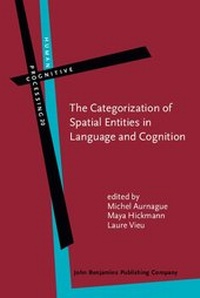
The Categorization of Spatial Entities in Language and Cognition
1st Edition
Published on 18. April 2007
VIII, 371 pages
978-90-272-9267-4 (ISBN)
Description

Despite a growing interest for space in language, most research has focused on spatial markers specifying the static or dynamic relationships among entities (verbs, prepositions, postpositions, case markings.). Little attention has been paid to the very properties of spatial entities, their status in linguistic descriptions, and their implications for spatial cognition and its development in children. This topic is at the center of this book, that opens a new field by sketching some major theoretical and methodological directions for future research on spatial entities. Brought together linguistic descriptions of spatial systems, formal accounts of linguistic data, and experimental findings from psycholinguistic studies, all couched within a wide cross-linguistic perspective. Such an interdisciplinary approach provides a rich overview of the many questions that remain unanswered in relation to spatial entities, while also throwing a new light on previous research focusing on related topics concerning space and/or the relation between language and cognition.
More details
Other editions
Additional editions
Michel Aurnague | Maya Hickmann | Laure Vieu
The Categorization of Spatial Entities in Language and Cognition
Book
04/2007
John Benjamins Publishing Co
€127.20
Shipment within 10-15 days
Persons
Content
- The Categorization of Spatial Entities in Language and Cognition
- Editorial page
- Title page
- LCC data
- Table of contents
- Contributors
- Introduction
- 1. The categorization of spatial entities in different research fields
- 1.1. Categorization
- 1.2. Previous work
- 1.3. Open issues
- 2. Towards new directions: An overview of the contents of this volume
- 2.1. Spatial entities and the structures of languages: Descriptive work
- 2.2. Spatial categorization in language and cognition: Psycholinguistic and developmental studies
- 2.3. Characterizing categories of spatial entities: Formal ontology and formal semantics
- 3. Conclusion and prospects
- References
- Spatial entities and the structures of languages: Descriptive work
- A taxonomy of basic natural entities
- 1. Introduction
- 2. Basic material entities
- 3. Spatial and material entities
- 4. Count entities and masses
- 5. Masses and aggregates
- 6. Aggregates and collections
- 7. Mixtures
- 8. Mixtures and the use of the preposition in
- 9. Conclusion
- References
- On the spatial meaning of contre in French
- 1. Introduction
- 2. Sketching three different types of prototypical schemata
- 2.1. The force exertion originates in the figure
- 2.2. The force exertion originates in the ground entity
- 2.3. Opposite force exertion from two entities of the same class of objects
- 3. Three cases where contre cannot be directly associated with force exertion
- 3.1. Tension reduced to a perceptive effect of contact and proximity
- 3.2. Visual contrast between entities reduced to their two-dimensional contour
- 3.3. Direction and facing position
- 4. Conclusion
- References
- The prepositions par and à travers and the categorization of spatial entities in French
- 1. Introduction
- 2. The existing "static'' ontology of spatial entities in French
- 3. Par and the categorization of spatial entities
- 3.1. Par and NP denoting space portions
- 3.2. Par and NP denoting locations
- 3.3. Par and NP denoting objects
- 3.4. Par and NP denoting mixed entities
- 3.5. Par and NP denoting substances
- 4. A travers and the categorization of spatial entities
- 4.1. A travers and NP denoting space portions
- 4.2. A travers and NP denoting locations
- 4.3. A travers and NP denoting objects
- 4.4. A travers and NP denoting mixed entities
- 4.5. A travers and NP denoting substances
- 5. Conclusion
- References
- Appendixes
- The linguistic categorization of spatial entities
- 0. Introduction
- 1. Classifiers in a typological overview of nominal classification systems
- 1.1. Classifiers among other nominal classification systems
- 1.2. A typology of classifier systems
- 1.3. Numeral classifiers and physical properties of spatial entities
- 1.4. Degrees of specificity of the classifiers
- 1.5. The dynamic dimensions of classifier systems
- 1.6. Classifiers and other classification systems of spatial entities
- 1.7. A multidimensional approach and fieldwork methodology
- 2. A sampler of classifier systems
- 2.1. Numeral classifier systems
- 2.2. Noun classifiers
- 2.3. Genitive classifiers
- 2.4. Verbal classifiers
- 3. A descriptive typological framework on how information on spatial entities might be expressed in languages
- 3.1. Strategies of encoding
- 3.2. Information may be about different characteristics of the spatial entities
- 3.3. About spatial information in nominal classification systems
- 3.4. Some languages obsess about spatial information and spatial entities
- References
- The expression of semantic components and the nature of ground entity in orientation motion verbs
- 1. Introduction
- 2. A brief outline of motion constructions and object marking in Korean and French
- 2.1. Korean motion constructions
- 2.2. French motion constructions
- 2.3. Korean object marking system
- 2.4. French prepositional system
- 3. Basic Motion vs. Deictic Motion
- 4. Object marking
- 4.1. Korean Data
- 4.2. French Data
- 4.3. Linguistic material that expresses specific localization
- 5. Object Selection
- 5.1. Ontology of spatial entities
- 5.2. Locative/ ablative object and the prepositions à/ de
- 5.3. Accusative/ direct object
- 5.4. Directional object and the preposition vers (`towards')
- Conclusion
- References
- Appendixes
- Table of abbreviations
- Source of exemples
- Spatial categorization in language and cognition: Psycholinguistic and developmental studies
- Categorizing spatial entities with frontal orientation
- 1. Introduction
- 2. Isolating and ordering the factors
- 2.1. Isolating the factors
- 2.2. Ordering the factors
- 3. ILNs and factors: Avant/devant and dynamic versus static function
- 3.1. Standard van and dynamic function
- 3.2. Open-sided van: Introducing static function
- 3.3. Standard and open-sided vans
- 4. Judgment task
- 4.1. Response latencies
- 4.2. Distributions
- 5. Perspectives: Frontal orientation and categorization of spatial entities
- 5.1. ILNs, component nouns and the distinction ``location''/``object''
- 5.2. Factors/properties and categorization of spatial entities
- References
- Containment, support, and beyond
- Introduction
- 1. Cognitive foundations of spatial semantic development
- 2. How universal are spatial semantic categories?
- 3. Categorization of topological relations in the acquisition of English and Korean
- 3.1. Topological spatial categories in adult English and Korean
- 3.2. Categorization of topological relationships in young children's spontaneous and elicited speech
- 3.3. Topological categories in comprehension
- 4. The learning process
- 4.1. Infant categorization of topological relations
- 4.2. Evidence for category construction from error patterns across languages
- 5. Conclusions
- References
- Static and dynamic location in French
- 1. Space and linguistic relativity
- 1.1. Space in language
- 1.2. Space in language development
- 2. Location and motion in French
- 2.1. Static location and object displacements
- 2.2. Caused and voluntary motion with animate entities
- 3. Conclusions
- References
- Precursors to spatial language
- References
- The sources of spatial cognition
- 1. Introduction
- 1.1. Theoretical questions
- 1.2. Representation in infants
- 2. Two-dimensional representations of three-dimensional situations
- 3. Searching for objects
- 3.1. Back to theories
- 3.2. Late searching inefficiency
- 4. Motor impairment and language acquisition
- 5. Conclusion
- References
- Characterizing categories of spatial entities: Formal ontology
- From language to ontology
- 1. Introduction
- 2. The "Surface Grammar'' trap
- 3. The "Deep Structure'' trap
- 4. Speaking with the vulgar
- 5. Conclusion
- References
- The temporal essence of spatial objects
- 1. Introduction
- 2. The ontological problem of the reference to concrete entities
- 2.1. Words and objects
- 2.2. Part, wholes, categories
- 2.3. Occurrents vs. Continuants ontology
- 3. Expressing spatial and temporal properties in a unified ontology
- 3.1. A spatio-temporal mereology and topology
- 3.2. Temporal parts
- 4. Reconsidering categories of reference
- 4.1. Object and substance
- 4.2. Substantial vs. non-substantial count nouns
- 4.3. Singular and collective entities
- 4.4. Objects and events
- 5. Conclusion and open questions
- References
- Part-of relations, functionality and dependence
- 1. Introduction
- 2. The multiplicity of part-whole relations
- 2.1. Part-whole relations in language are not just mereology
- 2.2. The multiple relation hypothesis
- 2.3. The role of ontological distinctions among entities
- 3. Analysis of functionality
- 4. Function of entities "under a description''
- 4.1. Lexical types
- 4.2. Function
- 5. Functional dependence
- 5.1. Generic functional dependence
- 5.2. Individual functional dependence
- 5.3. Formalizing Component-integral whole
- 6. Transitivity
- 6.1. Is Component-integral whole transitive?
- 6.2. (In)Transitivity of CIW revisited and other inferential properties
- 7. Conclusion
- References
- Objects, locations and complex types
- 1. Introduction
- 2. The argument for dot objects
- 3. Lexical semantics and common-sense metaphysics
- 4. The composition logic
- 4.1. The set of types
- 4.2. The rules for the composition logic
- 4.3. Rules for complex types
- 5. Complex types, physical objects and locations
- 6. Conclusions
- References
- Language index
- Subject index
- The series Human Cognitive Processing
