

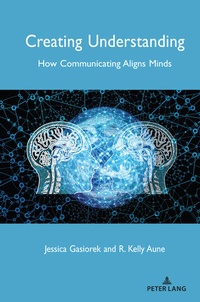
Creating Understanding
Description

What, exactly, is understanding? And how do people create, maintain, and manipulate states of understanding via communication? This book addresses these questions, drawing on interdisciplinary scholarship in cognitive science, communication, psychology, and pragmatics. Rejecting classic descriptions of communication as "sending and receiving messages," this book proposes a novel perspective that depicts communication as a process in which interactants construct, test, and refine mental modes of a joint experience on the basis of the meme states (mental representations) activated by stimuli in social interactions. It explains how this process, when successful, results in interactants' mental models aligning, or becoming entrained-in other words, in creating a state of understanding. This framework is grounded in a set of foundational observations about evolved human cognition that highlight people's intrinsic social orientation, predisposition toward efficiency, and use of predictive interference-making. These principles are also used to explain how codified systems ("codes") emerge in extended or repeated interactions in which people endeavor to create understanding. Integrating and synthesizing research across disciplines, this book offers communication scholars and students a theoretical framework that will transform the way they see understanding, communication, and social connection.
Reviews / Votes
"Understanding is often as difficult to define as it is to experience. How do we understand others, and how do we know we have understood them? These are among the provocative questions deftly unpacked in this exciting new volume by Gasiorek and Aune. The authors introduce a process model of how people generate entrainment in their mental representations of interaction. By situating understanding at the core of communication-and by integrating perspectives from philosophy, linguistics, and cognitive psychology-Gasiorek and Aune have reconceptualized the very nature of what it means to understand."Kory Floyd, Co-editor, The Handbook of Communication Science and Biology; Professor, University of ArizonaMore details
Other editions
Additional editions
Persons
Jessica Gasiorek (Ph.D., University of California - Santa Barbara) is an associate professor in the Department of Communicology at the University of Hawai`i at Manoa. Her research addresses communication accommodation, social cognition, intergroup dynamics, and communication about age and aging.
R. Kelly Aune (Ph.D., University of Arizona) is a professor in the Department of Communicology at the University of Hawai`i at Manoa. His research and teaching address message processing, inference-making and implicature, and creating understanding.
Content
Acknowledgments - Introduction - Communication and Understanding - Conceptualizing Understanding - Premises: Human Cognition and Behavior - Components of Communicating - Creating Understanding - Contextual Factors - Codification - Connections and Implications - Contributions and Future Directions -Index.
