

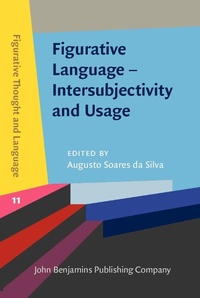
Figurative Language - Intersubjectivity and Usage
1st Edition
Published on 19. May 2021
454 pages
978-90-272-6003-1 (ISBN)
Description

Intersubjectivity and usage play central roles in figurative language and are pivotal notions for a cognitively realistic research on figures of thought, speech, and communication. This volume brings together thirteen studies that explore the relationship between figurativity, intersubjectivity and usage from the Cognitive Linguistics perspective. The studies explore the impact of figurativity on areas of lexicon and grammar, on real discourse, and across different semiotic systems. Some studies focus on the psychological processes of the comprehension of figurativity; other studies address the ways in which figures of thought and language are socially shared and the variation of figures through time and space. Moreover, some contributions are established on advanced corpus-based techniques and experimental methods. There are studies about metaphor, metonymy, irony and puns; about related processes, such as humor, empathy and ambiguation; and about the interaction between figures. Overall, this volume offers the advantages and the opportunities of an interactional and usage-based perspective of figurativity, embracing both the psychological and the intersubjective reality of figurative thought and language and empirically emphasizing the multidimensional character of figurativity, its central function in thought, and its impact on everyday communication.
More details
Other editions
Additional editions
Augusto Soares da Silva
Figurative Language - Intersubjectivity and Usage
Book
05/2021
John Benjamins Publishing Co
€123.30
Shipment within 10-15 days
Content
- Intro
- Figurative Language - Intersubjectivity and Usage
- Editorial page
- Title page
- Copyright page
- Table of contents
- Acknowledgements
- List of contributors
- Introduction. Figurative language: Intersubjectivity and usage
- 1. Figurative language, intersubjectivity and usage
- 2. Social and empirical turn in figurativity research
- 3. Overview of the sections and contributions
- 3.1 Part one. Intersubjectivity and interaction
- 3.2 Part two. Mechanisms and processes
- 3.3 Part three. Usage and variation
- References
- Part I. Intersubjectivity and interaction
- Second-order empathy, pragmatic ambiguity, and irony
- 1. Introduction
- 2. Demarcations
- 3. Ambiguities
- 3.1 Referential ambiguity
- 3.2 Speech-act-related ambiguity
- 3.3 Sociocommunicative ambiguity
- 3.4 Non-verbal empathic ambiguity
- 4. Representatives
- 5. Conclusions
- Acknowledgement
- References
- Desiderata for metaphor theory, the Motivation & Sedimentation Model and motion-emotion metaphoremes
- 1. Introduction
- 2. Five desiderata for a contemporary theory of metaphor
- 2.1 Combining communication and cognition
- 2.2 Combining the universal and the culture-specific
- 2.3 Combining stable and dynamic aspects
- 2.4 Metaphors across semiotic systems
- 2.5 Explicit theoretical and operational definitions
- 2.6 Summary
- 3. Metaphor within the Motivation & Sedimentation Model
- 4. Comparing motion-emotion metaphoremes across languages
- 4.1 General considerations
- 4.2 Methodology
- 4.3 Results
- 4.4 Summary
- 5. Conclusions
- Acknowledgements
- References
- Appendix
- Evaluating metaphor accounts via their pragmatic effects
- 1. Introduction
- 2. Metaphor accounts
- 2.1 Similarity
- 2.2 Categorization
- 2.3 Conceptual metaphor
- 2.4 Blending
- 2.5 Embodied simulation
- 3. Varyingly structured metaphors
- 4. Predictions of metaphor accounts
- 4.1 Similarity predictions
- 4.2 Categorization predictions
- 4.3 Conceptual metaphor predictions
- 4.4 Blending predictions
- 4.5 Embodied simulation predictions
- 5. Experiments
- 5.1 Participants
- 5.2 Materials
- 5.3 Results
- 5.5 Discussion
- References
- Appendix. Contexts and utterances used in the Experiments
- The multimodal negotiation of irony and humor in interaction: On the role of eye gaze in joint pretense
- 1. Introduction
- 2. Irony and humor in interaction
- 3. Eye gaze in interaction
- 4. Eye gaze and interactional humor
- 5. Research questions and data set
- 6. A micro-analysis of selected sequences
- 7. Concluding remarks
- Acknowledgements
- References
- Part II. Mechanisms and processes
- Metaphor and irony: Messy when mixed
- 1. Introduction
- 2. Examples of irony/metaphor mixing
- 2.1 Some examples suitable for irony-upon-metaphor
- 2.2 An example suitable for metaphor-upon-irony
- 3. A (non-fatal) problem with metaphor-upon-irony analyses
- 3.1 The potential and cost of metaphor-upon-irony analysis
- 3.2 Pasta and siestas revisited
- 3.3 A middle way
- 4. The ironicity-first processing strategy
- 5. Further discussion: When other analyses are appropriate
- 5.1 Contrast-imbued analogy and metaphor
- 5.2 Parallel versus serial mixing of irony and metaphor
- 5.3 Metaphor within attitude-wrapped irony
- 5.4 Hyperbole in metaphor/irony mixtures
- 6. Summary and conclusions
- Acknowledgements
- Funding
- References
- Metonymic indeterminacy and metalepsis: Getting two (or more) targets for the price of one vehicle
- 1. Introduction
- 2. Metonymic interaction: Chains and tiers
- 3. Metonymic indeterminacy
- 3.1 Sylleptic and complementary metonymies
- 3.2 Metonymy and metalepsis
- 3.3 Multiple metonymic targets
- 4. Recapitulation and concluding remarks
- Acknowledgements
- Funding
- References
- On verbal and situational irony: Towards a unified approach
- 1. Introduction
- 2. Verbal irony
- 2.1 Pretense versus echo
- 2.2 Verbal irony as a clash between scenarios
- 2.3 Pretended agreement
- 2.4 Chained reasoning schemas in verbal irony
- 3. Situational irony
- 3.1 Previous accounts of situational irony
- 3.2 The epistemic scenario
- 3.3 Chained reasoning schemas in situational irony
- 4. The unified approach: A common framework for verbal and situational irony
- 5. Conclusions
- Acknowledgements
- Funding
- References
- On figurative ambiguity, marking, and low-salience meanings
- 1. Introduction - disambiguation vs. ambiguation
- 2. The phenomenon of marking multiple meanings
- 2.1 Why ambiguation?: Why marking?
- 2.2 Is ambiguation the same as punning?
- 2.3 Does ambiguation always involve a figurative meaning and a literal meaning?
- 3. Ambiguity processing models and their predictions for marked ambiguity
- 3.1 Which meanings benefit from marking?
- 3.2 The Low-Salience Marking Hypothesis
- 4. Experiments
- 4.1 Experiment 1 - an offline study
- 4.2 Experiment 2 - an online study
- 5. General discussion
- Acknowledgements
- Funding
- References
- Appendix
- Part III. Usage and variation
- Metaphor, metonymy and polysemy: A historical perspective
- 1. Introduction
- 2. The semantic history of dull
- 3. The emergence of the sense 'not bright'
- 4. Motivation for the meaning 'not sharp'
- 5. Conclusion
- References
- Appendix. Abridged OED2 entry for dull
- Dull, adj
- Psycholinguistic approaches to figuration
- 1. Introduction
- 2. Meaning activation and cross-modal priming
- 2.1 Investigating figurative processing using cross-modal priming
- 2.2 Interacting variables in idiom processing
- 2.3 Cross-modal priming and metaphor processing
- 2.4 Other approaches to priming in the study of figurative language
- 3. Resolving meaning in context: The use of eye-tracking
- 3.1 Eye-tracking and the 'idiom superiority effect'
- 3.2 Figurative vs. literal meaning in idiom processing
- 3.3 Eye-tracking and the processing of metaphor and metonymy
- 3.4 Individual differences in the processing of figurative language
- 3.5 The importance of familiarity and conventionalization in figurative processing
- 3.6 Eye-tracking in other contexts
- 4. Conclusions
- 4.1 Implications for theories of figurative processing
- References
- Appendix. List of experimental studies
- The fabric of metaphor in discourse: Interweaving cognition and discourse in figurative language
- 1. Introduction
- 2. Concepts and units of analysis of metaphor in use
- 3. Online and off-line levels of metaphor in use
- 4. Exploring local mappings in a metaphor niche
- 5. Conclusions
- References
- Sources of verbal humor in the lexicon: A usage-based perspective on incongruity
- 1. Introductory remarks on investigating verbal humor in the lexicon
- 2. Nominal compounds and the humorousness of metaphor
- 3. Verbal humor in the French and Italian lexicon
- 4. Reinterpreting incongruity from a usage-based perspective: A semiotic typology
- I. Conceptual aspects as a source of verbal humor
- II. The signified as a source of verbal humor
- III. The signifier as a source of verbal humor
- IV. The phonic or graphic realization of the sequence of signs as a source of verbal humor
- V. Verbal humor related to the referent (and the target concept)
- VI. Pragmatic factors of verbal humor that are related to speaker-hearer interaction
- 5. Conclusion
- Acknowledgements
- References
- Measuring the impact of (non)figurativity in the cultural conceptualization of emotions in the two main national varieties of Portuguese
- 1. Introduction
- 2. Cultural variability of anger and pride and cultural differences between Portugal and Brazil
- 3. Corpus data and methodology
- 3.1 Data
- 3.2 Multifactorial usage-feature and profile analysis
- 3.3 Conceptual metaphors and the profile-based approach
- 3.4 Multivariate quantitative methods
- 4. Results
- 4.1 Multiple correspondence analysis: Feature clusters of anger and pride
- 4.2 Logistic regression analysis: anger and pride features predicting EP and BP varieties
- 4.3 Multiple correspondence analysis: Profiles of anger and pride metaphors
- 4.4 Logistic regression analysis: anger and pride metaphors predicting EP and BP varieties
- 5. Conclusions
- Funding
- References
- Index
