

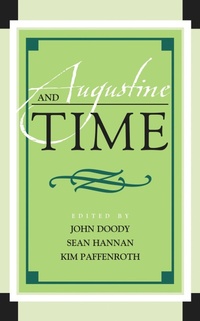
Augustine and Time
Lexington Books (Publisher)
1st Edition
Published on 25. May 2021
356 pages
978-1-9787-8971-5 (ISBN)
Description

This collection examines the topic of time in the life and works of Augustine of Hippo. Adopting a global perspective on time as a philosophical and theological problem, the volume includes reflections on the meaning of history, the mortality of human bodies, and the relationship between temporal experience and linguistic expression. As Augustine himself once observed, time is both familiar and surprisingly strange. Everyone's days are structured by temporal rhythms and routines, from watching the clock to whiling away the hours at work. Few of us, however, take the time to sit down and figure out whether time is real or not, or how it is we are able to hold our past, present, and future thoughts together in a straight line so that we can recite a prayer or sing a song.
Divided into five sections, the essays collected here highlight the ongoing relevance of Augustine's work even in settings quite distinct from his own era and context. The first three sections, organized around the themes of interpretation, language, and gendered embodiment, engage directly with Augustine's own writings, from the Confessions to the City of God and beyond. The final two sections, meanwhile, explore the afterlife of the Augustinian approach in conversation with medieval Islamic and Christian thinkers (like Avicenna and Aquinas), as well as a broad range of Buddhist figures (like Dharmakirti and Vasubandhu).
What binds all of these diverse chapters together is the underlying sense that, regardless of the century or the tradition in which we find ourselves, there is something about the puzzle of temporality that refuses to go away. Time, as Augustine knew, demands our attention. This was true for him in late ancient North Africa. It was also true for Buddhist thinkers in South and East Asia. And it remains just as true for humankind in the twenty-first century, as people around the globe continue to grapple with the reality of time and the challenges of living in a world that always seems to be to be speeding up rather than slowing down.
Divided into five sections, the essays collected here highlight the ongoing relevance of Augustine's work even in settings quite distinct from his own era and context. The first three sections, organized around the themes of interpretation, language, and gendered embodiment, engage directly with Augustine's own writings, from the Confessions to the City of God and beyond. The final two sections, meanwhile, explore the afterlife of the Augustinian approach in conversation with medieval Islamic and Christian thinkers (like Avicenna and Aquinas), as well as a broad range of Buddhist figures (like Dharmakirti and Vasubandhu).
What binds all of these diverse chapters together is the underlying sense that, regardless of the century or the tradition in which we find ourselves, there is something about the puzzle of temporality that refuses to go away. Time, as Augustine knew, demands our attention. This was true for him in late ancient North Africa. It was also true for Buddhist thinkers in South and East Asia. And it remains just as true for humankind in the twenty-first century, as people around the globe continue to grapple with the reality of time and the challenges of living in a world that always seems to be to be speeding up rather than slowing down.
More details
Series
Edition
1. Auflage
Language
English
Place of publication
United States
Publishing group
Bloomsbury Publishing Plc
Target group
Professional and scholarly
ISBN-13
978-1-9787-8971-5 (9781978789715)
Copyright in bibliographic data and cover images is held by Nielsen Book Services Limited or by the publishers or by their respective licensors: all rights reserved.
Schweitzer Classification
Other editions
Additional editions
John Doody | Sean Hannan | Kim Paffenroth
Augustine and Time
Book
03/2023
Lexington Books
€48.40
Shipment within 3-4 weeks
Persons
John Doody is Senior Visiting Professor at Arizona State University. He is a member of the School for Civic and Economic Thought and Leadership.
Kim Paffenroth is Professor of Religious Studies and the Director of the Honors Program at Iona College. He has written extensively on Augustine, the Bible, and on the interface between Christian belief and popular culture. In the last category, he produced Gospel of the Living Dead: George Romero's Visions of Hell on Earth (Baylor, 2006), which won the Bram Stoker Award and led Dr. Paffenroth to write several popular zombie novels. His newest work on Augustine, On King Lear, The Confessions, and Human Experience and Nature, is due out in 2021 from Bloomsbury.
Sean Hannan is an Assistant Professor in the Humanities Department at MacEwan University in Edmonton, Alberta, Canada. His first book, On Time, Change, History, and Conversion, was published by Bloomsbury in 2020. With W. Ezekiel Goggin, he is currently co-authoring Mysticism and Materialism in the Wake of German Idealism (under contract with Routledge).
Kim Paffenroth is Professor of Religious Studies and the Director of the Honors Program at Iona College. He has written extensively on Augustine, the Bible, and on the interface between Christian belief and popular culture. In the last category, he produced Gospel of the Living Dead: George Romero's Visions of Hell on Earth (Baylor, 2006), which won the Bram Stoker Award and led Dr. Paffenroth to write several popular zombie novels. His newest work on Augustine, On King Lear, The Confessions, and Human Experience and Nature, is due out in 2021 from Bloomsbury.
Sean Hannan is an Assistant Professor in the Humanities Department at MacEwan University in Edmonton, Alberta, Canada. His first book, On Time, Change, History, and Conversion, was published by Bloomsbury in 2020. With W. Ezekiel Goggin, he is currently co-authoring Mysticism and Materialism in the Wake of German Idealism (under contract with Routledge).
Content
Part I: Interpreting Augustine On Time
Chapter 1: Time, Eternity, and History in Augustine's Early Works by Thomas Clemmons
Chapter 2: Keeping Time in Mind: Saint Augustine's Solution to a Perplexing Problem by Alexander R. Eodice
Chapter 3: Time After Augustine by James Wetzel
Part II: Time, Language, And Song
Chapter 4: Living as Singing: Augustine's Understanding of the Voice of Creatures in the Confessions by Makiko Sato
Chapter 5: Time, Mirror of the Soul by Cristiane Negreiros Abbud Ayoub
Chapter 6: The Inner Word and the Outer Word: Time, Temporality, and Language in Augustine and Gadamer by Matthew W. Knotts
Part III: Time, Embodiment, And Gender
Chapter 7: Augustinian Temporality and Resurrected Bodies by Paul Ulishney
Chapter 8: Love in the Time of Augustine: Rape, Suicide, and Resurrection in the City of God by Patricia Grosse
Chapter 9: Augustine and the Gendered Self in Time by Megan Loumagne Ulishney
Part IV: Augustinian Temporality in The Middle Ages
Chapter 10: Augustine and Avi
Chapter 1: Time, Eternity, and History in Augustine's Early Works by Thomas Clemmons
Chapter 2: Keeping Time in Mind: Saint Augustine's Solution to a Perplexing Problem by Alexander R. Eodice
Chapter 3: Time After Augustine by James Wetzel
Part II: Time, Language, And Song
Chapter 4: Living as Singing: Augustine's Understanding of the Voice of Creatures in the Confessions by Makiko Sato
Chapter 5: Time, Mirror of the Soul by Cristiane Negreiros Abbud Ayoub
Chapter 6: The Inner Word and the Outer Word: Time, Temporality, and Language in Augustine and Gadamer by Matthew W. Knotts
Part III: Time, Embodiment, And Gender
Chapter 7: Augustinian Temporality and Resurrected Bodies by Paul Ulishney
Chapter 8: Love in the Time of Augustine: Rape, Suicide, and Resurrection in the City of God by Patricia Grosse
Chapter 9: Augustine and the Gendered Self in Time by Megan Loumagne Ulishney
Part IV: Augustinian Temporality in The Middle Ages
Chapter 10: Augustine and Avi
