

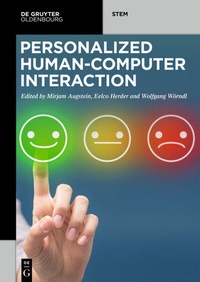
Personalized Human-Computer Interaction
Description

Personalized and adaptive systems employ user models to adapt content, services, interaction or navigation to individual users' needs. User models can be inferred from implicitly observed information, such as the user's interaction history or current location, or from explicitly entered information, such as user profile data or ratings. Applications of personalization include item recommendation, location-based services, learning assistance and the tailored selection of interaction modalities.
With the transition from desktop computers to mobile devices and ubiquitous environments, the need for adapting to changing contexts is even more important. However, this also poses new challenges concerning privacy issues, user control, transparency, and explainability. In addition, user experience and other human factors are becoming increasingly important.
This book describes foundations of user modeling, discusses user interaction as a basis for adaptivity, and showcases several personalization approaches in a variety of domains, including music recommendation, tourism, and accessible user interfaces.
More details
Other editions
New editions
Additional editions
Persons
Mirjam Augstein , FH Hagenberg. Eelco Herder , Radboud University Nijmegen. Wolfgang Wörndl , TU München.
Content
- Intro
- Introduction
- Contents
- List of Contributing Authors
- Part I: Foundations of user modeling
- 1. Theory-grounded user modeling for personalized HCI
- 2. Opportunities and challenges of utilizing personality traits for personalization in HCI
- Part II: User input and feedback
- 3. Automated personalization of input methods and processes
- 4. How to use socio-emotional signals for adaptive training
- 5. Explanations and user control in recommender systems
- Part III: Personalization approaches
- 6. Tourist trip recommendations - foundations, state of the art, and challenges
- 7. Pictures as a tool for matching tourist preferences with destinations
- 8. Towards personalized virtual reality touring through cross-object user interfaces
- 9. User awareness in music recommender systems
- 10. Personalizing the user interface for people with disabilities
- 11. Adaptive workplace learning assistance
- Index
