

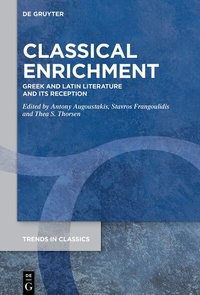
Classical Enrichment
Description

This collection brings together twenty eight chapters written by Stephen Harrison's colleagues and former students from around the globe to celebrate both his distinguished teaching and research career as a classicist and his outstanding and admirable service to the international classical community. The wide variety of original contributions on topics ranging from Greek to Latin and ancient literature's reception in opera and contemporary writing is divided into five parts. Each corresponds to the staggering publication record of the honorand, encompassing, as it does, a broad literary spectrum, starting from the literature of the end of the Roman Republic and coming down to Neo-Latin and the reception of Classics in Irish, in English poetry and in European literature and culture in general. This corpus of compelling chapters is hoped to match Stephen Harrison's rich research output in an illuminating dialogue with it.
More details
Other editions
Additional editions
Persons
Content
- Intro
- Preface
- Contents
- Format and Abbreviations
- Classical Enrichment: In Praise of Stephen Harrison
- An Overview of this Volume
- Part I: Greek and Roman Interactions
- Text and Context: A Question of Method
- Hellenistic Literature and Latin Literature: Towards Totality
- Horace at the Symposium: Talking with Maecenas and Messalla, Singing with Lyde and Phyllis
- Healing One's Sorrow with the Miseries of Others: Consolation and Schadenfreude in Greek and Roman Thought
- Part II: Early and Late Republican Literature
- Rival Plotlines and Lovers' Hardships in Plautus' Asinaria
- Catullus, Nepos, and the Muse
- Catullus' Dirty Kiss (c. 99): Roman Poetry's #MeToo Moment
- Cicero's Marius and his Marius: Life, Dreams, and Intertext
- Part III: Augustan Poetry
- Iambic Parody in Horace's Epode 11: A Variation on Vergil's Generic Games in Eclogue 10?
- Virgil and the Roman Republic: Continuity and Rupture
- Aeneas, the Penates, and Italian Nationalism
- Dido's First Curse (A. 4.380-387)
- Turnus Donning Tragedy: The Baldric in Virgil's Aeneid
- Notes on the Text and Interpretation of Horace's Odes and Carmen Saeculare
- Editing Sulpicia
- Et mihi cedet amor: The Revenge of an Abusive Master in Ars amatoria's Proem
- Amor and amicitia: Ovid's Ars and the Ancient Discourse on Friendship
- The Lover's Calendar (Ars amatoria 1.399-418)
- Part IV: The Ancient Novel
- Recasting Epic in Petronius' "Dinner at Trimalchio's"
- Planet Earth: The Paradoxographic Turn in Antonius Diogenes, Achilles Tatius, Iamblichus, and Longus
- Posthuman Style: Syzygic Affirmations in Achilles Tatius
- Reevaluating and Repositioning the Historia Apollonii Regis Tyri
- Part V: Reception
- The Rape Scene in Terence's Eunuchus and its Reception in the Joseph Plays in the 16⊃&th&/sup& Century
- Endless Pleasure: Congreve's Semele and her Classical Past
- Revolutionary Psyche
- Bann Valley Eclogues
- Crossing Bridges: Derek Mahon and a Resistant Tragic Tradition
- Staying Home with Hesiod: Peter Fallon's Deeds and Their Days
- List of Contributors
- General Index
- Index of Manuscripts and Annotated Volumes
- Index of Passages
