

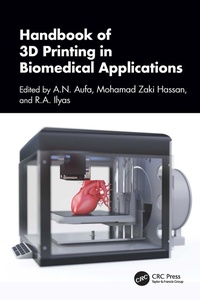
Handbook of 3D Printing in Biomedical Applications
1st Edition
Published on 30. May 2025
410 pages
978-1-040-34883-3 (ISBN)
Description

3D printing is a promising fabrication technique capable of creating objects with precise structures and shapes based on 3D model data, allowing for versatile alterations and production of intricate shapes while also reducing the consumption of feedstock, particularly crucial in the cost-sensitive realm of medicine. In the biomedical sphere the use of 3D printing spans various applications, from artificial organs to sensors and orthopedic implants. This handbook explores the transformative role of technology in healthcare, focusing on materials, design, and innovation. It covers diverse applications like prosthetics, devices, tissue engineering, and medicine. This comprehensive resource highlights cutting-edge advancements, ethical considerations, and future trends, offering insights for researchers, professionals, and students.
Explores the latest advances, technologies, and practical applications of additive manufacturing in biomedical engineering, including its impact on tissue engineering, drug delivery systems, regenerative medicine, and orthodontics
Covers polymer 3D bioprinting techniques and advanced materials pivotal for successful biomedical implants in clinical settings
Discusses the integration of smart materials and their applications including point-of-care solutions
Encompasses various facets of medical technology, including diagnostic instruments, therapeutic devices, tissue engineering, and regenerative medicine
Examines both in vivo and in vitro studies related to 3D printing, unraveling their significance and implications in various contexts
Considers challenges and future perspectives
With its comprehensive approach, this handbook serves as the definitive resource for researchers, practitioners, and advanced students, fostering a deeper appreciation and understanding of the transformative power of 3D printing in shaping the future of biomedical engineering.
Explores the latest advances, technologies, and practical applications of additive manufacturing in biomedical engineering, including its impact on tissue engineering, drug delivery systems, regenerative medicine, and orthodontics
Covers polymer 3D bioprinting techniques and advanced materials pivotal for successful biomedical implants in clinical settings
Discusses the integration of smart materials and their applications including point-of-care solutions
Encompasses various facets of medical technology, including diagnostic instruments, therapeutic devices, tissue engineering, and regenerative medicine
Examines both in vivo and in vitro studies related to 3D printing, unraveling their significance and implications in various contexts
Considers challenges and future perspectives
With its comprehensive approach, this handbook serves as the definitive resource for researchers, practitioners, and advanced students, fostering a deeper appreciation and understanding of the transformative power of 3D printing in shaping the future of biomedical engineering.
More details
Edition
1. Auflage
Language
English
Place of publication
London
United Kingdom
Publishing group
Taylor & Francis Ltd
Target group
College/higher education
Professional and scholarly
Illustrations
20 Tables, black and white; 6 Line drawings, black and white; 55 Halftones, black and white; 61 Illustrations, black and white
File size
18,77 MB
ISBN-13
978-1-040-34883-3 (9781040348833)
Copyright in bibliographic data and cover images is held by Nielsen Book Services Limited or by the publishers or by their respective licensors: all rights reserved.
Schweitzer Classification
Other editions
Additional editions
A.N. Aufa | Mohamad Zaki Hassan | R.A. Ilyas
Handbook of 3D Printing in Biomedical Applications
Book
05/2025
1st Edition
CRC Press
€244.50
Shipment within 10-20 days

Book
05/2025
CRC Press
Unfortunately, price unknown
Available (delivery time upon request)
Persons
A.N. Aufa is with the Faculty of Artificial Intelligence, Universiti Teknologi Malaysia.
Mohamad Zaki Hassan is Senior Lecturer in the Faculty of Artificial Intelligence, Universiti Teknologi Malaysia.
R.A. Ilyas is Senior Lecturer at the Universiti Teknologi Malaysia and holds Fellowships with the Institute of Advanced Materials, Sweden, and the International Society for Development and Sustainability, Japan.
Mohamad Zaki Hassan is Senior Lecturer in the Faculty of Artificial Intelligence, Universiti Teknologi Malaysia.
R.A. Ilyas is Senior Lecturer at the Universiti Teknologi Malaysia and holds Fellowships with the Institute of Advanced Materials, Sweden, and the International Society for Development and Sustainability, Japan.
Content
0. Prelims. 1. Fundamental Concepts of Additive Manufacturing in the Biomedical Field. 2. Additive Manufacturing of Biocompatible Polymers and Their Future Trend in the Biomedical Field. 3. Materials in Biomedical Additive Manufacturing and Their Challenges. 4. Current Trend of Additive Manufacturing in Biomedical Applications. 5. Applications of 3D Bioprinting in Anatomical Structure. 6. In Vivo Studies of 3D Bioprinting. 7. In Vitro Studies of 3D Printing and 3D Bioprinting in Drug Delivery. 8. Development of 3D Printable Collagen, Gelatin, and Chondroitin Sulfate Hydrogels for Implantable Tissue Applications. 9. Development of Gelatin, Collagen and Chondroitin as Bioink in 3D Bioprinting. 10. Utilization of Gelatin, Collagen, and Chondroitin Sulfate in 3D Bioprinting. 11. Silk Fibroin Nanofiber, Nano-Chitin, and Chitosan: Promising Biomaterials in 3D Biofabrication. 12. Bioink Technology In 3D Bioprinting and Their Improvement. 13. Polysaccharide-Based Bioinks and Hydrogel Technology in 3D Bioprinting. 14. Innovation and Patentability of Biopolymers for 3D Bioprinting in Biomedical Applications. 15. 3D Bioprinting Technique of Synthetic Polymers. 16. Synthetic Composites for 3D Bioprinting Applications. 17. 3D Bioprinting in Orthodontics. 18. The Emergence of Bioink 3D Printing in Dental Orthodontics. 19. Pellet Extrusion Additive Manufacturing of Carbon Nanotube Reinforced PEEK-Based Composites for Biomedical Applications. 20. Clinical Status, Manufacturing Issue, Laws, and Future Perspectives.
