

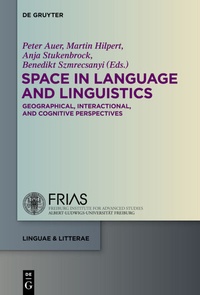
Space in Language and Linguistics
Description

This book brings together three perspectives on language and space that are quite well-researched within themselves, but which so far are lacking productive interconnections. Specifically, the book aims to interconnect the following research areas:
- Language, space, and geography
- Grammar, space, and cognition
-
Language and interactional spaces
The contributions in this book cover geographical language variation within and across languages, language use in stationary and mobile interactional spaces, computer-mediated communication, and spatial reasoning across languages. This range of issues showcases the thematic and methodological breadth of research on language and space. In order to identify interconnections, the respective contributions are accompanied by commentaries that highlight common threads.
More details
Other editions
Additional editions
Persons
Content
2 - Integrating the perspectives on language and space [Seite 9]
3 - Section 1: Geography and variation across languages [Seite 27]
3.1 - Disentangling geography from genealogy [Seite 29]
3.2 - The vertical archipelago: Adding the third dimension to linguistic geography [Seite 46]
3.3 - Language contact between geographic and mental space [Seite 69]
3.4 - Commentary: The notion of space in linguistic typology [Seite 109]
4 - Section 2: Geography and variation within languages [Seite 113]
4.1 - Ideology and discourse in the enregisterment of regional variation [Seite 115]
4.2 - Identity, ethnicity and place: The construction of youth language in London [Seite 136]
4.3 - How powerful is geography as an explanatory factor in morphosyntactic variation? Areal features in the Anglophone world [Seite 173]
4.4 - Area formation in morphosyntax [Seite 203]
4.5 - How much does geography influence language variation? [Seite 230]
4.6 - Commentary: Lost in space?. The many geographies and methodologies in research on variation within languages [Seite 248]
5 - Section 3: Interactional spaces [Seite 253]
5.1 - Interactional space and the study of embodied talk-in-interaction [Seite 255]
5.2 - On the interactive achievement of space â?" and its possible meanings [Seite 284]
5.3 - Plaza: Space or place? [Seite 312]
5.4 - Xi to vi: â?oOver that way, look!â??: (Meta)spatial representation in an emerging (Mayan?) sign language [Seite 342]
5.5 - Commentary: What difference does space make for interaction and interaction for space? [Seite 409]
6 - Section 4: Mobile spaces [Seite 417]
6.1 - Action and space: Navigation as a social and spatial task [Seite 419]
6.2 - Rearranging (in) space. On mobility and its relevance for the study of face-to-face interaction [Seite 442]
6.3 - Commentary: Being mobile, talking on the move. Conceptual, analytical and methodological challenges of mobility [Seite 472]
7 - Section 5: Mediated spaces [Seite 479]
7.1 - Language, media, and digital landscapes [Seite 481]
7.2 - Space in computer-mediated communication. Corpus-based investigations on the use of local deictics in chats [Seite 502]
7.3 - Vernacular and multilingual writing in mediated spaces. Web-forums for post-colonial communities of practice [Seite 537]
7.4 - Pointing within the abdomen: Local deixis under restricted conditions [Seite 565]
7.5 - Commentary: Making space [Seite 609]
8 - Section 6: Typology and spatial reasoning [Seite 613]
8.1 - Exploiting space in German Sign Language. Linguistic and topographic reference in signed discourse [Seite 615]
8.2 - Space in semantic typology: Object-centered geometries [Seite 645]
8.3 - Gesture, space, grammar, and cognition [Seite 675]
8.4 - Commentary: Is there a deictic of frame of reference? [Seite 695]
9 - Index [Seite 701]
