

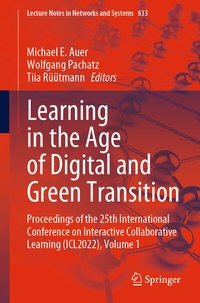
Learning in the Age of Digital and Green Transition
Proceedings of the 25th International Conference on Interactive Collaborative Learning (ICL2022), Volume 1
1st Edition
Published on 21. March 2023
XXV, 1090 pages
978-3-031-26876-2 (ISBN)
Description

We are currently witnessing a significant transformation in the development of education on all levels and especially in post-secondary education. To face these challenges, higher education must find innovative ways to quickly respond to these new needs.
These were the aims connected with the 25th International Conference on Interactive Collaborative Learning (ICL2022), which was held in Vienna, Austria, from September 27 to 30, 2022.
Since its beginning in 1998, this conference is devoted to new approaches in learning with a focus on collaborative learning in higher education.
This book contains papers in the fields of:
Collaborative Learning Digital Transition in Education Technology Enhanced Learning Advances in Machine and Technology Enhanced Learning Educational Virtual Environments Flipped Classrooms Games in Engineering Education Entrepreneurship in Engineering Education
Interested readership includes policymakers, academics, educators, researchers in pedagogy and learning theory, school teachers, the learning industry, further and continuing education lecturers, etc.
These were the aims connected with the 25th International Conference on Interactive Collaborative Learning (ICL2022), which was held in Vienna, Austria, from September 27 to 30, 2022.
Since its beginning in 1998, this conference is devoted to new approaches in learning with a focus on collaborative learning in higher education.
This book contains papers in the fields of:
Collaborative Learning Digital Transition in Education Technology Enhanced Learning Advances in Machine and Technology Enhanced Learning Educational Virtual Environments Flipped Classrooms Games in Engineering Education Entrepreneurship in Engineering Education
Interested readership includes policymakers, academics, educators, researchers in pedagogy and learning theory, school teachers, the learning industry, further and continuing education lecturers, etc.
More details
Series
Language
English
Place of publication
Cham
Switzerland
Publishing group
Springer International Publishing
Target group
Professional and scholarly
Product notice
Reflowable
Illustrations
XXV, 1090 p. 331 illus., 288 illus. in color.
File size
87,41 MB
ISBN-13
978-3-031-26876-2 (9783031268762)
DOI
10.1007/978-3-031-26876-2
Schweitzer Classification
Other editions
Additional editions
Michael E. Auer | Wolfgang Pachatz | Tiia Rüütmann
Learning in the Age of Digital and Green Transition
Proceedings of the 25th International Conference on Interactive Collaborative Learning (ICL2022), Volume 1
Book
03/2023
Springer
€299.59
Shipment within 15-20 days
Persons
Content
- Intro
- Preface
- Committees
- Contents
- Collaborative Learning
- Collaborative Learning Supported by a Brownfield Remediation Case Study
- 1 Introduction
- 2 Purpose and Goal
- 3 Research Project Cooperation and Collaboration
- 4 Research Project - Environmental Aspects
- 5 Research Project - Technical Aspects
- 6 Research Work of LITEC Students
- 7 Use of the Machine in Research Work
- 8 Summary and Outcome
- References
- Interactive Collaborative Learning with Explainable Artificial Intelligence
- 1 The Background - Explainability of AI
- 1.1 Explainability of Black Boxes
- 1.2 Explainability by Design
- 2 The Application Domain - Learning of String Patterns
- 3 Learning Goals and Didactic Concepts
- 3.1 Learning Goals
- 3.2 Didactic Approach
- 4 Case Study of Collaborative Learning with XAI
- 4.1 Unsystematic Exploration
- 4.2 Systematic Exploration
- 5 Toward an Evaluation
- 6 Conclusions and Outlook
- References
- Digital Global Classroom, a Collaborative Online International Learning (COIL) Approach: An Innovative Pedagogical Strategy for Sustainable Competency Development and Dissemination of SDGs in Engineering Higher Education
- 1 Introduction
- 2 Methodology
- 2.1 Global Classroom
- 2.2 GC Natural Resources and Climate Change
- 2.3 GC Biomimetics Course
- 2.4 Skills to Develop in COIL Courses
- 3 Results
- 3.1 Global Classroom and COIL
- 3.2 Natural Resources Global Classroom Experience
- 3.3 Biomimicry Global Classroom Experience
- 3.4 The Takeout of this Experience, a New Step in Green Education
- 4 Conclusion
- References
- Digital Communication Tools in Private and Professional Environments
- 1 Introduction
- 2 Objectives
- 3 Method
- 4 Outcomes
- 5 Discussion
- 5.1 Private versus Professional Environment
- 5.2 Decision Factors
- 5.3 Covid and Virtual Worlds
- 6 Conclusion
- References
- Blended Assessment in Higher Education Collaborative Case Study Work - A Qualitative Study
- 1 Introduction
- 2 Methodology
- 3 Blended Assessment
- 4 Case Study
- 5 Results
- 6 Guidelines to Implement Blended Assessment
- 7 Conclusion and Discussion
- References
- Learning Units and Micro-contents in the Reinterpreted Online Teaching Space
- 1 Introduction
- 2 Background and Approach
- 3 Objectives and Outcomes
- 3.1 Creation of Open Learning Material Structure
- 3.2 Learning Resource Development and its Practical Implementation
- 3.3 Development of Methodological and Subject Knowledge
- 3.4 The Construction System of the Learning Units - Micro-content Framework
- 4 Conclusions and Recommendations
- References
- Learning from Agile Methods: Using a Kanban Board for Classroom Orchestration
- 1 Introduction
- 2 Related Research
- 3 Applying Agile Methods as General Teaching Methods
- 4 A Digital Tool for Supporting Agile Teaching
- 5 Lessons Learned and Evaluation of the Prototype
- 5.1 Lesson Learned from In-Class Usage of the Teaching Method
- 5.2 Evaluation of the Prototype
- 6 Discussion
- 7 Conclusions and Outlook
- References
- Co-creation, Co-learning and Co-teaching Are Key - Developing Intercultural, Collaborative, and Digital Competences Through Virtual Exchange
- 1 Introduction
- 2 Virtual Exchange in Higher Education
- 2.1 Competence Development Through Virtual Exchange
- 2.2 No Change Without Exchange - Solving Global Challenges Requires Collaborating Global Citizens
- 3 Lessons Learned: VE Good Practice Examples
- 3.1 Project Based Virtual Exchanges
- 3.2 Simulation and Collaboration in Virtual Laboratories
- 3.3 Augmenting One's Own Cultural Perceptions Through Virtual Exchange
- 4 Conclusion
- References
- STEM via Co-teaching. e-me Case Study
- 1 Introduction
- 1.1 Pedagogical Use of Digital Tools
- 2 Methodology
- 2.1 Implementation of the SKill's Lab
- 3 Results
- 3.1 Evaluation of the SKill's Lab-Quantitative Research
- 4 Conclusions
- References
- Collaborative Augmented Reality Tools for Behavioral Lessons
- 1 Introduction
- 2 Related Work
- 3 PBIS and Behavioural Lessons
- 3.1 The PBIS AR Learning Experience
- 4 Multi-user Activities Within Behavioural Lessons
- 5 Conclusions and Future Work
- References
- Perception of Collaborative Student-Led Tutorials with Laboratory Experiments in e-Learning
- 1 Introduction
- 2 Education in Fundamentals of Fluid Mechanics
- 2.1 Lecture, Exercise, and Laboratory Experiments: On-site and Online
- 2.2 Student-Led Tutorials: On-Site
- 2.3 Student-Led Tutorials: Online
- 3 Results
- 3.1 Results of M1
- 3.2 Results of M2
- 3.3 Results of M3
- 3.4 Results of M4
- 4 Discussion
- 4.1 Perception of On-Site and On-Line Tutorials Their Differences (RQ1)
- 4.2 Perception of Laboratory Experiments by Students (RQ2)
- 4.3 Comparison of Different Formats of Student-Led Tutorials (RQ3)
- 4.4 How Well did the Tutors Manage in the Distance Format (RQ4)
- References
- Self-directed and Collaborative Learning in an Advanced Training Context: Conception and Implementation of an Innovative Online Teacher Qualification Program
- 1 Introduction
- 2 Insights into the Multi-stage Development Process of the Program
- 2.1 Social Conditions and Demographic Characteristics of the Target Group
- 2.2 Support Needs and Background Knowledge of the Target Group
- 2.3 Conception of a Competence Framework Along Support Needs
- 2.4 Development of the Thematic Plan
- 3 Concept and Setup of the Online Training Course
- 3.1 Overall Setup and Structure
- 3.2 Template - Microlearning Units
- 3.3 Setup of the Microlearning Units - An Example
- 4 Concept and Setup of the Undime Community
- 5 Peer Learning and Collaborative Learning - Interactions Between Training Course and Community
- 6 Outlook and Conclusion
- References
- Virtual Assistants (Chatbots) as Help to Teachers in Collaborative Learning Environment
- 1 Introduction
- 2 State of the Art
- 2.1 eLearning
- 2.2 Virtual Assistants - Chatbots
- 3 Our Approach
- 3.1 Orchestration Oriented Approach
- 3.2 Integration of the Notion of Exercise
- 3.3 Integration of the Notion of Session
- 4 Targets of Our System
- 4.1 Generic Orientation
- 4.2 Field Orientation: A Case Study of English Language Learning ACLE
- 5 Conclusions
- References
- An International Digital Learning Experience: The "Reinserta" Challenge
- 1 Introduction
- 2 Method
- 3 Evaluation of Results
- 4 Conclusions
- References
- Application of Component Organized Learning Method for DIGSCM 4.0 Hybrid Courses
- 1 Introduction
- 2 Literature Review
- 3 Component Organized Learning
- 3.1 Application of COL Concept
- 3.2 Assessment of Companies Needs to Move Toward Digitalisation
- 3.3 Definition of Skills Priorities and Development of Course Content
- 3.4 Dynamic Curriculum Management Based on Companies' Current Needs
- 4 Piloted Courses
- 5 Summary
- References
- A Scaffolding Strategy to Organize Collaborative Learning
- 1 Introduction
- 2 Collaboration and Active Learning
- 2.1 Active Learning Strategies
- 2.2 Scaffolding
- 3 Collaborative Learning
- 3.1 Technological Tools to Support Collaborative Learning
- 3.2 Moodle Environment
- 3.3 Google Workspace for Education
- 3.4 Knowledge Forum
- 4 Functionalities of the Collaborative Tools
- 4.1 Support for Collaborative Learning Through Scaffolding
- 4.2 Case Study
- 4.3 Result Analysis
- 5 Conclusions
- References
- Effect on the Competencies Development and Collaborative Learning During the COVID-19 Lock Down from a Student Perception
- 1 Introduction
- 1.1 Collaborative Learning (CL)
- 1.2 Competencies
- 2 Methodology
- 3 Results and Discussion
- 4 Conclusions
- References
- Understanding Collaboration in Virtual Labs: A Learning Analytics Framework Development
- 1 Introduction
- 1.1 Research Question
- 2 Background
- 2.1 Learning Analytics in Virtual Labs
- 2.2 Learning Analytics in Supporting Collaboration
- 3 Methodology
- 4 Artefact Development
- 5 Evaluation
- 6 Discussion
- 7 RQ: How can learning analytics support collaboration in virtual labs?
- 8 Conclusions
- References
- Digital Transition in Education
- Augmented Reality in Engineering Education - A Comparison of Students' and Teachers' Perceptions
- 1 Introduction
- 2 Augmented Reality in Industry and Education
- 3 Problem Statement and Research Questions
- 4 Methodology and Design of the Empirical Study
- 4.1 Design of the Questionnaire
- 4.2 Hypotheses
- 4.3 Selection of the Participants
- 5 Results
- 5.1 Description of the Participants
- 5.2 Presentation and Analysis of Responses
- 5.3 Validation of the Hypotheses
- 5.4 Correlation Analysis
- 5.5 Diploma Thesis
- 5.6 Answer to the Research Questions
- 6 Conclusions, Limitations, and Further Research
- References
- Digital Twins and Sustainability in Vocational Education and Training: The Case of Structural Environment and Architectural Design in Vocational High Schools
- 1 Introduction
- 2 Elements of the Paper
- 3 The Sector Analysis
- 4 The Curriculum
- 5 Digital Twins and Safety
- 6 Conclusions and Future Work
- References
- Hands-On Firefighting Training Using a Remote-Controlled Extinguishing Laboratory
- 1 Introduction
- 2 Firefighting Training
- 3 Remote-Controlled Extinguishing Lab
- 3.1 Function and Principle of the Extinguishing Unit
- 3.2 Actuator Concept
- 3.3 Sensor Concept
- 4 Acoustic Fire Detection-A New Research Area
- 5 Web Client
- 6 Anticipated Outcomes
- References
- Formal Assessment at COVID19 Time via Laboratory Remoting: Solutions and Reflections
- 1 Introduction
- 2 Context
- 2.1 Remote Instruction
- 2.2 Remote Formal Assessment
- 2.3 Online Proctoring
- 2.4 Laboratory Remoting
- 3 Our Remote Exam Setup
- 4 Experience Report
- 5 Discussion
- 5.1 How Did the Solution Work?
- 5.2 Did the Remote Exam Increase the Students' Anxiety Level?
- 5.3 Did Students Like and Accept the Implemented Solution?
- 5.4 Are There Any Privacy Issues?
- 6 Conclusions
- References
- Multiplatform Embedded Systems Extension Board - MARTA
- 1 Introduction
- 2 Embedded Systems Platforms
- 2.1 Esp32 - Arduino Platform
- 2.2 Arm Cortex-M STM32F407 Platform
- 2.3 PLC - Phoenix Contact PLCnext Platform
- 2.4 Raspberry Pi 3B Platform
- 3 Hardware Description
- 3.1 General Purpose IO
- 3.2 Pulse Width Modulation
- 3.3 SPI Bus
- 3.4 I2C Bus
- 3.5 Analog Input
- 4 Example Projects
- 5 Conclusions
- References
- Challenges of Hybrid Flexible (HyFlex) Learning on the Example of a University of Applied Sciences
- 1 Introduction
- 2 Background
- 2.1 Implementation of Flexible Learning in Higher Education
- 2.2 The Skills Needed to Cope with Learning
- 3 Methodology
- 4 Results
- 4.1 Quantitative Analysis of Problems
- 4.2 Qualitative Content Analysis of Results
- 5 Discussion
- 6 Summary
- References
- Mentoring Opportunities for Students with Special Needs
- 1 Introduction
- 2 Experience of Digital Education for Students with Special Needs
- 3 Research on Mentoring Students with Special Needs
- 4 Opportunities for Mentoring Students
- 5 Mentoring Programs in Hungary
- 6 Summary
- References
- Conception of a Machine Learning Driven Adaptive Learning Environment Using Three-Model Architecture
- 1 Introduction
- 2 Research Questions
- 3 Theoretical Foundation
- 3.1 Three-Model Architecture
- 3.2 Competence-Based Knowledge Space Theory
- 3.3 Machine Learning Techniques for Adaptive Learning Environments
- 3.4 Initialization of the Learner Model Using Machine Learning
- 4 Realization
- 4.1 Conception of the Domain Model
- 4.2 Conception of the Learner Model
- 4.3 Conception of a Tutorial Model
- 5 Discussion and Derivation
- 6 Future Research
- References
- Education 4.0 in the New Normal - Higher Education Goes Agile with E-Portfolio
- 1 Motivation
- 2 Background
- 2.1 Technology Trends
- 2.2 Education 4.0 Smart Blended Learning Process
- 2.3 Agile Learning
- 2.4 Reflection in/on Action
- 2.5 Reflection in/on Action Using the E-Portfolio
- 3 Methodology
- 4 Results
- 5 Conclusion and Future Work
- References
- An Analysis of Barriers and Facilitators for the Development of Digital Competencies of Engineering Students
- 1 Introduction
- 1.1 The Digital Competence (DC) Framework
- 1.2 The "Technology Acceptance" as a Factor that Limits or Facilitates the Effective Use of ICTs in the Educational Context
- 1.3 Online Learning (OL) and "Emergency Online Learning (EOL)"
- 1.4 Related Studies
- 2 Research Results
- 2.1 Research Questions, Objectives, Materials and Methods
- 2.2 Instrument, Data Collection and Analysis
- 2.3 Research Results
- 3 Discussion and Conclusions
- References
- The Impact of Virtual Learning on Undergraduate and Postgraduate Programmes: A Sri Lankan Experience
- 1 Introduction
- 2 Purpose
- 3 Approach
- 3.1 Questionnaire Survey
- 3.2 Student Performance
- 4 Actual Outcomes
- 4.1 Demographic Data
- 4.2 Preferences and Perceptions
- 4.3 Positive Aspects of Virtual Learning
- 4.4 Drawbacks of Virtual Learning
- 5 Discussion
- 6 Conclusions and Recommendations
- References
- A Cloud Computing Service Framework for Guided Life Long Learning
- 1 Introduction
- 2 Washington Accord and Related Issues
- 2.1 Washington Accord and India
- 3 Review Works
- 3.1 Lifelong Learning - Scenario in Some Developed Countries
- 3.2 Information Technology and Lifelong Learning
- 3.3 Components of E-Learning Technology
- 3.4 Cloud Computing Overview
- 4 Applications in Cloud Computing Environment
- 5 Crisis Faced by Young Graduates
- 6 Prospects to the Young Graduates
- 7 Proposed Cloud Computing Service Framework
- 7.1 Unprecedented Fast Technological Growth
- 7.2 Proposed Service Framework
- 8 Conclusions
- References
- The Design and Implementation of the Cloud-Based System of Open Science for Teachers' Training
- 1 Introduction
- 1.1 Problem Statement
- 2 The State of the Art
- 3 The Conceptual and Terminological Body
- 4 The Model and Approach
- 5 The Experimental Testing
- 6 Conclusion and Discussion
- References
- Education for Sustainability: Calculation of the Digital Carbon Footprint
- 1 Introduction
- 1.1 Sustainability Competencies at Tecnologico de Monterrey, Mexico
- 1.2 Digital Carbon Footprint
- 1.3 Objectives of This Study
- 1.4 Background
- 2 Methodology
- 3 Results and Discussion
- 4 Conclusions
- References
- Assessing Students' Motivation in a University Course on Digital Education
- 1 Introduction
- 2 Scenario
- 3 Methodology
- 3.1 Survey
- 3.2 Statistical Evaluation
- 4 Results
- 4.1 Demographics
- 4.2 Exploration
- 4.3 Correlation and Factor Analysis
- 5 Discussion
- 6 Conclusion
- References
- Digital Transformation of Teaching and Perception at TU Graz from the Students' Perspective: Developments from the Last 17 Years
- 1 Introduction: Digital Transformation of Teaching in Higher Education
- 2 Digital Transformation of (University) Teaching from Students' Perspective
- 3 Research Questions and Research Approach
- 4 The Development of the Strategic Implementation of Digital Transformation in Teaching at TU Graz
- 5 Students' Perspective on E-Learning in 2014
- 6 Students' Perspective on E-Learning in 2021
- 7 Comparison of E-Learning Attitudes 2014 und 2021
- 8 Discussion and Outlook
- References
- Towards Virtualizing Structural Engineering Education
- 1 Introduction
- 2 Case Study on the Digitalization of Teaching in Civil Engineering
- 2.1 Course Description
- 2.2 Digital Transformation of the Laboratory Processes
- 2.3 Project Objective and System Requirements
- 3 Concept and Realization
- 3.1 Initial Considerations
- 3.2 Selection of Locations
- 3.3 Handling Detail Information
- 3.4 Implementation
- 3.5 Evaluation
- 4 Results and Discussion
- 4.1 Final Prototype
- 4.2 Evaluation
- 5 Conclusion and Outlook
- References
- Enhancing Media Literacy in Higher Education
- 1 Introduction
- 2 An Analysis of the State of the Art in Media Literacy Education
- 2.1 Media Literacy
- 2.2 Aspects of Media Literacy in Higher Education
- 3 Understanding Media Literacy
- 4 Recommendations for Media Literacy Education at Universities - Philosophical and Pedagogical Foundations
- 4.1 Philosophical Foundations
- 4.2 Pedagogical Foundations
- 5 Media Literacy Education as Missing Piece in Higher Education
- 6 Summary and Outlook
- References
- Use of Instant Messaging to Improve Communication Between Teachers and Students
- 1 Context
- 2 Method
- 3 Results
- 4 Conclusions
- References
- Machine Learning Based Emotion Recognition in a Digital Learning Environment
- 1 Introduction
- 2 Background and Related Work
- 3 Methods
- 3.1 Dataset Description
- 3.2 Data Preprocessing
- 3.3 Experiments
- 4 Results
- 5 Conclusion
- References
- Pocket Labs as a STEM Learning Tool and for Engineering Motivation
- 1 Introduction
- 2 Literature Review
- 3 Methodology
- 3.1 The IFAC Project
- 3.2 The Use Case
- 4 Findings and Interpretations
- 5 Conclusion
- References
- Remote Virtual Laboratory Innovation on MIAP Engineering Teaching Model for Electrical Measurement Course
- 1 Introduction
- 2 Remote Learning and Engineering Teaching
- 2.1 Remote Learning
- 2.2 The MIAP Based Engineering Teaching Model
- 3 Virtual Laboratory Development and Implementation
- 3.1 Development of Virtual Laboratory Teaching Package
- 3.2 Implementation in Remote Learning and Teaching
- 4 Research Results
- 4.1 The Quality of the Remote-Based MIAP Teaching Model
- 4.2 The Evaluation of Learning Achievement
- 4.3 The Satisfaction of the Students
- 5 Summary
- References
- Teachers' Readiness for Emergency Remote Teaching and Its Relation to Subject Area During the COVID-19 Pandemic
- 1 Introduction
- 1.1 Context
- 1.2 The Aim of the Research
- 1.3 Theoretical Framework
- 2 Methods
- 2.1 Preparation of Questionnaire
- 2.2 Statistical Analysis
- 2.3 Study Design and Procedure
- 3 Results
- 3.1 Study Sample
- 3.2 Differences Among Subject Areas in 2020 and 2021
- 3.3 Development of the Readiness for ERT
- 4 Discussion
- 4.1 Strengths and Limitations of This Study
- 5 Conclusions
- References
- Exploring Engineering Students' Perceptions About the Use of ICTs and Educational Technologies in VET
- 1 Use of ICTs in the University Context
- 1.1 Use of ICTs in the Chilean University Context
- 2 Exploring Engineering Students' Perceptions About the Use of ICTs and Educational Technologies
- 2.1 Methodology
- 2.2 Population and Procedure
- 2.3 Results of the Students' Survey
- 3 Conclusion
- References
- Educators and Digital Fit? A Diversity Study Based on the Person-Environment Fit Model in Times of Increasing Digitalization in Schools
- 1 Introduction
- 1.1 A Globalized World
- 1.2 Digital Education Interventions in Austria
- 1.3 Individual Prerequisites of Educators in Austria
- 1.4 Educators and Digital Fit in Austria
- 2 Methodology
- 3 Results
- 4 Conclusion
- 5 Discussion
- References
- Work-in-Progress: Managing the Different Levels of Abstraction for University Courses in STEM Disciplines Using Interactive Scripts
- 1 Introduction and Motivation
- 2 Levels of Abstraction in the Learning Process
- 3 Integration of the Different Levels of Abstraction When Using Interactive Scripts
- 3.1 Design and Implementation of Interactive Scripts
- 3.2 Use Cases of the Interactive Scripts in University Classes
- 3.3 Use Cases from the Students' Point of View
- 4 Preliminary Results
- 5 Conclusions and Outlook
- References
- Practical Aspects of Using 3D Technology to Disseminate Cultural Heritage Among Visually Impaired People
- 1 The Issue of Making Museum Collections Available to the Blind
- 2 The Use of 3D Printing Technology in Museology
- 3 The Process of Providing Museum Exhibits
- 3.1 Description of Objects
- 3.2 Data Acquisition and Processing
- 3.3 Presentation of 3D Models
- 4 Pilot Studies and Results
- 5 Conclusions
- References
- Adapting Experiential E-learning in Engineering Education with Industry 4.0 Vision
- 1 Introduction
- 2 Learning Outcomes and Teaching Strategy for Sensors and Actuator Course
- 3 Lab-at-Home Experimentation: Experiential E-learning Platform (EELP)
- 4 Practical Laboratory Framework: Implementation of KOLB'S Experiential Learning Cycle
- 4.1 KOLB'S Concrete Experience
- 4.2 KOLB'S Reflective Observation
- 4.3 KOLB'S Abstract Conceptualization
- 5 Conclusion
- References
- The Gaps and Strategies for Sustainable Digital Transition in Education
- 1 Background
- 1.1 Framework
- 1.2 Case Study: Ansys Granta EduPack
- 2 Discussion
- References
- Technology Enhanced Learning
- Reshaping Teaching-Learning Process During COVID - 19 Pandemic
- 1 Introduction
- 1.1 Impact of COVID-19 on Human Life
- 1.2 Pre and Post of COVID-19 Pandemic in the Teaching-Learning Process- Reshaping the Paradigm
- 1.3 Objectives of the study
- 1.4 Impact of the Paradigm Shift on the Teaching-Learning Process
- 1.5 After Effect of COVID-19 on Teaching-Learning Process
- 1.6 Initiatives Taken by the Government
- 1.7 Conclusion
- References
- Automatic Short Answer Grading Using Universal Sentence Encoder
- 1 Introduction
- 2 Literature Review
- 3 ASAG Methodology
- 4 Universal Sentence Encoder
- 5 Experimentation and Results
- 6 Conclusion
- References
- What Determines Student Satisfaction in an eLearning Environment? An Analysis
- 1 Introduction: Cognitive Factors in eLearning vs. Traditional Learning
- 2 Spatial Co-ordinates
- 3 Time Models and Learning Process
- 4 Associative Processes in Spatial-Temporal Cognition
- 5 Enhancement of Acquisition of Skills - A Student' Vision
- 6 Conclusions
- References
- Lego Technology as a Means of Enhancing the Learning Activities of Junior High School Students in the Condtions of the New Ukrainian School
- 1 Introduction
- 2 Scientific-Theoretical Review of LEGO Interactive Technology Learning Opportunities: An Analysis of Global Learning Theory and Practice
- 3 Organizational Content and Characteristics of the Learning Activities of Young Students in the New Ukrainian School
- 4 Methodological Peculiarities of Using LEGO Constructor Technology to Intensify Learning Activities Junior School Children
- 5 Discussion and Conclusion
- References
- Enriching Teacher Training for Industry 4.0 Through Interaction with a High School Engineering Project
- 1 Introduction
- 2 The Courses
- 2.1 The Teacher Education Course
- 2.2 The School Project
- 3 The Study
- 3.1 Data Collection and Analysis
- 3.2 Contribution of the Teacher Education Course
- 3.3 Contribution of the Prospective Teachers' Lesson
- 4 Discussion and Conclusion
- References
- Competency-Based Approach and Learning Plans in Moodle. A Case of International Engineering Educator Certification Program (IEECP) in Latin America
- 1 Introduction
- 2 Background
- 3 Competency Based Approach in Moodle
- 3.1 Competency Frameworks
- 3.2 Assessment Scales
- 3.3 Advanced Grading Methods: Rubrics
- 3.4 Learning Plans
- 4 International Engineering Educator Certification Program (IEECP) in Latin America
- 5 Competency Based Approach Model of the IEECP
- 6 Competency Based Approach in the IEECP LMS
- 6.1 Moodle Course Design and Teachers Roles
- 6.2 Learning Outcomes Assessment
- 6.3 Competency Framework, Taxonomies and Competency Rules
- 6.4 Competency Framework, Moodle Courses and Activities
- 6.5 Students Learning Plans, Learning Process Monitor
- 7 IEECP Online Learning Process
- 8 IEECP Teachers and Students Opinion
- 8.1 Students Opinions
- 8.2 Teachers Opinions
- 9 Conclusions
- References
- Work in Progress: Technology Enhanced Learning - A View from "The Other Side"
- 1 Introduction
- 1.1 A View from the "Other Side"?
- 1.2 The Context
- 1.3 Faculty as Active Players in Courseware Development
- 1.4 The Organization of This Work
- 2 Digital Learning Contents
- 3 Create-Share-Reuse Assets - Description of the Project
- 3.1 What Are Assets?
- 3.2 Initial Steps
- 4 Create-Share-Reuse Assets - Results of the Project
- 4.1 Who Creates Assets?
- 4.2 How Are Assets Reused?
- 5 Comments and Next Steps
- References
- The Internet of Digital Twins: Advances in Hyperscaling Virtual Labs with Hypervisor- and Container-Based Virtualization
- 1 Introduction
- 2 Technical Terms and Cloud Computing Services
- 2.1 Separation of Responsibilities in IaaS, PaaS, and SaaS Cloud Service Operation Models
- 2.2 Hypervisors
- 2.3 OS-Level/Container Virtualization
- 3 The State of the Art
- 4 System Architecture
- 4.1 Exemplary Use Case: The Virtual Industrial Cybersecurity Lab
- 5 Public Cloud Implementation
- 5.1 Implementation with Azure Virtual Desktop
- 5.2 Implementation with IONOS' Data Center Designer
- 6 Results and Discussion
- 7 Conclusion and Future Work
- References
- Perception Towards ``Zoom'' Live Lectures by Master's Students of Sweden
- 1 Introduction
- 1.1 Research Problem
- 1.2 Aim and Research Question
- 1.3 Delimitations of the Study
- 2 Method
- 2.1 Research Strategy
- 2.2 Data Collection Method
- 2.3 Participants
- 2.4 Data Analysis Method
- 2.5 Research Ethics
- 3 Results
- 3.1 Data Collection and Analysis
- 3.2 Findings
- 4 Discussion
- 4.1 Analysis of the Results
- 4.2 Future Research
- 4.3 Conclusion
- References
- Advances in Machine and Technology Enhanced Learning
- Studying the Spread of COVID-19 and Its Impact on E-learning: From a Deep Learning Perspective
- 1 Introduction
- 2 Coronaviruses Overview
- 3 The Case Fatality Ratio for Coronavirus in Saudi Arabia
- 4 The IFR for Coronavirus in KSA
- 5 The Future Predictions of the COVID-19 Disease in KSA
- 6 Studying the Impact of E-learning in KKU Through the Covid-19: From a DL Perspective
- 7 Conclusions
- References
- A Virtual Interactive Environment for Arts and Design Students
- 1 Introduction
- 2 Literature Review
- 2.1 Educational Applications
- 2.2 Virtual Environments for Artists
- 2.3 Digitized 3D Models
- 3 Arts and Design
- 3.1 Perspective
- 3.2 Lighting
- 3.3 Proportion
- 4 Solution
- 4.1 Requirements
- 4.2 Proposed Virtual Interactive Environment
- 4.3 Approaching the Project
- 4.4 The Application Tools
- 5 Evaluation
- 6 Conclusion and Future Work
- References
- Agent Based Adaptive Interfaces for Extraversion and Introversion
- 1 Introduction
- 2 Big Five Personality Traits
- 2.1 The Framework
- 2.2 The Big Five Personality Test in Education
- 2.3 The Big Five Personality Test in Interface Design
- 3 Machine Learning Powered Adaptive Interfaces
- 4 Extraversion/Introversion Interface Experiment
- 4.1 Introduction
- 4.2 Prepping for Lecture Feature
- 4.3 Implementation Approach
- 5 Experimental Method
- 5.1 The Big Five Personality Test
- 5.2 User Journey Scenario
- 5.3 The SUS Usability Test
- 5.4 Verbal Feedback
- 6 Results
- 7 Conclusion and Future Work
- References
- From Explaining to Engaging: A Seventy-Thirty Rule
- 1 Introduction
- 2 Literature Survey
- 2.1 Student-Centred Learning
- 2.2 Online Learning
- 2.3 Learning Theory
- 3 The Journey into Online Learning
- 4 The Journey Back to On-Campus Learning
- 5 Results and Discussion
- 5.1 Quantitative Results
- 5.2 Qualitative Results
- 5.3 Discussion
- 6 Conclusion
- References
- A Comprehensive Review on Deep Learning-Based Generative Linguistic Steganography
- 1 Introduction
- 2 Deep Learning-Based Linguistic Steganography
- 3 Discussion and Research Direction
- 4 Evaluation Criteria
- 4.1 Information Hiding Capacity
- 4.2 Hidden Capacity Analysis
- 4.3 Information Imperceptibility
- 5 Conclusion
- References
- Mind Waves Time Series Analysis of Students' Focusing and Relaxing Sessions
- 1 Introduction
- 2 Literature Survey
- 3 Proposed Model
- 3.1 Time Series Representation for Trend Extraction
- 3.2 Male/Female Classification
- 4 Conclusions/Recommendations/Summary
- References
- Educational Virtual Environments
- Work-In-Progress: Development of a Virtual and Interactive Microgrids Learning Environment for Microgrids Sustainability - The Case of East Africa
- 1 Introduction
- 2 Research Motivation and Purpose
- 3 Virtual and Interactive Microgrid Learning Environment
- 3.1 VIMLE Core System Features and User Requirements
- 3.2 VIMLE System Design - Architecture and Associated Software Tools
- 4 Approach to VIMLE Design and Implementation
- 4.1 Methodological Approach
- 4.2 Microgrid Content for Knowledge Transfer
- 4.3 Development of VIMLE Laboratories
- 4.4 VIMLE System Layout
- 5 Conclusion
- References
- Experience with an Interdisciplinary Approach to Removing Barriers Related to IT Personalized Support for Teachers in the Creation and Transmission of Educational Content
- 1 Introduction
- 2 Conceptual Framework
- 3 The Research Approach Examples
- 4 Barriers in Research
- 4.1 Informatics Barriers
- 4.2 Human Factors: Students and Teachers
- 4.3 Interdisciplinary Barriers
- 4.4 Overcoming and Eliminating Barriers
- 5 Conclusions
- References
- Recent Developments on Apps Targeting Reading Difficulties
- 1 Introduction
- 2 Graphogame
- 3 I Read
- 4 Child-Friendly App - the Piggy Bank
- 5 Discussion and Conclusion
- References
- Analyzing the Impact of a Gamification Approach on Primary Students' Motivation and Learning in Science Education
- 1 Introduction
- 2 Literature Review
- 3 Methodology
- 3.1 Research Design
- 4 Results
- 4.1 RQ1
- 4.2 RQ2
- 4.3 RQ3
- 5 Discussion
- 6 Limitations
- 7 Conclusions
- References
- Ensuring the Quality of Academic Computer Science Education Despite the Corona Situation
- 1 Introduction
- 2 Approach
- 3 Results
- 3.1 Responses in December 2020 and June 2021
- 3.2 Adjustments in Teaching
- 4 Conclusion
- References
- Teaching the Simple Network Management Protocol Using the Packet Tracer Anywhere Network Simulator
- 1 Introduction
- 2 Study Purpose and Goals
- 3 Purpose of the Study
- 4 Approach
- 5 Suggested Teaching Scenario
- 6 Results
- 7 PTa User Learning Benefits
- 8 PTa User Experience Questionnaire
- 9 Discussion of the Results - Conclusions
- 10 Future Work
- References
- Electromagnetic Waves and Their Quantum Nature. Starting from "Scratch" .
- 1 Introduction
- 2 The Scratch Programming Language
- 3 Rationale for the Present Study
- 4 The Research
- 4.1 Purpose
- 4.2 Research Sample
- 4.3 Research Tools
- 4.4 Research Stage
- 5 Results
- 5.1 Statistical Analysis - Data Analysis
- 5.2 Discussion of the Results
- 5.3 Focus Group Results
- 6 Conclusion and Results
- References
- Automated Building of an Environment for Secure Software Development in Web Technologies Courses
- 1 Introduction
- 2 Related Works
- 3 Research Methodology
- 4 Results and Discussion
- 5 Conclusion
- References
- Data Merging for Learning Analytics in Learning Environments
- 1 Introduction
- 2 Related Works
- 3 A Data Merging Method for Learning Analytics
- 4 Evaluation and Results of the Data Merging Method
- 4.1 Input Data
- 4.2 Pre-processing Data
- 4.3 Data Merging
- 4.4 Results
- 5 Conclusion
- References
- Fostering Awareness About Academic Success for First-Generation Students Through a Digital Serious Game
- 1 Context
- 2 Purpose
- 3 State of the Art
- 4 Outcomes
- 5 Conclusion
- References
- Analysis of the Learning Experience in a Chemical AR Application Using Process Mining
- 1 Introduction
- 2 Methodology
- 3 Results
- 3.1 Performance per Group
- 3.2 Process Maps per Group
- 4 Discussion
- 5 Conclusions and Future Work
- References
- Teaching and Supporting Higher Education Students Affected by War, Conflict, or Displacement: Changes to the ELT Classroom
- 1 Introduction
- 2 Literature Review and Methods
- 3 Results and Discussion
- 3.1 Peculiarities of the Organization of Online Classes and Synchronous Work
- 3.2 Peculiarities of Organizing Students' Individual Learning Trajectories
- 3.3 The Importance of Community and Communication in Supporting Learning
- 3.4 The Role of Teacher Self-care and Wellbeing in Challenging Contexts
- 4 Conclusions and Recommendations
- References
- Poster: EduGraph: Dashboard for Personalised Feedback in Massive Open Online Courses
- 1 Introduction
- 1.1 Relevant Research
- 2 Methodology
- 3 EduGraph Development
- 4 Evaluation
- 5 Evaluation Results
- 6 Discussion and Conclusions
- References
- Prepare to Implement E-Learning Strategies and Shift into Resilience E-Learning Technologies
- 1 Introduction
- 1.1 The Impact of COVID-19 on the Universal Educational Systems
- 1.2 Libyan Educational System Issues and Trends
- 1.3 Suggestions to Shift into Resilience E-Learning Strategies and Technologies
- 2 Conclusion
- References
- Flipped Classrooms
- Flipping the Microwave Engineering Class
- 1 Introduction
- 2 Bloom's Taxonomy
- 3 Microwave Engineering Course Design
- 4 Microwave Engineering Course Design
- 5 Results and Discussion
- 6 Conclusions
- References
- Real-Time Sensory Adaptive Learning for Engineering Students
- 1 Introduction
- 2 Background
- 2.1 GP3 Eye Tracker
- 2.2 Gazepoint Software
- 2.3 Secondary Monitor and Personal Computer
- 3 Methodology
- 4 Results
- 4.1 Eye Tracking Experiment Output
- 4.2 Questionnaire Output
- 5 Discussion
- 6 Conclusion
- References
- Implementation and Experiences of a Flipped Lecture Hall - A Fully Online Introductory Programming Course*-4pt
- 1 Introduction
- 2 Background and Related Work
- 3 Course Outline
- 3.1 Structure of Lectures
- 3.2 Structure of Exercises
- 3.3 Technologies
- 4 Evaluation
- 4.1 Participants
- 4.2 Materials and Methods
- 4.3 Procedure
- 5 Findings and Discussion
- 6 Conclusion
- References
- Measuring Learners' Stances to a Socratic Collaborative Flipped Teaching Approach
- 1 Introduction
- 2 Relevant Literature: Teaching Scenarios
- 3 Method
- 4 Results
- 5 Conclusions
- References
- Poster: Language Education for Engineering Students - A Multi-dimensional Teaching Model
- 1 Teaching Foreign Languages for Engineering Students
- 2 A Multiple-dimensioned Teaching Model
- 3 Pedagogical Advantages
- 3.1 Holistic Approach
- 3.2 Individualization
- 3.3 Contextual Learning (Internationalization, Language in a Professional Context)
- 3.4 Engagement
- 3.5 Flexibility
- 4 COIL and LSP in Multidimensional Language Teaching
- 4.1 French
- 4.2 German
- 5 The Different Dimensions and Their Teaching/learning Activities
- 6 A Multi-dimensional Teaching is the Future of Language Education
- References
- Games in Engineering Education
- A Serious Game as an Educational Tool to Teach Physics to High Functioning Autism Students
- 1 Introduction
- 2 Rationale for the Present Study
- 3 The Research
- 3.1 The Purpose of the Research -Research Questions
- 3.2 The Sample
- 3.3 Research Tools
- 3.4 Research Stages
- 4 Results
- 4.1 Method of Processing the Experimental Data
- 4.2 Discussion of Results
- 5 Discussions and Conclusions
- References
- Developing Gamification Strategies for International, Interdisciplinary, Team-Based Online Courses in Engineering Design
- 1 Introduction
- 2 Theoretical Background
- 3 Problem Statement and Research Questions
- 4 Methods
- 5 Case Study Wrap-Up
- 6 Case Study Results and Transfer
- 7 Empirical Evaluation with Game Balance Simulation Tools
- 8 Result Interpretation
- 9 Process Development for Gamification in Teaching
- 10 Discussion
- 11 Conclusion
- References
- A Serious Game for Learning Cell Biology Using Pedagogical Engineering Design
- 1 Introduction
- 2 Proposal of an Innovative Pedagogical Model for Teaching the Cell Biology Module
- 3 Multimodal Pedagogical Design
- 4 A Conceptual Framework for the Development of a Serious Game for the Teaching of Cell Biology
- 4.1 The Learning Game Design Model
- 4.2 The Storytelling of the Learning Game
- 4.3 The Serious Game Scenario and Storyboard
- 5 Conclusion
- References
- DC motor Analysis Based on Improvement of PID Coefficients Using PSO Algorithm for Educational Use
- 1 Introduction
- 2 Method and Material
- 3 Designed System and Inputs
- 4 Results and Discussion
- 5 Conclusion
- References
- Non-game Incentives in Gamified Programming Education: More Marks or Prizes
- 1 Introduction
- 2 Literature Review
- 3 The Assessment Submission System and the Gamification
- 4 Method
- 5 Results and Discussion
- 6 Conclusion and Future Work
- References
- A Game-Based Learning Project - Calculating Limit of Sequences with the Didactic Game LimStorm
- 1 Introduction
- 2 Phases of the LimStorm Project
- 3 Integrating the LimStorm Didactic Game into Education
- 4 Summary of the Test Results
- 5 Conclusion
- 6 Project Affiliation
- References
- Gamification Mobile Applications: A Literature Review of Empirical Studies
- 1 Introduction
- 2 Conceptualization of Gamification
- 3 Methodological Approach
- 4 Results
- 4.1 Gamification Design Element
- 4.2 Outcomes and Effect
- 4.3 Research Areas
- 5 Discussion
- 6 Conclusion and Outlook
- Appendix
- References
- Motivators Matter When Gamifying Learning Activities
- 1 Introduction
- 2 Background
- 3 The Study
- 4 The Results
- 5 Discussion and Conclusion
- References
- Towards the Implementation of a Digital Escape Room in a Higher Education (Java) Programming Course
- 1 Introduction and Motivation
- 2 Current Didactic Setting
- 3 Escape Room Design
- 3.1 Participant Analysis
- 3.2 Learning Objectives
- 3.3 Theme and Narrative
- 3.4 Puzzles
- 4 Escape Room Architecture
- 4.1 Escape Room Requirements
- 4.2 Escape Room Architecture (Components)
- 4.3 Component Interactions and Interfaces
- 5 Conclusion and Future Work
- References
- Improvement and Evaluation of Serious Game "Friend Me"
- 1 Introduction
- 2 Description of Friend Me
- 2.1 Users' Comments
- 3 New Version of Friend Me
- 3.1 Design
- 3.2 Implementation
- 4 Evaluation
- 4.1 Expert Evaluation
- 4.2 User Evaluation
- 5 Conclusion and Future Work
- References
- Work-in-Progress: The Social Networks Users' Behavior Change Using Gamified Education and Their Personality
- 1 Introduction
- 2 Related Works
- 3 Gamification Design and Implementation
- 4 Research Design
- 5 Conclusion
- References
- Addressing Online-Learning Challenges Through Smartphone-Based Gamified Learning Platform
- 1 Introduction
- 2 Problem Definition
- 3 Methodology
- 3.1 Program Management
- 3.2 Content Creation
- 3.3 Design (Game Design, User Interface, and User Experience)
- 3.4 Software Development
- 3.5 User Testing and Feedback
- 4 Results and Discussions
- 4.1 DT Module of LnF Application
- 4.2 Results from User Testing
- 5 Conclusion
- 5.1 Future Work
- References
- Entrepreneurship in Engineering Education
- Prototyping with Blockchain: A Case Study for Teaching Blockchain Application Development at University
- 1 Introduction
- 2 Background and Related Work
- 2.1 The Potential of Blockchain and Web3
- 2.2 Blockchain Applications and Their Usability
- 2.3 The Design Sprint Framework
- 2.4 Summary
- 3 Course Description
- 3.1 Participants and Team Assignment
- 3.2 Course Structure and Procedure
- 4 Results and Evaluation
- 4.1 Developed Blockchain Application
- 4.2 Learning Outcomes
- 4.3 Overall Course Evaluation and Student Perception
- 5 Discussion
- 5.1 Educational Impact
- 5.2 Lessons Learned
- 6 Conclusion
- References
- How to Manage Any Transition: History as a Teacher of Leadership Principles, and as a Booster to Student Engineers' Careers, Education and Integration
- 1 Engineers: Much Needed Bridge-Builders into the Future
- 2 Purpose or Goal
- 3 Approach
- 3.1 Paris Verdict
- 3.2 Excursions
- 4 Obtaining Certificates
- 4.1 Presentations
- 4.2 Timelines
- 4.3 Examinations
- 5 Summing Up
- 6 Actual or Anticipated Outcomes
- 6.1 Students' Testimonials
- 6.2 Managers' Testimonials
- 6.3 President's Testimonial
- 7 Conclusions
- References
- Digital Learning for Enhancing Entrepreneurial Skills of Future Engineers
- 1 Introduction
- 2 Context of This Research
- 3 Results and Discussion
- 4 Lessons Learned
- References
- Entrepreneurship for Engineers Certifications at Higher Colleges for Engineering in Austria
- 1 Entrepreneurship in Engineering Education - Introduction
- 1.1 Entrepreneurship Education: International - Europe - Austria
- 1.2 Links to Documents and Homepages
- 2 Certification EEE "ENTRepreneurship in Engineering Education" for Higher Colleges for Engineering in Austria
- 2.1 The EEE-Logo
- 2.2 EEE-Certification Criteria
- 2.3 EEE-Certified Schools
- 3 EEE Survey 2022
- 3.1 Questions/Survey Items
- 4 Survey Theses
- 5 Results of the EEE-Survey 2022
- 5.1 Our school achieved the EEE certification for. Years
- 5.2 "Entrepreneurship Education for Engineers (EEE)"..
- 5.3 Certification EEE: The following aspects were decisive for the school to apply for a EEE certification.
- 5.4 Certification EEE: Other aspects, that were decisive for the school to apply for a EEE certification. (not mentioned in the question before)
- 5.5 EEE Criteria for School Mangement & Teachers: Awareness
- 5.6 EEE Criteria for School Mangement & Teachers: Importance
- 5.7 EEE Criteria for Students: Awareness
- 5.8 EEE Criteria for Students: Importance 1
- 5.9 Recommendation of EEE Certification:
- 6 Conclusions
- Reference
- Promotion of Social Entrepreneurship Among Higher Educational Institutions in India
- 1 Review Literature
- 2 Perspectives from Academic Literature
- 3 Reflections and Implications
- 4 Conclusion
- References
- The Role of Student Teams in Entrepreneurship Education
- 1 Introduction
- 2 Student Teams and Their Importance for Entrepreneurship Education
- 3 Student Teams at TU Graz
- 4 Conclusion
- References
- Identification and Characterization of Entrepreneurship Related Touchpoints in Student Customer Journeys
- 1 Introduction
- 2 Theoretical Background
- 2.1 Entrepreneurship Education
- 2.2 Using the Theory of Planned Behavior Lens to Examine the Effects from Entrepreneurship Related Experiences Along Students' Customer Journey
- 3 Methods
- 3.1 Case Selection
- 3.2 Case Selection
- 4 Findings
- 5 Discussion and Conclusion
- 6 Limitations and Future Research
- References
- Author Index
