

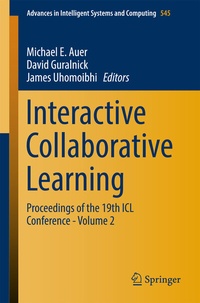
Interactive Collaborative Learning
Description

This book presents the proceedings of the 19th International Conference on Interactive Collaborative Learning, held 21-23 September 2016 at Clayton Hotel in Belfast, UK.
We are currently witnessing a significant transformation in the development of education. The impact of globalisation on all areas of human life, the exponential acceleration of developments in both technology and the global markets, and the growing need for flexibility and agility are essential and challenging elements of this process that have to be addressed in general, but especially in the context of engineering education. To face these topical and very real challenges, higher education is called upon to find innovative responses.
Since being founded in 1998, this conference has consistently been devoted to finding new approaches to learning, with a focus on collaborative learning. Today the ICL conferences have established themselves as a vital forum for the exchange of information on key trends and findings, and of practical lessons learned while developing and testing elements of new technologies and pedagogies in learning.
More details
Other editions
Additional editions
Content
- Intro
- Preface
- ICL2016
- Committees
- General Chair
- ICL2016 Chair
- International Chairs
- Program Co-chairs
- Technical Program Chair
- IEEE Liaison
- Workshop and Tutorial Chair
- Special Session Chair
- Demonstration and Poster Chair
- Awards Chair
- Publication Chair
- Senior PC Members
- Program Committee
- Contents
- Mobile Learning Environments Applications
- Developing an Android Mobile Bluetooth Chat Messenger as an Interactive and Collaborative Learning Aid
- Abstract
- 1 Introduction
- 2 Aims and Objectives
- 3 Literature Review
- 3.1 Google's Android
- 3.2 The Android's Architecture
- 3.3 Android Linux Kernel
- 3.4 Libraries
- 3.5 Dalvik Virtual Machine (DALVIK VM)
- 3.6 Android Software Development Kit (SDK)
- 3.7 Bluetooth Technology
- 3.8 Market and Market Share Analysis
- 4 Project Specification
- 4.1 Purpose of the System
- 4.2 Assumptions and Dependencies
- 4.3 Constraints
- 4.4 Functional Requirements
- 5 Development Phases
- 6 Conclusion and Further Work
- References
- Learning Technological Innovation on Mobile Applications by Means of a Spiral of Projects
- 1 Introduction
- 2 Context
- 3 Expected Learning Outcomes
- 4 Methodology
- 4.1 First Step: Facing the Project
- 4.2 Second Step: Working in Pairs
- 4.3 Third Step: Working in Groups
- 4.4 Assessment
- 5 Results
- 5.1 Deliverables
- 5.2 Examples of Some Resulting Projects
- 5.3 Evaluation of the Learning Experience
- 6 Conclusions and Future Directions
- References
- Multimedia as a Modern Didactic Tool - Windows EDU Proof of Concept Project at Czech Technical University in Prague
- Abstract
- 1 Introduction
- 2 Approach
- 3 Outcomes
- 3.1 E-U-R
- 3.2 Examples of Selected Concepts
- References
- Gamification in 11th Grade Mathematics Lessons - One Possible Interactive Approach
- Abstract
- 1 Introduction
- 2 Gamification
- 2.1 Overview of Definitions
- 2.2 Similarities and Differences Between Game, Serious Game and Gamification
- 2.3 Gamification in the Education
- 3 Application of Gamification in Math Class in 11th Grade
- 3.1 The First Stage of the Study
- 3.2 Second Phase of the Study
- 3.3 Applying Kahoot! in the Learning Process
- 3.4 Analysis of Data Obtained from the Evaluation of Knowledge and Skills in Mathematics of Students from Both Groups
- 4 Conclusion
- References
- Work in Progress: Using Pocket Labs in Master Degree Programs
- 1 Introduction
- 2 Pocket Labs at CUAS
- 3 Case Studies
- 3.1 Microcontroller Special Topics
- 3.2 Real-Time Systems Special Topics
- 3.3 Electronic Engineering
- 4 Student Perception and Impact
- 5 Conclusion and Outlook
- References
- New Learning Models and Applications
- A Multi-dimensional Investigation of Self-regulated Learning in a Blended Classroom Context: A Case Study on eLDa MOOC
- Abstract
- 1 Introduction
- 2 Related Review
- 2.1 Self-regulated Learning
- 2.2 Blended Learning
- 3 Methodology
- 3.1 Research Question
- 3.2 Theoretical Framework of the Study
- 4 eLDa Platform
- 4.1 Course Design
- 4.2 The Research Development
- 4.3 Blended Course Architecture
- 5 Results
- 5.1 The Research Participants
- 5.2 Data Collection Procedure and Approach
- 5.3 SRL Dimensions: Survey Responses
- 5.4 Measuring Self-regulated Learning Skills
- 5.5 Data Analysis
- 5.6 Visualising SRL Profiles amongst Students
- 5.7 Results by Individual Students
- 5.8 Average Weekly Assessment Marks
- 6 Discussion
- 7 Conclusion
- Acknowledgment
- References
- Application of Non Linear Story Telling in Medical Education
- Abstract
- 1 Introduction
- 2 State of the Art
- 3 Implementation
- 3.1 Storyboard
- 3.2 Production
- 3.3 Postprocessing
- 3.4 Modelling the Non Linear Story in an Open Source LMS
- 4 Evaluation Results
- 5 Summary
- 6 Conclusions
- References
- EI and Learning Styles: The Effect on Learning of Generationals
- Abstract
- 1 Introduction
- 2 Systematic Literature Review Defined
- 2.1 Five Steps to the Systematic Literature Review
- 3 Literature Review
- 3.1 Key Word Search
- 4 Generationals
- 4.1 Workplace
- 4.2 Emotional Intelligence
- 4.3 Learning Styles
- 4.4 Learning Styles Inventory
- 5 Purpose
- 6 Participant Characteristics
- 7 Research Methodology
- 8 Methods
- 8.1 Participant Characteristics
- 8.2 Research Questions and Hypotheses
- 8.3 Measures
- 8.4 Data Analysis
- 9 Results
- 9.1 Research Question 1
- 9.2 Hypothesis 1
- 9.3 Hypothesis 2
- 10 Actual or Anticipated Outcomes
- 11 Conclusions/Recommendations/Summary
- References
- Comparison of Two Team Learning and Team Entrepreneurship Models at a Finnish University of Applied Sciences
- Abstract
- 1 Introduction
- 2 Research Methods Used in Developing the Team Entrepreneurship Model
- 3 Demands for Undergraduate Studies - Where Should We Be Heading?
- 4 Two Team Entrepreneurship Models and Their Comparison
- 5 The Current Deployment of the Team Entrepreneurship Model
- 6 Discussion
- 7 Summary
- References
- Survey of ICT Culture of Mentor Teachers
- Abstract
- 1 Introduction
- 2 Background, Goal and Methodology of Research
- 3 Application of ICT Equipment
- 3.1 Using of Computer and Internet
- 3.2 Ownership of ICT Equipment
- 3.3 Application of ICT Equipment in Education
- 4 Internet Communities and Web2 Solutions
- 5 Results and Conclusions
- References
- Blended Learning and Fundamental Disciplines
- Abstract
- 1 Introduction
- 2 Literature Review
- 3 Discussion and Results
- 4 Conclusion
- References
- A Study on Haptic Media to Support Verbal Explanations
- Abstract
- 1 Introduction
- 2 Research Questions
- 3 Experiment
- 3.1 Data Collection
- 3.2 Acquisition of Verbal Explanation
- 3.3 Evaluation of Media
- 4 Results
- 5 Discussion and Conclusion
- Acknowledgement
- References
- The BRSU Race Academy: A Tutored Peer-Teaching Learning Approach
- Abstract
- 1 Introduction
- 2 Specific Background
- 2.1 The Formula Student Competition
- 2.2 BRS Motorsport Formula Student Team
- 3 Shaping the BRSU Race Academy
- 3.1 Background, Main Idea and Goals
- 3.2 Why Tutored Peer-Teaching?
- 3.3 Competences Needed for Peer-Teaching in Engineering Education
- 4 Approach
- 4.1 General Setup
- 4.2 Present and Future Course Formats
- 4.3 Freshmen Lectures (and Evaluation)
- 5 Conclusion and Outlook
- References
- Predicting Students' Behavior During an E-Learning Course Using Data Mining
- Abstract
- 1 Introduction
- 2 Competence-Based Approach
- 3 Motivation
- 4 Methodology
- 5 Implementation
- 6 Prediction
- 7 Analysis
- 8 Discussion
- 9 Conclusion
- Acknowledgments
- References
- Analysis of Interests of Applicants in Technologically Oriented Study in the Czech Republic and Its Support
- Abstract
- 1 Introduction
- 2 Materials and Methods
- 3 Results
- 3.1 Influence of Parents
- 3.2 Influence of Information Media
- 3.3 Effect of Elementary School
- 3.4 Influence of Region, Regional Government, Interest Groups, Unions etc.
- 3.5 Influence of High Technical Schools
- 3.6 Influence of Friends and Acquaintances
- 3.7 Influence of Regional Firms and Enterprises
- 4 The Results, Conclusions
- Acknowledgements
- References
- Towards an Ontology Approach in Teaching Geometry
- Abstract
- 1 Introduction
- 2 Ontologies and Education
- 3 Why Ontologies in Education?
- 4 Mathematical Knowledge Representation
- 5 Application of the Method
- 5.1 The Reason for This Experiment
- 5.2 Some Facts About the Experiment
- 5.3 Initializing the Process
- 5.4 Defining the Properties
- 5.5 Making It More Interesting and Intriguing
- 5.6 A Confirmation Example
- 5.7 Does a Polygon Exist in Real Life?
- 5.8 Could It Be a Roughly Ploted Circle?
- 6 The Ontology Participation
- 7 Evaluation
- 8 Conclusions
- 9 Future Steps
- Acknowledgment
- References
- Towards Formally Prioritizing the Activities of Group Course Work Inside Student Teams
- Abstract
- 1 Introduction
- 2 Related Work
- 3 The Model and Process
- 3.1 Multi-level Hierarchy Decision Problems
- 3.2 Basis of the Computation
- 3.3 The Process
- 4 Case Study
- 5 Conclusions
- References
- Augmented Reality in Engineering
- 1 Introduction
- 1.1 Exploring the Senses in Virtual Laboratories
- 2 Augmented and Virtual Reality
- 2.1 Online Experimentation@FEUP
- 2.2 The U-Academy
- 3 Description of the Case Study
- 3.1 Objectives
- 3.2 Student Sample and Method
- 4 Some Results
- 4.1 Questionnaire
- 4.2 Students Report
- 5 Final Comments
- References
- Maker-MOOC - How to Foster STEM Education with an Open Online Course on Creative Digital Development and Construction with Children
- Abstract
- 1 Introduction
- 2 Maker Days for Kids
- 3 Massive Open Online Course: Maker
- 3.1 Maker-MOOC
- 4 Evaluation
- 5 Discussion
- 6 Conclusion
- References
- Efficiency Over 1000 Students - The Evolution of an On-line Course: From e-Learning to Flipped Classroom
- Abstract
- 1 Introduction
- 2 The First Semester
- 2.1 Cost Effectiveness
- 2.2 Reflection of Participants
- 3 Second Semester
- 3.1 Reflection of Participants
- 4 Third Semester
- 5 Final Model
- 6 Summary and Future Work
- References
- The Use of Serious Games in Educational Environment
- Abstract
- 1 Foreword
- 2 Job Requirements Have Changed
- 3 Use of Serious Games
- 4 Variations of Business Games
- 4.1 Example: Business Game Factory by BTI GmbH, Stuttgart
- 5 Live Experience - Interview with Dipl. oec. Birgit Zürn
- 6 Individual Games for Universities - Example TopEvent
- 7 Conclusion/Summary
- Online Environments and Laboratories
- Using Persuasive System Design Principles to Evaluate Two Next Generation Digital Learning Environments
- Abstract
- 1 Introduction
- 2 Background
- 2.1 Digital Learning Environments
- 2.2 Task-Test-Monitor (TTM)
- 2.3 Motivational Active Learning (MAL)
- 2.4 Persuasive Systems
- 2.5 Related Work
- 3 Methodology
- 4 Analysis of Persuasive Features of TTM and MAL
- 4.1 Primary Task Support
- 4.2 Credibility Support
- 4.3 Dialogue and Social Support
- 5 Discussion
- 5.1 Evaluation Based on Postulates of Persuasive Systems Design
- 5.2 Evaluation Based on System Characteristics
- 5.3 Overall Evaluation
- 6 Limitations
- 7 Summary
- Acknowledgment
- References
- The Future of "Hardware - Software Reconfigurable"
- Abstract
- 1 Introduction
- 2 LabVIEW in Hardware - Software Reconfigurable
- 3 The New Raspberry PI in Education
- 4 LabVIEW Compiler to Raspberry PI
- 5 Conclusions
- References
- An Instrument for Creativity Potentiation - Remote Experiment
- Abstract
- 1 Introduction
- 2 Remote Experiment and Creative Potential
- 3 Conclusions
- Acknowledgment
- References
- Spatial Orientation and 3D Geometry
- 1 Introduction
- 2 Our Approach
- 2.1 The Game
- 2.2 The Unfolding Cube
- 2.3 The Labyrinth
- 3 3D Tasks and Their Automatic Evaluation -- GeoTest
- 3.1 Motivation
- 3.2 GeoTest
- 3.3 GeoTest Features
- 3.4 3D Graphics View in GeoTest
- 3.5 Spatial Problems
- 3.6 Examples of Tasks Available
- 4 Conclusions
- References
- Augmenting E-learning Tools for STE Disciplines and Resource Constrained Environments
- 1 Introduction
- 2 Background
- 3 Methodology - Augmenting E-learning
- 3.1 Recording of Classroom Lessons
- 3.2 Portable Off-Line Archives of Learning Resources
- 4 Results - Augmenting MOODLE
- 4.1 Experiment 1 - Recording of Classroom Lessons
- 4.2 Experiment 2 Creation of Off-Line Archive of LCMS
- 4.3 Discussion
- 5 Conclusion
- References
- Contribution to the Standard of Manufacturing the Remote Laboratory Equipment for Science, Technology, Engineering and Mathematics (STEM) Education
- Abstract
- 1 Introduction
- 2 Overview of the Main Protocols
- 2.1 Stream Control Transmission Protocol (SCTP)
- 2.2 Extensible Messaging and Presence Protocol (XMPP)
- 2.3 Web Real Time Communication (WebRTC)
- 3 Presentation of the Proposed Architecture
- 4 Experimental Results
- 4.1 OpenWRT
- 4.2 Integration of Our Model in TP-Link (TL-MR3020)
- 4.3 Secure Shell (SSH) Over SCTP
- 5 Conclusion and Future Work
- Acknowledgments
- References
- FORGE Enabling FIRE Facilities for the eLearning Community
- 1 Introduction
- 2 FIRE Facilities
- 3 FORGE Architectural Design
- 4 Recommendation for Using FIRE Facilities
- 5 Challenges Raised by FORGE
- 6 Conclusion
- References
- Unified Platform for Both Virtual and Real Equipment Management of Remote Laboratories in Science, Technology, Engineering and Mathematics (STEM) Education
- Abstract
- 1 Introduction
- 2 Research Context: Case Study of Senegal Virtual University
- 2.1 The National Network for Higher Education and Research of Senegal
- 2.2 The Senegal Virtual University (UVS)
- 2.3 The Applied Mathematics and Computer Science (MAI) Education Program
- 3 Remote and Virtual Laboratories
- 4 Research Methodology
- 4.1 Design of Senegal Virtual University (UVS): VirtLab
- 4.2 Design of Bambey Remote Laboratory
- 4.3 Design of the Software Structure of the Platform
- 5 Main Use Cases of the Platform
- 5.1 Reservation of Remote Laboratory Equipment
- 5.2 Assignation of Virtual Machines to Students
- 5.3 Collaboration Diagram
- 5.4 Remote Access to Physical Machine
- 6 Experiments
- 6.1 Experiment No. 1: Numerical Calculation as Works in Practice
- 6.2 Experiment No. 2: Hands-on Experiment for Local Networks Lessons
- 6.3 Experiment No. 3: Physics Course as Work Practice
- 6.4 Experiment No. 4: Hands-on Experiment for a Telecommunication Course
- 7 Conclusion and Future Work
- Acknowledgments
- References
- Work-in-Progress: MicroElectronics Cloud Alliance
- Abstract
- 1 Introduction
- 2 Why Was This Project Designed?
- 3 Objectives
- 4 What the Partnership Has Till Now and What Is the Innovation?
- 5 Work in Progress
- 6 Summary and Expected Impact of the Project
- Acknowledgement
- References
- A Remote Laboratory Architecture for Agile Learning
- Abstract
- 1 Introduction
- 2 A New Concept of E-Learning
- 3 System Requirements
- 4 Development Issues
- 5 Case Studies
- 6 Conclusions and Future Work
- Acknowledgements
- References
- Computer-Aided Language Learning (CALL)
- Engineering Students' Needs in Foreign Language Learning in the Czech Republic
- Abstract
- 1 Introduction
- 2 ESP Teaching at FIM UHK
- 3 Research Design
- 3.1 Research Objective
- 3.2 Research Sample
- 3.3 Methods and Tools
- 4 Research Results
- 4.1 Learning Foreign Languages Before Respondents' University Study
- 4.2 Learning Foreign Languages Within University Study
- 4.3 Students' Plans on How to Use the English/ESP Knowledge in the Future
- 5 Discussions and Conclusions
- Acknowledgment
- References
- Developing a Common Learning Platform for Foreign Language Teaching
- Abstract
- 1 Introduction
- 2 Background
- 3 Significance of the Study
- 4 Approach
- 5 Discussion and Findings
- 6 Conclusion
- Acknowledgements
- References
- The Magic Power of the . Magic PowerPoint to Foster Vocational Learners' Participation and Speaking Skills in English! - A Comparative Study
- Abstract
- 1 Introduction
- 2 Rationale as to the Method and the Topic Chosen
- 3 The Research
- 3.1 Research Questions
- 3.2 The Sample
- 3.3 The Research Tools
- 3.4 Research Phases
- 4 Data Analysis
- 4.1 Questionnaire Analysis and Results
- 5 Interviews Analysis
- 6 Results
- 7 Discussion and Conclusions
- References
- "Classrooms Without Borders" - Instructive Scenarios Based on Mobile Learning to Support Differentiated Learning in Vocational School Settings
- Abstract
- 1 Introduction
- 2 Rationale as to the Method and the Topic Chosen
- 3 Methodology
- 3.1 Research Questions
- 3.2 The Sample
- 3.3 The Research Tools
- 4 Data Analysis
- 4.1 Research Question One: Reasons for Using Mobile Devices to Teach E.S.P
- 4.2 Research Question Two: Exploitation of Mobile Devices for Teaching - Instructive Scenarios
- 4.3 Research Question Three: Teachers' Opinion on Mobile Learning
- 5 Analysis of the Questionnaire
- 6 Discussion and Conclusions
- References
- The Implementation of a Web Application for Screening Children with Dyslexia
- Abstract
- 1 Introduction
- 2 Method
- 2.1 Participants
- 2.2 Materials and Procedure
- 2.3 Implementation (The Web Application)
- 3 Results
- 4 Discussion
- References
- Real World Experiences and Pilot Projects
- Role Scientometric Researches' Results in Management of Forming the Educational Trajectories in the Electronic Educational Environment
- Abstract
- 1 Introduction
- 2 Creation of Algorithm of Modular Formation of Educational Trajectories
- 3 Conclusion
- References
- Studying Security of Data in Cloud Computing Through Cryptographic Approach
- Abstract
- 1 Introduction
- 2 Cloud Computing Security
- 3 Cryptography
- 4 Previous Works in Cloud Computing Security
- 5 Cryptographic Approach and Analysis Results for Cloud Computing
- 5.1 Security Analysis Results
- 6 Conclusions
- References
- Engineering Challenging Entrepreneurship Practice
- Abstract
- 1 Introduction
- 2 COPEC: Science and Education Research Council
- 3 Educational Aspects in Current Reality
- 4 Details of the Innovative Office
- 5 Adopted Methodology for the Development of the Project
- 6 Schedule for 2015/2016
- 7 Main Objectives of the Project
- 8 Project Status
- 9 Conclusions
- Acknowledgment
- References
- Towards a Technology-Enhanced Assessment Service in Higher Education
- Abstract
- 1 Introduction
- 2 e-assessment Framework
- 2.1 e-assessment Framework
- 2.2 The Three Assessment Scenarios
- 2.3 Experiments with Early Adopters
- 2.4 Illustration of One Specific Scenario
- 3 Survey Setup and Analysis
- 3.1 Methodology
- 3.2 Analysis
- 3.3 Summary
- 4 Results and Discussion
- References
- Teaching Nanotechnology as a Framework of Social Inclusion, Empowerment, and Deep Learning
- Abstract
- 1 Introduction
- 2 Method
- 2.1 Participants
- 2.2 Materials
- 2.3 Procedure
- 2.4 Familiarization Phase
- 2.5 Experimental Phase
- 3 Results
- 3.1 Social Inclusion
- 3.2 Deep Learning
- 3.3 Empowerment
- 4 Discussion
- 5 Conclusions
- Acknowledgements
- References
- TC - Tax Compliance
- Abstract
- 1 Specification of TC
- 2 Entrepreneur's Tax Behaviour
- 3 Tax Compliance - Entrepreneurship Basic Instinct Trained and Educated at Vienna's Most Important Technical School, the Tgm Vienna
- 4 Summary
- Entrepreneurship in Engineering Education
- Abstract
- 1 Introduction
- 2 State of the Art in Entrepreneurship Education
- 2.1 Current Entrepreneurship Situation in Austria
- 2.2 Entrepreneurship Education and Teaching
- 3 Entrepreneurship Education in Austria
- 3.1 Entrepreneurship Education in Austria in General
- 3.2 Entrepreneurship Education in Austria in Engineering
- 4 Embedding Entrepreneurship Education into Graz University of Technology
- 4.1 Current Entrepreneurial Activities and Lectures
- 4.2 Other Lectures at Graz University of Technology
- 4.3 Other Selected Entrepreneurial Activities at Graz University of Technology
- 5 Discussion and Outlook
- 5.1 Discussion and Evaluation of TUG Activities
- 5.2 Outlook
- References
- AfrikaBot: Design of a Robotics Challenge to Promote STEM in Africa
- Abstract
- 1 Introduction
- 2 Overview of AfrikaBot
- 3 Design Considerations for AfrikaBot
- 3.1 Organisational Features
- 3.2 Physical Design
- 3.3 Educational Design and Software
- 4 Early Results from AfrikaBot
- 5 Conclusion
- Acknowledgments
- References
- What to Teach and When
- Abstract
- 1 Introduction
- 2 Topic Order in the Introductory Physics Sequence
- 3 Light, Sound, Action!
- 4 Background Research
- 5 Broader Implications in STEM
- 6 Summary and Possibilities for Further Research
- Acknowledgment
- References
- From Chernobyl to the Classroom: A Case Study Connecting Historic Events to Class Projects
- 1 Introduction
- 2 Chernobyl
- 2.1 Background and Radiation Profile
- 2.2 Classroom Presentation Sample
- 3 Datasets and Future Assignments
- 4 Conclusion
- References
- I'm an Outlier! Is This Important? - Answers Based on a Satisfaction and Perception Questionnaire
- Abstract
- 1 Introduction
- 2 Materials and Methods
- 2.1 Questionnaire
- 2.2 Sample Characterization
- 3 Results and Discussion
- 4 On-Going Work and Final Remark
- Acknowledgements
- References
- Integrating Web Information Systems in Engineering Curricula: A Self-tutoring Tool
- Abstract
- 1 Introduction
- 2 Approach
- 3 Fundamental Concepts, Structure and Roadmap
- 4 Actual or Anticipated Outcomes
- 5 Conclusions
- References
- Ubiquitous Learning Environments, Platforms and Authoring Tools
- Automated and Assisted Authoring of Serious Game Scenarios
- Abstract
- 1 Introduction
- 2 Related Work
- 3 Approach
- 3.1 Shared Context for Learning Environment
- 3.2 Defining and Representing a Scenario
- 3.3 Authoring Tool
- 4 Conclusion
- References
- The Challenges of Assessing the Level of Professional Competence Formation
- Abstract
- 1 Introduction
- 2 Research into Competence
- 3 Approach to Competence Assessment
- 4 Conclusions
- Acknowledgements
- References
- Arduino Based Physics and Engineering Remote Laboratory
- Abstract
- 1 Introduction
- 2 Experiments Design
- 2.1 Arduino Board Types
- 2.2 Typical Configurations
- 3 Experiments with Arduino Boards
- 3.1 Experiment with Sensors and Actuators
- 3.2 Solar Panel Experiment
- 4 Conclusion
- Acknowledgements
- References
- Enhancing Adaptivity in Moodle: Framework and Evaluation Study
- Abstract
- 1 Introduction
- 2 Learning Styles
- 3 Related Work
- 4 System Overview
- 5 Framework of the Adaptivity Mechanism
- 5.1 Learning Objects
- 5.2 Course Structure
- 5.3 Adaptation Features
- 5.4 Adaptation Algorithm
- 5.5 Adaptation Techniques
- 6 Evaluation Study
- 7 Conclusion
- References
- An IT-Based Learning Approach About Finite State Machines Using the Example of Stock Trading
- Abstract
- 1 Introduction
- 2 The Learning Objectives
- 2.1 Elements of a Finite State Machine
- 2.2 Architecture and Essential Properties of Finite State Machines
- 2.3 Representations of Finite State Machines
- 3 Application
- 4 Test Setting of FSTG
- 4.1 Construction of the Questionnaire
- 4.2 Elements of the Test Lesson
- 5 Results
- 5.1 Evaluation of the Before-Test
- 5.2 Comparison of the Before-Test and the After-Test
- 5.3 Findings
- 6 Conclusion
- References
- Open-Access Student-Centered Learning
- 1 Introduction
- 2 Background
- 2.1 HASTAC
- 2.2 The Futures Initiative CBOX
- 2.3 Similarities and Differences
- 3 Methodology
- 4 Website Structure
- 4.1 hastac.orghastac.org
- 4.2 futuresinitiative.orgfuturesinitiative.org
- 5 Results and Analysis
- 5.1 HASTAC Groups
- 5.2 Futures Initiative Child Sites
- 6 Outcomes
- 7 Conclusions
- References
- SLNet 2.0: Serious Networking in Universities. A New Platform Based on Clustorization
- Abstract
- 1 Introduction
- 2 SLNet 2.0
- 2.1 The Collaborative Content Creation
- 2.2 The Grouping Engine
- 2.3 The Collaborative Project Realization
- 2.4 The Forums
- 2.5 Realization
- 3 Conclusion
- References
- Development of an E-learning Platform for Storage, Simulation and Online Experimentation of Models of Physiological Processes
- Abstract
- 1 Introduction
- 2 Background
- 3 Motivation
- 4 Objective
- 5 The Platform
- 6 Online Experimentation
- 7 Conclusions and Future Work
- Acknowledgements
- References
- Author Index
