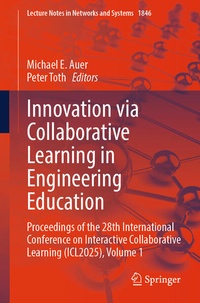
Innovation via Collaborative Learning in Engineering Education
Description

This book contains papers in the fields of AI and its use in education and training, collaborative learning, and digital transition in education. The authors are currently witnessing a significant transformation in the development of education on all levels and especially in post-secondary and higher education. To face these challenges, higher education must find innovative and effective ways to respond in a proper way. Changes have been made in the way we teach and learn, including the massive use of new means of communication, such as videoconferencing and other technological tools.
Moreover, the current explosion of artificial intelligence tools is challenging teaching practices maintained for centuries. Scientifically based statements as well as excellent best practice examples are necessary for effective teaching and learning engineering.
The 28 th International Conference on Interactive Collaborative Learning (ICL2025) and 54 th Conference of International Society for Engineering Pedagogy (IGIP), which took place in Budapest, Hungary, between 1 and 3 October 2025, was the perfect place where current trends in higher education were presented and discussed.
IGIP conferences have been held since 1972 on research results and best practices in teaching and learning from the point of view of Engineering Pedagogy Science. ICL conferences have been held since 1998 being devoted to new approaches in learning with a focus on collaborative learning in higher education. Nowadays, the ICL conferences are a forum of the exchange of relevant trends and research results as well as the presentation of practical experiences in learning and Engineering Pedagogy. In this way, we try to bridge the gap between 'pure' scientific research and the everyday work of educators.
This volume contains papers in the fields of:
· AI and its Use in Education and Training
· Collaborative Learning
· Digital Transition in Education
Interested readership includes policy makers, academics, educators, researchers in pedagogy and learning theory, schoolteachers, learning industry, further and continuing education lecturers, etc.
More details
Other editions
Additional editions