

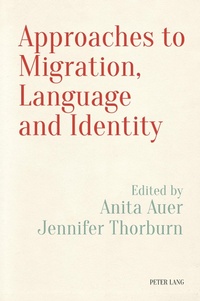
Approaches to Migration, Language and Identity
Description

This book foregrounds the use of different methods for the study of migration, language and identity. It brings together studies from fields such as ethnology, linguistics, literature and religious studies. The scenarios investigated range from Czech-German language contact in nineteenth-century Vienna to Eritreans living in the present-day America, and also include studies of migrants in the Ruhr Valley in Germany, far-right discourse in Italy, Yugoslavian and Tunisian migrants in Switzerland, racializing discourses in Brexit Britain and identity assignation of Palestinian dancers. The volume thus displays a wide array of scenarios linked to language, migration and identity as well as a variety of predominantly qualitative methods that have been applied from different disciplinary perspectives.
More details
Other editions
Additional editions
Persons
Anita Auer is Professor of English Linguistics at the University of Lausanne, Switzerland. She is a historical (socio)linguist with a special interest in diachronic and synchronic aspects of language variation and change. Her current research focuses on alternative histories of the English language (e.g. the role of historical urban vernaculars in standardisation processes; the language of the labouring poor in Late Modern England) as well as language maintenance and shift amongst Swiss heritage speakers in North America.
Jennifer Thorburn is Maître d'enseignement et de recherche in English Linguistics at the University of Lausanne. She is a variationist sociolinguist who works primarily on language in Indigenous communities and regional varieties of English. Her current projects focus on attitudes to language and computer-mediated communication.
Content
Contents: Anita Auer and Jennifer Thorburn: Approaches to Migration, Language and Identity: Setting the Scene - Agnes Kim: The Melting Pot Revisited: Historical Sociolinguistic Perspectives on Migration and Language Contact in Vienna - Warsa Melles: Linguistic and Cultural Adaptation: Analysing Eritrean Immigrants in the United States and Their Perception of Self-Image - Wolfgang Imo and Evelyn Ziegler: Migration in the Ruhr Area: Stancetaking and Attitude Expression in Talk-in-Interaction - Stéphane Maffli: The Novel Fly Away, Pigeon by Melinda Nadj Abonji (2011) and the Consequences of Migration in a Swiss Context - Marianna Griffini: Civic Discourse: Representing Immigrants in the Italian Far Right - Monika Salzbrunn and Simon Mastrangelo: Representations of Tunisian Undocumented Migration on the Internet: Methodological Approaches to a Digital Anthropology of Facebook - Patricia Ronan: Linguistic Inclusion of School-Age Immigrants in Ruhr Valley Schools from a Teacher's Perspective - Ana Laura Rodriguez Quinones: Being a Dancer beyond Being Palestinian: Resisting Identity Assignations through Contemporary Dance - Steven Dixon-Smith: «How Are You Brown?»: Orienting to Racializing Discourses and Exclusion at University in Brexit Britain.
