

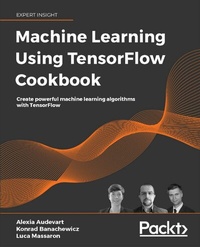
Machine Learning Using TensorFlow Cookbook
Create powerful machine learning algorithms with TensorFlow
1st Edition
Published on 8. February 2021
416 pages
978-1-80020-688-5 (ISBN)
Description

Comprehensive recipes to give you valuable insights on Transformers, Reinforcement Learning, and moreKey Features - Deep Learning solutions from Kaggle Masters and Google Developer Experts
- Get to grips with the fundamentals including variables, matrices, and data sources
- Learn advanced techniques to make your algorithms faster and more accurate
Book DescriptionThe independent recipes in Machine Learning Using TensorFlow Cookbook will teach you how to perform complex data computations and gain valuable insights into your data. Dive into recipes on training models, model evaluation, sentiment analysis, regression analysis, artificial neural networks, and deep learning - each using Google's machine learning library, TensorFlow. This cookbook covers the fundamentals of the TensorFlow library, including variables, matrices, and various data sources. You'll discover real-world implementations of Keras and TensorFlow and learn how to use estimators to train linear models and boosted trees, both for classification and regression. Explore the practical applications of a variety of deep learning architectures, such as recurrent neural networks and Transformers, and see how they can be used to solve computer vision and natural language processing (NLP) problems. With the help of this book, you will be proficient in using TensorFlow, understand deep learning from the basics, and be able to implement machine learning algorithms in real-world scenarios.What you will learn - Take TensorFlow into production
- Implement and fine-tune Transformer models for various NLP tasks
- Apply reinforcement learning algorithms using the TF-Agents framework
- Understand linear regression techniques and use Estimators to train linear models
- Execute neural networks and improve predictions on tabular data
- Master convolutional neural networks and recurrent neural networks through practical recipes
Who this book is forIf you are a data scientist or a machine learning engineer, and you want to skip detailed theoretical explanations in favor of building production-ready machine learning models using TensorFlow, this book is for you. Basic familiarity with Python, linear algebra, statistics, and machine learning is necessary to make the most out of this book.
- Get to grips with the fundamentals including variables, matrices, and data sources
- Learn advanced techniques to make your algorithms faster and more accurate
Book DescriptionThe independent recipes in Machine Learning Using TensorFlow Cookbook will teach you how to perform complex data computations and gain valuable insights into your data. Dive into recipes on training models, model evaluation, sentiment analysis, regression analysis, artificial neural networks, and deep learning - each using Google's machine learning library, TensorFlow. This cookbook covers the fundamentals of the TensorFlow library, including variables, matrices, and various data sources. You'll discover real-world implementations of Keras and TensorFlow and learn how to use estimators to train linear models and boosted trees, both for classification and regression. Explore the practical applications of a variety of deep learning architectures, such as recurrent neural networks and Transformers, and see how they can be used to solve computer vision and natural language processing (NLP) problems. With the help of this book, you will be proficient in using TensorFlow, understand deep learning from the basics, and be able to implement machine learning algorithms in real-world scenarios.What you will learn - Take TensorFlow into production
- Implement and fine-tune Transformer models for various NLP tasks
- Apply reinforcement learning algorithms using the TF-Agents framework
- Understand linear regression techniques and use Estimators to train linear models
- Execute neural networks and improve predictions on tabular data
- Master convolutional neural networks and recurrent neural networks through practical recipes
Who this book is forIf you are a data scientist or a machine learning engineer, and you want to skip detailed theoretical explanations in favor of building production-ready machine learning models using TensorFlow, this book is for you. Basic familiarity with Python, linear algebra, statistics, and machine learning is necessary to make the most out of this book.
All prices
More details
Other editions
Additional editions
Alexia Audevart | Konrad Banachewicz | Luca Massaron
Machine Learning Using TensorFlow Cookbook
Create powerful machine learning algorithms with TensorFlow
Book
02/2021
Packt Publishing
€47.00
Shipment within 3-4 weeks
Content
- Intro
- Copyright
- Contributors
- Table of Contents
- Preface
- Chapter 1: Getting Started with TensorFlow 2.x
- How TensorFlow works
- Declaring variables and tensors
- Using eager execution
- Working with matrices
- Declaring operations
- Implementing activation functions
- Working with data sources
- Additional resources
- Chapter 2: The TensorFlow Way
- Operations using eager execution
- Layering nested operations
- Working with multiple layers
- Implementing loss functions
- Implementing backpropagation
- Working with batch and stochastic training
- Combining everything together
- Chapter 3: Keras
- Introduction
- Understanding Keras layers
- Using the Keras Sequential API
- Using the Keras Functional API
- Using the Keras Subclassing API
- Using the Keras Preprocessing API
- Chapter 4: Linear Regression
- Learning the TensorFlow way of linear regression
- Turning a Keras model into an Estimator
- Understanding loss functions in linear regression
- Implementing Lasso and Ridge regression
- Implementing logistic regression
- Resorting to non-linear solutions
- Using Wide & Deep models
- Chapter 5: Boosted Trees
- Introduction
- Chapter 6: Neural Networks
- Implementing operational gates
- Working with gates and activation functions
- Implementing a one-layer neural network
- Implementing different layers
- Using a multilayer neural network
- Improving the predictions of linear models
- Learning to play Tic-Tac-Toe
- Chapter 7: Predicting with Tabular Data
- Processing numerical data
- Processing dates
- Processing categorical data
- Processing ordinal data
- Processing high-cardinality categorical data
- Wrapping up all the processing
- Setting up a data generator
- Creating custom activations for tabular data
- Running a test on a difficult problem
- Chapter 8: Convolutional Neural Networks
- Introduction
- Implementing a simple CNN
- Implementing an advanced CNN
- Retraining existing CNN models
- Applying StyleNet and the neural style project
- Implementing DeepDream
- Chapter 9: Recurrent Neural Networks
- Text generation
- Sentiment classification
- Stock price prediction
- Open-domain question answering
- Summary
- Chapter 10: Transformers
- Text generation
- Sentiment analysis
- Open-domain question answering
- Chapter 11: Reinforcement Learning with TensorFlow and TF-Agents
- GridWorld
- CartPole
- MAB
- Chapter 12: Taking TensorFlow to Production
- Visualizing Graphs in TensorBoard
- Managing Hyperparameter tuning with TensorBoard's HParams
- Implementing unit tests
- Using multiple executors
- Parallelizing TensorFlow
- Saving and restoring a TensorFlow model
- Using TensorFlow Serving
- Packt Page
- Other Books You May Enjoy
- Index
