

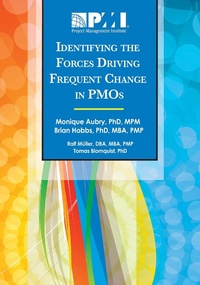
Identifying the Forces Driving Frequent Change in PMOs
Published on 1. August 2011
187 pages
978-1-62825-309-2 (ISBN)
Description

Project Management Offices (PMOs) are not etched in stone. They are complex entities which go through frequent transformations during their average two-year life span. So, what does that mean to project professionals? Identifying the Forces Driving Frequent Change in PMOs answers this question for both researchers and practitioners based on a three-year research effort focused on the organizational change process surrounding the transformation of a PMO. Seventeen case studies and 184 responses to a questionnaire provide the foundation. Results show the temporary nature of PMOs and reveal that significant changes in PMOs can be associated with an organization's internal and external environment.
More details
Other editions
Additional editions
Monique Aubry | Brian Hobbs | Ralf Mueller
Identifying the Forces Driving Frequent Change in PMOs
Book
08/2011
Project Management Institute
€28.50
Shipment within 10-20 days
Content
- Cover
- Title Page
- Copyright Page
- Acknowledgments
- Table of Contents
- List of Figures
- List of Tables
- Executive Summary
- Chapter One: Introduction
- 1.1. Context of this Research
- 1.2. The Origin of this Research
- Chapter Two: Literature Review and Conceptual Framework
- 2.1. The PMO in the Literature
- 2.1.1. Definition of the PMO and Standardization
- 2.1.2. PMO Descriptive Model
- 2.2. Organizational Structure
- 2.3. Organizational Change
- 2.3.1. Contingency Theory
- 2.3.2. The Evolutionary Perspective
- 2.3.3. Patterns of Change
- 2.3.4. Drivers of Change
- 2.4. Conceptualization of the PMO's Transformation Process
- Chapter Three: Methodology
- 3.1. Phase I: Case Studies
- 3.2. Phase II: The Survey
- 3.2.1. Data Collection Strategy
- 3.2.2. Data Analysis Strategy
- Chapter Four: Description of Case Studies
- 4.1. Organization 1: "The Network Company
- 4.1.1. Organizational Context
- 4.1.2. First Transformation of the PMO
- 4.1.3. Second Transformation of the PMO
- 4.1.4. Third Transformation of the PMO
- 4.2. Organization 2: "The Bank
- 4.2.1. Organizational Context
- 4.2.2. First Transformation of the PMO
- 4.2.3. Second Transformation of the PMO
- 4.3. Organization 3: "The Gamer
- 4.3.1. Organizational Context
- 4.3.2. First Transformation of the PMO
- 4.3.3. Second Transformation of the PMO
- 4.4. Organization 4: "The Developer
- 4.4.1. Organizational Context
- 4.4.2. Transformation of the PMO
- 4.5. Organization 5: "The Pack
- 4.5.1. Organizational Context
- 4.5.2. Transformation of the PMO
- 4.6. Organization 6: "The Armour
- 4.6.1. Organizational Context
- 4.6.2. Transformation of the PMO
- 4.7. Organization 7: "The Hospital
- 4.7.1. Organizational Context
- 4.7.2. Transformation of the PMO
- 4.8. Organization 8: "The Data Warehouse
- 4.8.1. Organizational Context
- 4.8.2. Transformation of the PMO
- 4.9. Organization 9: "The Store
- 4.9.1. Organizational Context
- 4.9.2. Transformation of the PMO
- 4.10. Organization 10: "The Financial Group
- 4.10.1. Organizational Context
- 4.10.2. Transformation of the PMO
- 4.11. Organization 11: "The Telephone Company
- 4.11.1. Organizational Context
- 4.11.2. Transformation of the PMO
- 4.12. Organization 12: "The Power Company
- 4.12.1. Organizational Context
- 4.12.2. Transformation of the PMO
- 4.13. Organization 13: "The Engineering Company
- 4.13.1. Organizational Context
- 4.13.2. Transformation of the PMO
- Chapter Five: Results from Case Studies
- 5.1. Typology of Drivers
- 5.2. Patterns of Change
- 5.2.1. Pattern 1. Transition Based upon the Level of Project Management Standardization
- 5.2.2. Pattern 2: PMO Playing between Growth and Contraction
- 5.2.3. Pattern 3: PMO Going Agile
- 5.3. Key Findings
- Chapter Six: Survey Results: Descriptive Statistics
- 6.1. General Information and Demographics
- 6.2. Description of the Change and Its Implementation
- 6.2.1. How long Ago was the Change Initiated?
- 6.2.2. The Amplitude of the Change
- 6.2.3. Implementation
- 6.3. Importance of Drivers of Change in PMO
- 6.3.1. The Importance of External Events as Drivers of PMO Change
- 6.3.2. The Importance of Internal Events as Drivers of PMO Change
- 6.3.3. The Importance of Issues as Drivers of PMO Change
- 6.4. Changes to PMO Roles or Functions
- 6.4.1. The Functions a PMO Fulfills
- 6.4.2. Change in Supportiveness or Control of the PMO
- 6.5. Changes to PMO Structural Characteristics
- 6.5.1. The PMO's Location within the Organization
- 6.5.2. Interdependence with Other PMOs
- 6.5.3. Hierarchical Level to which the PMO Reports
- 6.5.4. The PMO's Access to Top Management
- 6.5.5. Percentage of Projects and Project Managers
- 6.5.6. The PMO's Decision-Making Authority
- 6.5.7. PMO Funding
- 6.5.8. Organizational Culture
- 6.5.9. PMO's Accountability for Project Performance
- 6.6. Key Findings
- Chapter Seven: Survey Results: Factor and Correlation Analyses
- 7.1. Contextual Events Leading to a PMO Change
- 7.1.1. Issues Related to a PMO Change
- 7.1.2. The Relative Importance of the Drivers
- 7.2. The Nature of the Changes to PMOs
- 7.3. Impact after the Change
- 7.4. Correlations among Factors
- 7.5. Correlations with Contextual Factors
- 7.5.1. Contextual Factors
- 7.5.2. Implementation
- 7.5.3. Associations with the Importance of External Events (Event 1)
- 7.5.4. Associations with the Importance of Issues Related to Portfolio Management and Methods (Issue 1)
- 7.5.5. Associations with the Importance of Issues Related to Collaboration and Accountability (Issue 2)
- 7.5.6. Associations with the Importance of Issues Related to Project Management Maturity and Performance (Issue 3)
- 7.5.7. Associations with Increases in the Functions Filled by the PMO and its Supportiveness (Change 1)
- 7.5.8. Associations with Increases in the Scope and the Controlling Nature of the PMO's Mandate (Change 2)
- 7.5.9. Associations with Improvements in Portfolio Management and Methods (Impact 1)
- 7.5.10. Associations with Improvements in Collaboration, Accountability and Skill (Impact 2)
- 7.6. Key Findings
- Chapter Eight: Survey Results: Mediating and Moderating Effects
- 8.1. Mediating Effects
- 8.1.1. Variables Mediating the Relationship between External Events and Impact 2, Improvements in Collaboration, Accountability and Skill
- 8.1.2. Other Mediating Effects of Change Management
- 8.1.3. Mediation of the Relationship between the Importance of Collaboration Issues and Accountability Issues (Issue 2) and Improvements in these Issues (Impact 2)
- 8.2. Moderating Effects
- 8.2.1. Moderating Effects on Impact 1: Improvements in Portfolio Management and Methods
- 8.2.2. Moderating Effects on Impact 2: Improvements in Collaboration, Accountability and Skill
- 8.2.3. Moderating Effects on Impact 3: Work Climate and Cost of PMO
- 8.3. Discussion of the Findings Related to Mediating and Moderating Effects
- 8.3.1. Patterns Related to Improvements in Portfolio Management and Methods (Impact 1)
- 8.3.2. Patterns Related to Improvements in Collaboration, Accountability and Skill (Impact 2)
- 8.3.3. Patterns Related to Improvements in Work Climate and Cost of PMO
- 8.3.4. The Logic of PMO Transformations is Primarily Context-Specific
- 8.3.5. Moderating Effects of Project Management Maturity
- 8.3.6. Organizational Change
- 8.4. Key Findings Related to Mediating and Moderating Effects
- Chapter Nine: Discussion
- 9.1. Modeling the Transformation of PMOs
- 9.2. Why do PMOs Change?
- 9.3. The Implementation of the Change to the PMO
- 9.4. The Changes to the PMOs
- 9.5. The Failure to Identify Patterns in the Transformation Process
- Chapter 10: Conclusion
- Appendices
- References
