

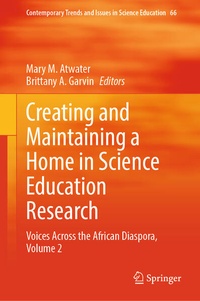
Creating and Maintaining a Home in Science Education Research
Description

This second volume explores the challenges faced by science education researchers of African ancestry in securing an ideal academic home. Highlighting systemic barriers, it advocates for addressing teacher shortages and informs the development of equitable teacher education programs, particularly for Teacher of Color and Indigenous Teachers (TOCIT). Featuring narratives from researchers navigating less-than-ideal environments, transitioning between institutions, or preparing for retirement, it offers invaluable insights into adaptation and resilience. With contributions from diverse institutional backgrounds, including Historically Black institutions, it concludes with policy and practice recommendations to foster inclusive science education and advance equity for African-ancestry professionals.
More details
Other editions
Additional editions
Persons
Mary M. Atwater is an inaugural AERA Fellow, an AAAS Fellow, the Chair of the NARST CADASE RIG, and a NARST past president. Based in Atlanta, Georgia, USA. Her research focuses on socio-cultural-historical factors that influence science education. She has been the PI or co-PI of funded grants, published articles and book chapters, edited books, co-authored K-8 science program, and edited an international handbook.
Brittany A. Garvin is an assistant professor in the School of Education at Indiana University, Indianapolis, USA. Her research addresses issues of race, culture, access, and educational opportunity in science education for minoritized student populations. Brittany is a member of the National Association for Research in Science Teaching and 2023 AAAS Fellow.
Content
Twice diasporized negotiating identity and blackness across borders of nation and academy.- From cotton fields to classrooms enduring legacies of strong black women shaping my journey in science education.- Improving the black community through a career in science education research advice to my younger self.- My Journey in creating a community and home in science education.- Fresh rice from something good to something even better.- The dynamical transition through science education as a home.- Science education a home for my growth development vision and action in research.- Science education in africa my sinusoidal wave home of five decades.
