

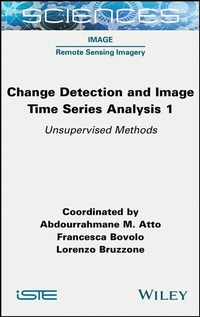
Change Detection and Image Time-Series Analysis 1
Unsupervised Methods
1st Edition
Published on 2. December 2021
304 pages
978-1-119-88224-4 (ISBN)
Description

Change Detection and Image Time Series Analysis 1 presents a wide range of unsupervised methods for temporal evolution analysis through the use of image time series associated with optical and/or synthetic aperture radar acquisition modalities.
Chapter 1 introduces two unsupervised approaches to multiple-change detection in bi-temporal multivariate images, with Chapters 2 and 3 addressing change detection in image time series in the context of the statistical analysis of covariance matrices. Chapter 4 focuses on wavelets and convolutional-neural filters for feature extraction and entropy-based anomaly detection, and Chapter 5 deals with a number of metrics such as cross correlation ratios and the Hausdorff distance for variational analysis of the state of snow. Chapter 6 presents a fractional dynamic stochastic field model for spatio temporal forecasting and for monitoring fast-moving meteorological events such as cyclones. Chapter 7 proposes an analysis based on characteristic points for texture modeling, in the context of graph theory, and Chapter 8 focuses on detecting new land cover types by classification-based change detection or feature/pixel based change detection. Chapter 9 focuses on the modeling of classes in the difference image and derives a multiclass model for this difference image in the context of change vector analysis.
Chapter 1 introduces two unsupervised approaches to multiple-change detection in bi-temporal multivariate images, with Chapters 2 and 3 addressing change detection in image time series in the context of the statistical analysis of covariance matrices. Chapter 4 focuses on wavelets and convolutional-neural filters for feature extraction and entropy-based anomaly detection, and Chapter 5 deals with a number of metrics such as cross correlation ratios and the Hausdorff distance for variational analysis of the state of snow. Chapter 6 presents a fractional dynamic stochastic field model for spatio temporal forecasting and for monitoring fast-moving meteorological events such as cyclones. Chapter 7 proposes an analysis based on characteristic points for texture modeling, in the context of graph theory, and Chapter 8 focuses on detecting new land cover types by classification-based change detection or feature/pixel based change detection. Chapter 9 focuses on the modeling of classes in the difference image and derives a multiclass model for this difference image in the context of change vector analysis.
More details
Other editions
Additional editions
Abdourrahmane M. Atto | Francesca Bovolo | Lorenzo Bruzzone
Change Detection and Image Time-Series Analysis 1
Unsupervised Methods
Book
01/2022
1st Edition
ISTE Ltd
€164.50
Shipment within 3-4 weeks
Persons
Abdourrahmane M. Atto is Associate Professor at the University Savoie Mont Blanc, France. His research interests include mathematical methods and models for artificial intelligence and image time series.
Francesca Bovolo is the Head of the Remote Sensing for Digital Earth Unit, Fondazione Bruno Kessler, Italy. Her research interests include remote sensing image time series analysis, content-based time series retrieval and radar sounders.
Lorenzo Bruzzone is Professor of Telecommunications and the Founder and Director of the Remote Sensing Laboratory at the University of Trento, Italy. His research interests include remote sensing, machine learning and pattern recognition.
Francesca Bovolo is the Head of the Remote Sensing for Digital Earth Unit, Fondazione Bruno Kessler, Italy. Her research interests include remote sensing image time series analysis, content-based time series retrieval and radar sounders.
Lorenzo Bruzzone is Professor of Telecommunications and the Founder and Director of the Remote Sensing Laboratory at the University of Trento, Italy. His research interests include remote sensing, machine learning and pattern recognition.
Content
- Cover
- Half-Title Page
- Title Page
- Copyright Page
- Contents
- Preface
- List of Notations
- Chapter 1. Unsupervised Change Detection in Multitemporal Remote Sensing Images
- 1.1. Introduction
- 1.2. Unsupervised change detection in multispectral images
- 1.2.1. Related concepts
- 1.2.2. Open issues and challenges
- 1.2.3. Spectral-spatial unsupervised CD techniques
- 1.3. Unsupervised multiclass change detection approaches based on modeling spectral-spatial information
- 1.3.1. Sequential spectral change vector analysis (S2CVA)
- 1.3.2. Multiscale morphological compressed change vector analysis
- 1.3.3. Superpixel-level compressed change vector analysis
- 1.4. Dataset description and experimental setup
- 1.4.1. Dataset description
- 1.4.2. Experimental setup
- 1.5. Results and discussion
- 1.5.1. Results on the Xuzhou dataset
- 1.5.2. Results on the Indonesia tsunami dataset
- 1.6. Conclusion
- 1.7. Acknowledgements
- 1.8. References
- Chapter 2. Change Detection inTime Series of Polarimetric SAR Images
- 2.1. Introduction
- 2.1.1. The problem
- 2.1.2. Important concepts illustrated bymeans of the gamma distribution
- 2.2. Test theory and matrix ordering
- 2.2.1. Test for equality of two complex Wishart distributions
- 2.2.2. Test for equality of k-complex Wishart distributions
- 2.2.3. The block diagonal case
- 2.2.4. The Loewner order
- 2.3. The basic change detection algorithm
- 2.4. Applications
- 2.4.1. Visualizing changes
- 2.4.2. Fieldwise change detection
- 2.4.3. Directional changes using the Loewner ordering
- 2.4.4. Software availability
- 2.5. References
- Chapter 3. An Overview of Covariance-based Change Detection Methodologies in Multivariate SAR Image Time Series
- 3.1. Introduction
- 3.2. Dataset description
- 3.3. Statistical modeling of SAR images
- 3.3.1. The data
- 3.3.2. Gaussian model
- 3.3.3. Non-Gaussian modeling
- 3.4. Dissimilarity measures
- 3.4.1. Problem formulation
- 3.4.2. Hypothesis testing statistics
- 3.4.3. Information-theoretic measures
- 3.4.4. Riemannian geometry distances
- 3.4.5. Optimal transport
- 3.4.6. Summary
- 3.4.7. Results of change detectors on the UAVSAR dataset
- 3.5. Change detection based on structured covariances
- 3.5.1. Low-rank Gaussian change detector
- 3.5.2. Low-rank compound Gaussian change detector
- 3.5.3. Results of low-rank change detectors on the UAVSAR dataset
- 3.6. Conclusion
- 3.7. References
- Chapter 4. Unsupervised Functional Information Clustering in Extreme Environments from Filter Banks and Relative Entropy
- 4.1. Introduction
- 4.2. Parametric modeling of convnet features
- 4.3. Anomaly detection in image time series
- 4.4. Functional image time series clustering
- 4.5. Conclusion
- 4.6. References
- Chapter 5. Thresholds and Distances to Better Detect Wet Snow over Mountains with Sentinel-1 Image Time Series
- 5.1. Introduction
- 5.2. Test area and data
- 5.3. Wet snow detection using Sentinel-1
- 5.4. Metrics to detect wet snow
- 5.5. Discussion
- 5.6. Conclusion
- 5.7. Acknowledgements
- 5.8. References
- Chapter 6. Fractional Field Image Time Series Modeling and Application to Cyclone Tracking
- 6.1. Introduction
- 6.2. Random field model of a cyclone texture
- 6.2.1. Cyclone texture feature
- 6.2.2. Wavelet-based power spectral densities and cyclone
- 6.2.3. Fractional spectral power decay model
- 6.3. Cyclone field eye detection and tracking
- 6.3.1. Cyclone eye detection
- 6.3.2. Dynamic fractal field eye tracking
- 6.4. Cyclone field intensity evolution prediction
- 6.5. Discussion
- 6.6. Acknowledgements
- 6.7. References
- Chapter 7. Graph of Characteristic Points for Texture Tracking: Application to Change Detection and Glacier Flow Measurement from SAR Image
- 7.1. Introduction
- 7.2. Texture representation and characterization using local extrema
- 7.2.1. Motivation and approach
- 7.2.2. Local extrema keypoints within SAR images
- 7.3. Unsupervised change detection
- 7.3.1. Proposed framework
- 7.3.2. Weighted graph construction from keypoints
- 7.3.3. Change measure (CM) generation
- 7.4. Experimental study
- 7.4.1. Data description and evaluation criteria
- 7.4.2. Change detection results
- 7.4.3. Sensitivity to parameters
- 7.4.4. Comparison with the NLM model
- 7.4.5. Analysis of the algorithm complexity
- 7.5. Application to glacier flow measurement
- 7.5.1. Proposed method
- 7.5.2. Results
- 7.6. Conclusion
- 7.7. References
- Chapter 8. Multitemporal Analysis of Sentinel-1/2 Images for Land Use Monitoring at Regional Scale
- 8.1. Introduction
- 8.2. Proposed method
- 8.2.1. Test site and data
- 8.3. SAR processing
- 8.4. Optical processing
- 8.5. Combination layer
- 8.6. Results
- 8.7. Conclusion
- 8.8. References
- Chapter 9. Statistical Difference Models for Change Detection in Multispectral Images
- 9.1. Introduction
- 9.2. Overview of the change detection problem
- 9.2.1. Change detection methods for multispectral images
- 9.2.2. Challenges addressed in this chapter
- 9.3. The Rayleigh-Rice mixture model for the magnitude of the difference image
- 9.3.1. Magnitude image statistical mixture model
- 9.3.2. Bayesian decision
- 9.3.3. Numerical approach to parameter estimation
- 9.4. A compound multiclass statistical model of the difference image
- 9.4.1. Difference image statistical mixture model
- 9.4.2. Magnitude image statistical mixture model
- 9.4.3. Bayesian decision
- 9.4.4. Numerical approach to parameter estimation
- 9.5. Experimental results
- 9.5.1. Dataset description
- 9.5.2. Experimental setup
- 9.5.3. Test 1: Two-class Rayleigh-Rice mixture model
- 9.5.4. Test 2: Multiclass Rician mixture model
- 9.6. Conclusion
- 9.7. References
- List of Authors
- Index
- Summary of Volume 2
- EULA
