

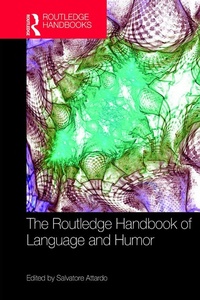
The Routledge Handbook of Language and Humor
Published on 17. February 2017
554 pages
978-1-317-55116-4 (ISBN)
Description

The Routledge Handbook of Language and Humor presents the first ever comprehensive, in-depth treatment of all the sub-fields of the linguistics of humor, broadly conceived as the intersection of the study of language and humor. The reader will find a thorough historical, terminological, and theoretical introduction to the field, as well as detailed treatments of the various approaches to language and humor. Deliberately comprehensive and wide-ranging, the handbook includes chapter-long treatments on the traditional topics covered by language and humor (e.g., teasing, laughter, irony, psycholinguistics, discourse analysis, the major linguistic theories of humor, translation) but also cutting-edge treatments of internet humor, cognitive linguistics, relevance theoretic, and corpus-assisted models of language and humor. Some chapters, such as the variationist sociolinguistcs, stylistics, and politeness are the first-ever syntheses of that particular subfield. Clusters of related chapters, such as conversation analysis, discourse analysis and corpus-assisted analysis allow multiple perspectives on complex trans-disciplinary phenomena. This handbook is an indispensable reference work for all researchers interested in the interplay of language and humor, within linguistics, broadly conceived, but also in neighboring disciplines such as literary studies, psychology, sociology, anthropology, etc. The authors are among the most distinguished scholars in their fields.
Reviews / Votes
"The present Handbook testifies to Salvatore Attardo's lifetime involvement in the linguistic mechanisms of humor and its societal effects. The collection of articles he has gathered here represents at the same time a milestone, a compendium, and a beacon: as a milestone, it marks the advances obtained in humor studies up to and including our times; as a state-of-the-art compendium, it both reveals the 'state' of the 'art', and details its cutting edges; and as a beacon, it identifies skerries and dangerous currents, while at the same time shining light on the path ahead across the uncharted waters of future study. I highly recommend the work to anybody involved in humor studies: from the interested bystander to the advanced student to the accomplished researcher and teacher - and beyond."Jacob L. Mey, The University of Southern Denmark
"This book will undoubtedly become the go-to book for scholars wanting updated summaries of linguistic concepts, tools and approaches to humour. Leading scholars review their fields in succinct and accessible chapters, introduced by Attardo. Topics range from key terms and theories of humour to neurolinguistics and the translation of humour, from corpus-assisted studies and humour markers to failed humour and humour of the internet. This is a truly invaluable collection."
Jessica Milner Davis, University of Sydney
More details
Series
Language
English
Place of publication
London
United Kingdom
Publishing group
Taylor & Francis Ltd
Target group
College/higher education
Illustrations
38 Tables, black and white; 8 Line drawings, black and white; 3 Illustrations, black and white
File size
3,64 MB
ISBN-13
978-1-317-55116-4 (9781317551164)
Copyright in bibliographic data and cover images is held by Nielsen Book Services Limited or by the publishers or by their respective licensors: all rights reserved.
Schweitzer Classification
Other editions
Additional editions
Salvatore Attardo
The Routledge Handbook of Language and Humor
Book
08/2022
1st Edition
Routledge
€71.30
Shipment within 10-20 days
Salvatore Attardo
The Routledge Handbook of Language and Humor
Book
02/2017
1st Edition
Routledge
€364.48
Shipment within 10-20 days
Person
Salvatore Attardo is Dean of the College of Humanities, Social Sciences and Arts at Texas A&M University-Commerce, USA. His publications include two monographs on humor, two collections of essays on the linguistics of humor, and the Encyclopedia of Humor Studies. He was Editor-in-Chief of HUMOR: International Journal of Humor Research for 10 years.
Content
Introduction
Salvatore Attardo
An Overview of Humor Theory
Cristina Larkin-Galinanes
Humor Universals
Annarita Guidi
Key Terms in the Field of Humor
Christian F. Hempelmann
Linguistics and Humor Theory
Salvatore Attardo and Victor Raskin
The Isotopy Disjunction Model
Amal Aljared
Puns and Tacit Linguistic Knowledge
Debra Aarons
Puns: Taxonomy and Phonology
Christian F. Hempelmann and Tristan Miller
Script-Based Semantic and Ontological Semantic Theories of Humor
Victor Raskin
The General Theory of Verbal Humor
Salvatore Attardo
Humor and Narrative
Wladyslaw Chlopicki
Humor and Stylistics
Paul Simpson and Derek Bousfield
Humor and Pragmatics
Salvatore Attardo
Relevance-Theoretic Treatments of Humor
Francisco Yus
Teasing
Michael Haugh
Politeness, Teasing, and Humor
Maria Shardakova
Irony and Sarcasm
Herbert L. Colston
Cognitive Linguistics and Humor Research
Geert Brone
Psycholinguistic Approaches to Humor
Belem G. Lopez and Jyotsna Vaid
Neurolinguistics of Humor
Hsueh-Chih Chen, Yu-Chen Chan, Ru-Huei Dai, Yi-Jun Liao, and Cheng-Hao Tu
Conversation Analysis of Humor
Phillip Glenn and Elizabeth Holt
Functionalist discourse analysis of humor
Stephanie Schnurr and Barbara Plester
Corpus-assisted studies of humor and laughter-talk
Alan Partington
Laughter
Juergen Trouvain and Khiet P. Truong
Failed Humor
Nancy Bell
Humor Support and Mode Adoption
Juanita M. Whalen and Penny M. Pexman
Humor markers
Christian Burgers and Margot van Mulken
Prosodic and Multimodal Markers of Humor
Elisa Gironzetti
Humor and Translation
Delia Chiaro
Audiovisual Translation of Humor
Chiara Bucaria
Humor and Second Language Development
Nancy Bell
Computational Treatments of Humor
Julia Taylor
Sociolinguistic Approaches to Humor
Catherine E. Davies
Genres of humor
Villy Tsakona
Online and Internet Humor
Eric Weitz
Salvatore Attardo
An Overview of Humor Theory
Cristina Larkin-Galinanes
Humor Universals
Annarita Guidi
Key Terms in the Field of Humor
Christian F. Hempelmann
Linguistics and Humor Theory
Salvatore Attardo and Victor Raskin
The Isotopy Disjunction Model
Amal Aljared
Puns and Tacit Linguistic Knowledge
Debra Aarons
Puns: Taxonomy and Phonology
Christian F. Hempelmann and Tristan Miller
Script-Based Semantic and Ontological Semantic Theories of Humor
Victor Raskin
The General Theory of Verbal Humor
Salvatore Attardo
Humor and Narrative
Wladyslaw Chlopicki
Humor and Stylistics
Paul Simpson and Derek Bousfield
Humor and Pragmatics
Salvatore Attardo
Relevance-Theoretic Treatments of Humor
Francisco Yus
Teasing
Michael Haugh
Politeness, Teasing, and Humor
Maria Shardakova
Irony and Sarcasm
Herbert L. Colston
Cognitive Linguistics and Humor Research
Geert Brone
Psycholinguistic Approaches to Humor
Belem G. Lopez and Jyotsna Vaid
Neurolinguistics of Humor
Hsueh-Chih Chen, Yu-Chen Chan, Ru-Huei Dai, Yi-Jun Liao, and Cheng-Hao Tu
Conversation Analysis of Humor
Phillip Glenn and Elizabeth Holt
Functionalist discourse analysis of humor
Stephanie Schnurr and Barbara Plester
Corpus-assisted studies of humor and laughter-talk
Alan Partington
Laughter
Juergen Trouvain and Khiet P. Truong
Failed Humor
Nancy Bell
Humor Support and Mode Adoption
Juanita M. Whalen and Penny M. Pexman
Humor markers
Christian Burgers and Margot van Mulken
Prosodic and Multimodal Markers of Humor
Elisa Gironzetti
Humor and Translation
Delia Chiaro
Audiovisual Translation of Humor
Chiara Bucaria
Humor and Second Language Development
Nancy Bell
Computational Treatments of Humor
Julia Taylor
Sociolinguistic Approaches to Humor
Catherine E. Davies
Genres of humor
Villy Tsakona
Online and Internet Humor
Eric Weitz
