

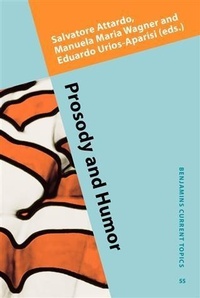
Prosody and Humor
1st Edition
Published on 6. December 2013
V, 192 pages
978-90-272-7118-1 (ISBN)
Description

This is the first-ever book-length collection of articles on the subject of prosody and humor. The chapters are written by the recognized leaders in the field and present the cutting edge of the research in this new interdisciplinary field of study. The book covers a broad range of languages, using several theoretical approaches, ranging from cognitive semantic theories, to discourse analysis, and anthropology. All the contributions are anchored in instrumental empirical data analysis. The topics covered range from humor in conversation, to sitcom scripts, from riddles to intonation jokes, from irony in a laboratory setting to irony occurring in conversation, from friends' conversations in France, to business meetings in rural Brazil. The unifying theme is the search for markers of the humorous or ironical intentions of the speakers or of the genre of interaction. Originally published in Pragmatics & Cognition 19:2 (2011) and 19:3 (2011).
More details
Other editions
Additional editions
Salvatore Attardo | Manuela Maria Wagner | Eduardo Urios-Aparisi
Prosody and Humor
Book
12/2013
John Benjamins Publishing Co
€90.10
Shipment within 10-15 days
Persons
Content
- Prosody and Humor
- Editorial page
- Title page
- LCC data
- Table of contents
- Prosody and humor
- 1. Introduction
- 1.1 A terminological caveat
- 2. The state of the art
- 2.1 Humor
- 2.2 Laughter
- 2.3 Irony
- 2.4 Phonological markers
- 2.5 Facial markers
- 2.6 Conclusions of the above discussions
- 3. The chapters in this book
- 4. Implications for pragmatics
- 4.1 Prosody as a marker
- 4.2 What does it mean to say that feature X is a "marker" of Y?
- 4.3 Prosodic and paralinguistic markers as eliciting affect
- 4.4 Further research
- References
- Recognizing sarcasm without language
- 1. Introduction
- 2. Acoustic-perceptual correlates of sarcasm in speech
- 3. On the cross-linguistic recognition of speaker attitudes
- 4. The present study
- 5. Method
- 5.1 Participants
- 5.2 Materials
- 5.3 Experimental tasks/procedure
- 5.4 Statistical procedure
- 6. Results
- 6.1 Response patterns
- 6.2 Cross-linguistic analysis of accuracy data for each attitude
- 7. Discussion
- 7.1 Future directions
- 7.2 Conclusion
- References
- Prosodic and multimodal markers of humor in conversation
- 1. Introduction
- 1.1 The jab line
- 1.2 Humor support
- 2. Methodology
- 2.1 Identifying humorous sequences
- 2.2 Acoustical analysis
- 2.3 A note on the coding of humor and humor support
- 3. Overall results
- 3.1 Speech rate
- 3.2 Pauses
- 3.3 Pitch
- 3.4 Volume
- 3.5 The canned jokes' performance
- 4. Comparison of the results for the dyadic exchange vs. the canned performance data
- 4.1 Pitch
- 4.2 Volume
- 4.3 Speech rate
- 5. Comparison of conversational humor vs. canned humor
- 5.1 Speech rate
- 5.2 Volume
- 5.3 Pitch
- 5.4 Pauses
- 6. Non-prosodic markers
- 6.1 Liminal sequences
- 7. Conclusions
- Transcription Chart
- References
- Prosody in spontaneous humor
- 1. Introduction
- 2. Method
- 2.1 Recordings
- 3. Results
- 4. Discussion
- References
- Appendix A
- Appendix B
- Formulaic jokes in interaction
- 1. Introduction
- 1.1 The prosody of jokes
- 1.2 The prosody of wh-questions
- 1.3 The prosody of riddles
- 2. Methodology
- 2.1 Data
- 2.2 Analyzing pitch variation
- 2.3 Pitch and gender
- 3. Analysis of pitch variation
- 3.1 Pitch range
- 3.1.1 Explanation for pitch range in riddle questions and conversational wh-questions
- 3.2 Pitch change within syllable nuclei
- 3.3 Mean absolute slope within syllable nuclei
- 3.4 Discussion
- 4. Conclusion
- References
- Verbal irony in the wild
- 1. Introduction
- 1.1 Verbal irony as implied language
- 1.2 Verbal irony and the voice
- 2. Descriptive analyses
- 3. Conclusion
- References
- Rich pitch
- 1. Introduction
- 2. Intonation, cohesion, and mental representation
- 3. The jokes
- 3.1 Jokes with deaccent
- 3.2 Jokes with contrast
- 4. Discussion
- 4.1 Humor and prosody
- 4.2 Theme and rheme
- 4.3 Processing cost
- 4.4 Ad hoc categories
- 4.5 Salience
- 4.6 Models of mental representation
- 5. Conclusion
- References
- Does prosody play a specific role in conversational humor?
- 1. Conversational humor
- 2. Corpus CID
- 2.1 General presentation
- 2.2 Device and protocol
- 2.3 The participants and their conditions of recording
- 2.4 Conversational characteristics of the data
- 3. Type of humor in the CID
- 4. Analysis
- 4.1 The humorous reported speech
- 4.2 Summary
- 4.3 Repetitions and confirmation requests/answers
- 5. Conclusion
- Conventions of transcription
- References
- Appendix: Translations
- Prosody of humor in Sex and the City
- 1. Introduction
- 2. Methods
- 3. Results
- 3.1 Humor types in SATC
- 3.2 Pitch variation
- 3.3 Pauses
- 4. Narrated scenes: A comparison
- 5. Discussion and conclusions
- References
- Index
