

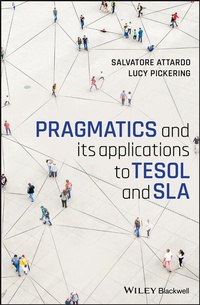
Pragmatics and its Applications to TESOL and SLA
Description

Pragmatics and its Applications to TESOL and SLA offers an in-depth description of key areas of linguistic pragmatics and a review of how those topics can be applied to pedagogy in the fields of second language acquisition (SLA) and teaching English to speakers of other languages (TESOL). This book is an excellent resource for students and professionals who have an interest in teaching pragmatics (speech acts, the cooperative principle, deixis, politeness theory, and more) in second language contexts.
This book introduces technical terminology and concepts--including the fundamentals of semantics and semiotics--in simple language, and it provides illuminating examples, making it an excellent choice for readers with an elementary linguistics background who wish to further their knowledge of pragmatics. It also covers more advanced pragmatics topics, including stance, indexicality, and pragmatic appropriateness. Key features include:
* A comprehensive introduction to pragmatics, covering meaning, speech acts, the cooperation principle, politeness, metapragmatics, and more
* A unique orientation toward practical application in second language acquisition studies and English-language instruction
* Two-part chapters clearly separating theoretical introductions from concrete, real-world applications of the theory
* Thorough coverage that is accessible to both students and professionals currently teaching English to speakers of other languages, including sample lesson plans
* Practical chapters on the interface between pragmatics and teaching, and on research design
Pragmatics and its Applications to TESOL and SLA is a comprehensive and coherent introduction, perfect for students, researchers, and scholars of pragmatics, second language acquisition, language teaching, and intercultural communication. It is also an excellent resource for professionals in the field of English-language education.
More details
Other editions
Additional editions
Persons
SALVATORE ATTARDO is Professor of Linguistics at Texas A&MCommerce, USA. He is editor of The Encyclopedia of Humor Studies (2014) and The Handbook of Language and Humor (2017) and co-author of Understanding Language Structure, Interaction and Variation, Third Edition (2014). He has published 12 books and over 100 articles. His latest book is The Linguistics of Humor: An Introduction (2020).
LUCY PICKERING is Professor of Applied Linguistics and Director of the Applied Linguistics Laboratory at Texas A&MCommerce, USA. She is the author of Discourse Intonation: A discourse-pragmatic approach to teaching the pronunciation of English (2018), co-editor of Language Learning, Discourse & Cognition (2018), co-editor of Talking at Work (2016), and co-author of English Communication for International Teaching Assistants (2013).
Content
List of Tables xi
List of Figures xiii
Preface xv
Typographical Conventions xix
1 Meaning 1
1.1 What Do We Mean By Meaning? 2
1.1.1 Semiotics 2
1.1.2 Extensional and Intensional Semantics 4
1.1.3 Language in Context 8
1.1.4 The Semantics/Pragmatics Boundary 9
1.1.5 Modularity 10
1.2 A Real Life Application 13
1.3 Conclusion 14
2 The Language Teaching and Pragmatics Interface 15
2.1 Are There Universals in Pragmatics That Students Can Bring To Their L2? 16
2.2 What Do Learners Typically Transfer From Their L1? 17
2.3 Can Pragmatics Be Taught Through Instruction? 19
2.4 Is There a Developmental Path for Pragmatics? 20
2.5 Is Acquisition of Pragmatics Different for L2 Child and Adult Learners? 21
2.6 Does the Learner Have To Sound Exactly the Same As a Native Speaker? 22
2.7 Can Pragmatics Be Assessed in the Classroom? 22
2.8 Conclusion 23
3 Speech Acts 23
3.1 Ordinary Language Philosophy, Oxford, and Austin 24
3.1.1 Austin and Performativity 26
3.1.2 Speech Acts, Searle 27
3.1.3 Realization Patterns 29
3.1.4 How Speech Acts Work 29
3.1.5 Indirect Speech Acts 32
3.1.6 Public Commitment for Speech Acts 33
3.2 Conclusion 35
3.3 Speech Acts in SLA and Applications to TESOL 35
3.3.1 Speech Acts in the TESOL Classroom: Materials 37
3.3.2 Sample Teaching Materials 39
4 Grice's Principle of Cooperation 41
4.1 Gricean Pragmatics as Rational Cooperation 41
4.1.1 Conversational Cooperation Is Rational 42
4.1.2 Implicatures 43
4.1.3 Scalarity and Implicatures 45
4.1.4 Flouting and Implicatures 46
4.1.5 Difference between Inferences, Presuppositions, and Implicatures 48
4.1.6 Developments of Grice's Theory 49
4.1.7 Modularity in Light of Gricean Pragmatics 55
4.2 Conclusion 56
4.3 Applications to SLA 56
4.3.1 Grice in SLA 56
4.3.2 Relevance Theory and SLA 59
4.3.3 TESOL Classroom Materials 61
4.3.4 Sample Teaching Materials 62
5 Politeness 64
5.1 Theories of Politeness 64
5.1.1 Classical Politeness Theories 65
5.1.2 Second Wave Approaches (1990 and forward) 70
5.1.3 Third Wave Theories: Ritualization and Norm 76
5.1.4 Universality of Politeness 78
5.1.5 Sociopragmatics and Power 80
5.2 Conclusion 81
5.3 Politeness and SLA 81
5.3.1 Politeness in the TESOL Materials 84
5.3.2 Sample Teaching Materials 85
6 Functional Sentence Perspective 87
6.1 Theoretical Background 87
6.1.1 Functionalism 87
6.1.2 Markedness 89
6.1.3 Word Order 90
6.1.4 Prominence 92
6.2 Aspects of FSP 92
6.2.1 Newness 93
6.2.2 Known-ness 94
6.2.3 Definiteness 95
6.3 Applications of FSP 97
6.3.1 FSP Reflects the Organization of Ideas in the Mind 97
6.3.2 Paragraph and Textual Organization 98
6.3.3 Marked Constructions 98
6.4 History and Terminology 101
6.4.1 The Prague School 101
6.4.2 European Functionalism 102
6.4.3 Generative Functionalism 103
6.4.4 West Coast Functionalism 105
6.5 Conclusion 105
6.6 FSP in SLA and the TESOL Classroom 105
6.6.1 FSP in SLA 105
6.6.2 FSP in TESOL 106
6.6.3 Sample Teaching Materials 107
7 Stance, Deixis, and Pragmatic markers 110
7.1 Modality 111
7.1.1 Modal Verbs 111
7.1.2 Epistemic and Deontic modality 113
7.2 Deixis 114
7.2.1 Place and Time deixis 115
7.2.2 Discourse Deixis 115
7.2.3 Social Deixis 116
7.3 Pragmatic Markers 116
7.3.1 Schiffrin's Discourse Markers 117
7.3.2 Procedural Information Markers 119
7.3.3 Connectors 119
7.4 Stance 120
7.5 Corpus-assisted Work 123
7.6 Conclusion 125
7.7 Pragmatic Markers in SLA and TESOL 126
7.7.1 Contrastive and Intercultural Studies in SLA and TESOL 126
7.7.2 Sample Teaching Materials 128
8 Interactional Sociolinguistics 130
8.1 The California Milieu 130
8.1.1 The Sociological/Phenomenological Approach 131
8.1.2 Conversation Analysis 134
8.2 Communicative Competence 135
8.3 The Definition of Context 136
8.3.1 Context 136
8.3.2 Communicative Practices 138
8.3.3 Conversational Inferences 139
8.3.4 Contextualization 140
8.4 Conclusion: Gumperz's Interactionism 146
8.5 Sociocultural Interaction and SLA 147
8.5.1 Interactional Sociolinguistics in the TESOL Classroom 151
8.5.2 Sample Teaching Materials 151
9 Data Collection and Research Design in Studies of L2 Pragmatics 153
9.1 Discourse Completion Tasks 153
9.2 Interactional Studies 156
9.2.1 Follow Up Interviews 157
9.3 Pseudolongitudinal 158
9.4 Longitudinal 158
9.4.1 Study Abroad 159
9.5 Computer Mediated Communication 160
9.6 Action Research 161
9.6.1 Student-collected Research 162
9.7 Conclusion 164
10 Metapragmatics 165
10.1 Metalanguage and Object Language 165
10.1.1 The Origins of the Language/Metalanguage Distinction 165
10.1.2 Uses of Metalanguage in Linguistics 167
10.1.3 Metadiscourse 168
10.2 Deixis, Indexicality, and the Semiotic Turn in Sociolinguistics 169
10.2.1 Deixis 169
10.2.2 Indexicality 170
10.2.3 The Semiotic Turn in Sociolinguistics 172
10.3 Metalinguistic Awareness 174
10.3.1 Implicit and Explicit Awareness 175
10.4 Ideology, or the Lack of Awareness 175
10.4.1 Definition of Ideology 175
10.5 Conclusion 180
11 Frontier 181
11.1 Pragmatic Resources in English as a Lingua Franca 181
11.2 Multilingualism 182
11.3 Embodied Cognition 185
11.4 Complexity Theory 186
11.4.1 Complex Systems 186
11.4.2 Applications to Linguistics 188
11.5 Cyberpragmatics 189
11.6 Neuropragmatics 191
11.6.1 Lateralization and Specialization 193
11.6.2 The Theory of Mind 194
11.6.3 Pragmatic Disorders 195
11.7 Conclusion 196
Bibliography 198
Name Index 229
Subject Index 239
1
Meaning
Let's start from a very simple, everyday situation, a man walks in a donut store and asks for a donut, for example, by saying: "May I have a donut, please?" The donut shop employee turns around, picks up a donut, and gives it to the man. There are many ways of looking at this situation, but we will focus on just one aspect: How did the man and the donut shop employee know that the uttering the word "donut" would cause the transaction to succeed?1 A simple explanation is that both the man and the employee know that "donut" means a certain kind of pastry made with sweet dough that is deep fried and covered with various glazes, sugar, and/or sprinkles. Furthermore, the man and the employee know that by using the word, they are referring to (i.e., they mean) an object that happens to be in the display case of the shop. However, the word "means" in this explanation is deceptively simple. In fact, a whole discipline, a part of philosophy, deals with the apparently simple idea of "meaning." Within linguistics, which is our domain, many ideas from philosophical semantics have been adopted but a few come from other fields, as we will see.
Semantics is thus the part of linguistics that deals with meaning. We will start out by defining meaning; to do so, we must introduce the idea of the semiotic sign and of code or, to put it differently, explain how it is possible to mean something using something else. We then introduce two major approaches to semantics: the extensional (referential) approach and the intensional approach. Once we have examined these two radically different ways of approaching semantics, we will examine the contentious issue of the boundary between semantics and pragmatics, which is entwined with the idea of context and of modularity. These are big ideas that exceed pragmatics and even linguistics. However, it is important to understand where pragmatics itself as a science is located, within the context of its two older sisters: philosophy and psychology.
1.1 What Do We Mean by Meaning?
Meaning can be a complex and off-putting topic: many students are discouraged by the difficult terminology and symbolism of logic, which is often used in its presentation, or are confused by the fact that there exist many conflicting theories of meaning, unlike the relative simplicity of morphology and phonology. It does not matter that if you scratch below the surface, both phonology and morphology are as conflicted as semantics. Most students never get the chance to enter semantics.
Conversely, others may feel that there's nothing to be studied there: after all, "cow" means "cow" and if I say "cow" I mean "cow" and that's it. What could be simpler? All you would need to teach to a learner of a foreign language would be the vocabulary. Is that a realistic view of language teaching? Of course not. There is much more to speaking a foreign language than plugging in words. In fact, even within a single language, what words convey may change. Consider the sentence: Nice driving! The meaning of the words is very clear: "nice" indicates a positive assessment and "driving" refers to operating and specifically directing a vehicle. However, Nice driving! could be uttered by a spouse to another who has just driven them to the airport in record time at rush hour, or to a spouse who just crashed the car into a tree, causing significant damage to the car. Note how the meaning of the words "nice" and "driving" is not affected at all by the change in situations. What changes is that the speaker means nice literally in the first situation and ironically in the second. So, even assuming that the meaning of words was simple and straightforward (it is not, incidentally!), the meaning of the utterance could change significantly. So, yes, meaning is complicated.
But, what is meaning, precisely? Meaning is the result of an act of semiosis conducted by an agent.2 Semiosis is the process of producing a sign. So, to begin with, meaning is associated with signs. We will discuss precisely how in what follows.
1.1.1 Semiotics
A sign is the union of a signifier and a signified. The signifier is the mental representation of the physical component of the sign, such as a sound, an image, or an alphabetic symbol. The sequence of phonemes /kæt/, the graphemes "cat," and Figure 1.1 are all possible signifiers of the sign "cat."
Figure 1.1 Image of a cat.
The signified is the mental representation of the entity referred to by the sign. When a speaker of English hears the sounds of the word /kæt/ or reads the letters "cat" or sees Figure 1.1, he/she thinks of a cat (has a mental representation, a concept). That thought is the meaning of the word "cat."
Figure 1.2 A sign is the union of a signifier and a signified.
So, in a sense, a sign is a tool to connect, via two mental representations, two physical world entities: a group of sounds, that is, the actual pronunciation of a group of phonemes and an actual physical object in the world, the referent (namely, an actual cat, with fur, a tail, whiskers, claws, who has been spayed, goes to the vet on Thursday, etc.). There is no easy way to connect the two without going through a conventional pairing of mental representations (of sounds, graphemes, etc. on the one side, and of referents, on the other). If we put all of this into a graphic representation, we get the so-called semiotic triangle, as shown in Figure 1.2. Note how there is no direct link between the sounds and the referent. The job of the sign is to connect the two (sounds and referents).
Figure 1.3 The indirect relationship between the sounds and the referent, mediated by the sign.
There is no reason, except social convention, for a cat to be called a cat or a dog a dog. Consider the fact that a dog is called "dog" in English, "chien" in French, "perro" in Spanish, and "gou" in Chinese. If there were a good reason for a dog to be called a dog, then that reason would hold also in China and France. Since it obviously doesn't, given the variety of terms just considered, then there isn't one. This is known as the principle of the arbitrariness of the sign.
There are exceptions: iconic signs have a connection with their referent - an arrow points in the direction you want to indicate; the line of a chart goes up in proportion to the increase of the quantity you are symbolizing. Onomatopoetic signs sound like the thing they refer to, for example, "bang," "crash," "hiss." These exceptions are limited and do not affect the principle of arbitrariness of the sign.
Generally speaking, signs are conventional: they exist only due to a social convention. Think of money: a dollar bill is just a piece of paper; it is not intrinsically valuable, like, say, gold or a car. The dollar bill is worth something only because we have a convention in our society that anyone will exchange that piece of paper for goods of some kind. When we say that it is a convention, we don't mean to diminish it. Clearly society invests large amount of resources and time to protect this convention: only the state is allowed to print money and if you try to do it on your own, the police will pay you a visit very soon.
A language is then a system of signs. The examples we have used so far, for simplicity, have all been lexical items, but grammatical constructions, word order, intonation, and so on are all signs, which are part of the system. A system of signs is also called a code. Think of the Morse code, which was used in the telegraph, in which to each letter of the alphabet correspond some combination of dashes and dots (Figure 1.4). This system is a code in the sense that to each letter we assign, by convention, a sequence of dashes and dots. Note that just like there was no reason for a cat to be called a cat, there is no reason for the letter A to be "dot-dash," it could just as well have been "dash-dot" (which happens to be the letter N).
Figure 1.4 The Morse code.
1.1.2 Extensional and Intensional Semantics
Consider the musical terminology of "largo" (see Figure 1.5). You are probably not familiar with the term, unless you are a trained classical musician. You may perhaps know that it is a tempo, that is, a description of how fast the music is to be performed. You may even be aware of the fact that largo is slower than allegro or andante, so you have some idea of what "largo" means, but until you actually hear a performance of a piece played in a largo tempo, you will not actually know what largo means. The difference is that when you are working with the theoretical definition, and the definition in terms of what "largo" is not (i.e., not allegro, not andante, etc.) you do have a meaning in mind, but when you actually hear it performed you have also something in the world that this meaning refers to.
Figure 1.5 Partition for the beginning of a Rachmaninoff piece with largo tempo.
We thus distinguish two approaches to semantics: the extensional approach that sees the meaning of a word as the thing it refers to and the intensional approach that sees meaning as the relationships that a word has...
