

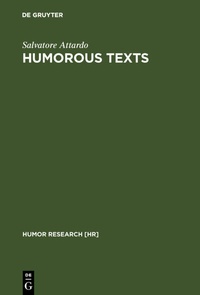
Humorous Texts
A Semantic and Pragmatic Analysis
1st Edition
Published on 14. December 2010
XIV, 238 pages
978-3-11-088796-9 (ISBN)
Description

This book presents a theory of long humorous texts based on a revision and an upgrade of the General Theory of Verbal Humour (GTVH), a decade after its first proposal. The theory is informed by current research in psycholinguistics and cognitive science. It is predicated on the fact that there are humorous mechanisms in long texts that have no counterpart in jokes. The book includes a number of case studies, among them Oscar Wilde's Lord Arthur Savile's Crime and Allais' story Han Rybeck. A ground-breaking discussion of the quantitative distribution of humor in select texts is presented.
More details
Series
Edition
Reprint 2010
Language
English
Place of publication
Berlin/Boston
Germany
Publishing group
de Gruyter Mouton
Target group
Professional and scholarly
US School Grade: College Graduate Student
Illustrations
9 Abbildungen, 10 s/w Tabellen
9 ill., 10 tbl.
File size
71,28 MB
ISBN-13
978-3-11-088796-9 (9783110887969)
Schweitzer Classification
Other editions
Additional editions
Book
05/2001
1st Edition
De Gruyter Mouton
€139.95
Shipment within 7-9 days
Person
Salvatore Attardo is Professor at the English Department of Youngstown State University, USA.
Content
- Intro
- Preface
- 0.1 A cautionary tale
- 0.2 Acknowledgments
- 0.2.1 Publications
- 0.2.2 People
- 1 Preliminaries
- 1.1 The SSTH
- 1.2 The Structure of a Semantic Theory
- 1.3 The Semantic Theory of Humor
- 1.4 The GTVH
- 1.5 Outline of the Theory
- 1.6 Methodological and metatheoretical issues
- 2 Literature Review
- 2.1 The Expansionist Approach
- 2.2 The Revisionist Approach
- 3 Semantic Analysis and Humor Analysis
- 3.1 Semantic and Pragmatic Tools
- 3.2 How is information added to the storage area?
- 3.3 The Text World
- 3.4 Surface structure recall
- 3.5 Summing up
- 4 Beyond the Joke
- 4.1 Narrative vs. Conversation
- 4.2 Joke cycles
- 4.3 Conclusion
- 5 A Theory of Humorous Texts
- 5.1 Method of analysis
- 5.2 Narratives
- 5.3 Lines and their Configurations
- 5.4 A typology of line position
- 5.5 Humorous Plots
- 5.6 Humorous Techniques
- 5.7 General Considerations
- 6 Diffuse Disjunction
- 6.1 Register humor
- 6.2 Irony
- 7 Case Studies
- 7.1 Chuckles Bites the Dust: the opening sequence
- 7.2 Sexton's Cinderella
- 7.3 A Merry Discourse of Meum and Tuum
- 7.4 Il nome della rosa: Analysis of one strand
- 7.5 Han Rybeck ou le coup de l'etrier
- 8 "Lord Arthur Savile's Crime" by Oscar Wilde
- 8.1 CHAPTER I
- 8.2 CHAPTER II
- 8.3 CHAPTER III
- 8.4 CHAPTER IV
- 8.5 CHAPTER V
- 8.6 CHAPTER VI
- 9 Further Perspectives
- 9.1 A quantitative look at LASC
- 9.2 General Conclusions
- 9.3 Limitations of the Model
- Primary Sources
- Works Cited
- Index
