

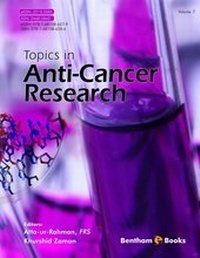
Topics in Anti-Cancer Research: Volume 7
1st Edition
Published on 30. November 2018
240 pages
978-1-68108-627-9 (ISBN)
Description

Topics in Anti-Cancer Research covers important advances on both experimental preclinical and clinical cancer research in drug development. The book series offers readers an insight into current and future therapeutic approaches for the prevention of d
All prices
More details
Other editions
Additional editions
Khurshid Zaman | Atta ur Rahman
Topics in Anti-Cancer Research - Volume 7
Book
11/2018
Bentham Science Publishers
€132.32
Shipment within 3-4 weeks
Content
- Cover
- Title
- Biblography
- End User License Agreement
- Contents
- Preface
- Introduction
- List of Contributors
- The Role of ncRNAs in Human Cancer and its Related Patents
- María I. Navarro-Mendoza1, Carlos Pérez-Arques1, Laura Murcia1, Alfonso F. López-Martínez2 and Francisco E. Nicolás1,*
- 1. INTRODUCTION
- 2. SMALL NCRNAS: MIRNAS, PIRNAS, TIRNAS, SNORNAS AND PARNAS
- 2.1. miRNAs
- 2.2. piRNAs
- 2.3. tiRNAs
- 2.4. snoRNAs
- 2.5. Small Promoter Associated RNAs
- 2.6. Other Small ncRNAs
- 3. LONG NCRNAS: LINCRNAS, T-UCRS, CERNAS AND OTHER LNCRNAS
- 3.1. LincRNAs
- 3.2. T-UCRs
- 3.3. CeRNAs
- 3.4. Other lncRNAs
- CURRENT & FUTURE DEVELOPMENTS
- CONSENT FOR PUBLICATION
- CONFLICT OF INTEREST
- ACKNOWLEDGEMENTS
- DISCLOSURE
- REFERENCES
- Taxol To Nanotaxol: A Journey Towards Enhanced Drug Delivery
- Tanvi Kaku1, Aiswarya Dash2 and Biswa P. Chatterji2,*
- 1. INTRODUCTION
- 1.1. Methods for Preparation of Paclitaxel Nanoparticles
- 1.1.1. CN1463969A
- 1.1.2. CN101829061A
- 1.2. Human Serum Albumin (HSA) Associated and Other Protein Associated and Functionalized Taxol® or Paclitaxel Nanoparticles as Drug Delivery Agents
- 1.2.1. US6506405B1
- 1.2.2. US8268348B2 and US20100112077A1
- 1.2.3. WO1994018954A1
- 1.2.4. US20040092577A1
- 1.2.5. US20090004118
- 1.2.6. US20090226393
- 1.2.7. US20100015051
- 1.2.8. US20100303723
- 1.2.9. WO2007034479
- 1.3. Micelles, Emulsions and Liposomes as Drug Delivery Carriers for Paclitaxel
- 1.3.1. US20150366806
- 1.3.2. WO2009070761
- 1.3.3. EP2494956 and EP2494957
- 1.3.4. WO1994007484
- 1.3.5. WO1996002247
- 1.3.6. CN102772368A
- 1.3.7. US5424073
- 1.3.8. KR101612194
- 1.3.9. US8663599B1
- 1.4. Carbon Nanoparticles as Drug Delivery Agents for Cancer Chemotherapy
- 1.4.1. EP3063091
- 1.4.2. US20090087493
- 1.4.3. KR20180016231
- 1.4.4. CN104998261
- 1.4.5. WO2014015334
- 1.5. Nanodevices for Paclitaxel Delivery to Cancer Cells
- 1.5.1. US20100215724
- 1.5.2. US20100303716
- DISCUSSION
- CURRENT & FUTURE DEVELOPMENTS
- CONSENT FOR PUBLICATION
- CONFLICT OF INTEREST
- ACKNOWLEDGEMENTS
- REFERENCES
- Advanced Therapy in Cancer: Stimuli-Responsive Nanocarriers for On-Demand Drug Delivery
- Azadeh Haeri*, Fatemeh Mehryab and Hamid R. Moghimi
- 1. INTRODUCTION
- 2. STIMULI-RESPONSIVE NANOCARRIERS
- 3. EXTERNAL STIMULI-RESPONSIVE DRUG DELIVERY
- 3.1. Temperature-Responsive Nanocarriers
- 3.2. Magnetic Field-Responsive Nanocarriers
- 3.3. Photo-Responsive Nanocarriers
- 3.4. Ultrasound-Responsive Nanocarriers
- 4. INTERNAL STIMULI-RESPONSIVE DRUG DELIVERY
- 4.1. pH-Responsive Nanocarriers
- 4.2. Enzyme-Responsive Nanocarriers
- 4.3. Redox-Responsive Nanocarriers
- 5. OTHER STIMULI-RESPONSIVE NANOCARRIERS
- CONCLUSION
- CURRENT & FUTURE DEVELOPMENTS
- CONSENT FOR PUBLICATION
- CONFLICT OF INTEREST
- ACKNOWLEDGEMENTS
- REFERENCES
- The Regulation and the Function of Autophagy in the Development and Behavior of Esophageal Cancers
- Erdem Ayik* and Gulsum O. Elpek
- 1. INTRODUCTION
- 2. GENERAL ASPECTS OF AUTOPHAGY
- 3. AUTOPHAGY IN CANCER
- 3.1. AP in Malignant Transformation
- 3.2. AP in Cancer Behavior and Treatment
- 4. AUTOPHAGY IN ESOPHAGEAL CANCER
- 4.1. Autophagy in the Development of EAC
- 4.2. Autophagy in the Development of ESCC
- 4.3. Autophagy in EAC Behavior and Treatment
- 4.3.1. AP-Related Findings on Tumor Behavior and Progression in Patients with EAC
- 4.3.2. In Vitro Investigation of AP in EAC
- 4.4. Autophagy in ESCC Behavior and Treatment
- 4.4.1. AP-Related Findings in Tumor Behavior and Progression in Patients with ESCC
- 4.4.2. In Vitro Investigation of AP in ESCC
- CONCLUSION
- CURRENT & FUTURE DEVELOPMENTS
- CONSENT FOR PUBLICATION
- CONFLICT OF INTEREST
- ACKNOWLEDGEMENTS
- LIST OF ABBREVIATIONS
- REFERENCES
- Recent Patents on Smart Nano-Formulations for Cancer Therapy
- Shaheen Sultana*, Mohammad Yusuf and Maria Khan
- 1. INTRODUCTION
- 1.1. Polymer-Based Nano-Formulations
- 1.1.1. Polymeric Nanoparticles
- 1.1.2. Hydrogels
- 1.1.3. Dendrimers
- 1.1.4. Micelles
- 1.2. Virus-Based Nanoparticles
- 1.3. Carbon Nanotubes
- 1.4. Lipid-Based Nano-Formulation
- 1.4.1. Liposomes
- 1.4.2. Solid Lipid Nanoparticles
- 1.5. Metal-Based Nanoparticles
- 1.5.1. Gold Nanoparticles (AuNPs)
- 1.5.2. Magnetic Nanoparticles (MNPs)
- CONCLUSION
- CURRENT & FUTURE DEVELOPMENTS
- CONSENT FOR PUBLICATION
- CONFLICT OF INTEREST
- ACKNOWLEDGEMENTS
- REFERENCES
- Potential Inflammatory Mechanisms Underlying Chemotherapy-Induced Peripheral Neuropathy and Skeletal Muscle Effects
- Claire E. Feather1,2,4, John B. Kwok4,5, Gila Moalem-Taylor3,4 and Patsie Polly1,2,4,*
- 1. INTRODUCTION
- 1.1. Chemotherapy, Neuropathic Pain and Skeletal Muscle Effects
- 1.2. Clinical Insights
- 2. AN OVERVIEW OF CHEMOTHERAPY-INDUCED NEUROMUSCULAR EFFECTS
- 2.1. Chemotherapy-Induced Peripheral Neuropathy (CIPN)
- 2.1.1. Animal Models
- 2.2. Effects of Chemotherapy on Muscle
- 2.2.1. Animal Models
- 3. CHEMOTHERAPY AND INFLAMMATION
- 3.1. Cytokines
- 3.2. Reactive Oxygen Species
- 4. INFLAMMATION-ASSOCIATED MOLECULAR PATHWAYS OF INTEREST
- 4.1. Upstream Inflammatory Signaling Pathways
- 4.2. Endoplasmic Reticulum Stress
- 4.3. Paclitaxel-Specific Molecular Alterations
- 5. GENETIC SUSCEPTIBILITY TO CHEMOTHERAPY-INDUCED NEUROMUSCULAR EFFECTS
- 6. CANCER-INDUCED AND CHEMOTHERAPY-INDUCED EFFECTS
- 7. RECENT DEVELOPMENTS IN THE TARGETING OF CHEMOTHERAPY-INDUCED NEUROMUSCULAR EFFECTS
- CONCLUSION
- CURRENT & FUTURE DEVELOPMENTS
- CONFLICT OF INTEREST
- ACKNOWLEDGEMENTS
- REFERENCES
- Recent Advances in Nutrigenomics: Patent Applications
- Elvan Y. Akyuza, Ozlem Aytekina, Banu Bayrama and Yusuf Tutara,b,*
- 1. INTRODUCTION
- 1.1. Nutrigenomics and its Relation to Cancer
- 1.2. Nutrition, Epigenetics, and Genome Stability
- 1.3. Diet and Cancer Prevention
- 1.4. Composition and Method to Optimize and Customize Nutritional Supplement Formulations by Measuring Genetic and Metabolomic Contributing Factors to Disease Diagnosis, Stratification, Prognosis, Metabolism, and Therapeutic Outcomes - US20060062859
- 1.5. Nutraceutical Compositions and Methods with Biologically Active Ingredients -US20080317734
- 1.6. Diagnostic System for Selecting Nutrition and Pharmacological Products for Animals - US7873482
- 1.7. System and Method for Evaluating and Providing Nutrigenomic Data, Information and Advice - US7877273
- 1.8. Multi-Stage Nutrigenomic Diagnostic Food Sensitivity Testing in Animals - US8450072
- 1.9. Predictive Markers for Cancer and Metabolic Syndrome - US2013045535
- 1.10. Novel Compositions from Nigella Sativa - US20150004266
- 1.11. Method of Dietary Treatment for Genetic and Epigenetic Diseases and Disorders - US20170056357
- 1.12. Bioenergetics Profiling of Circulating Blood Cells and Systems, Devices, and Methods Relating Thereto - US2015024795
- CONCLUSION
- CURRENT & FUTURE DEVELOPMENTS
- CONSENT FOR PUBLICATION
- CONFLICT OF INTEREST
- ACKNOWLEDGEMENTS
- REFERENCES
- Author Index
- Subject Index
- Back Cover
