

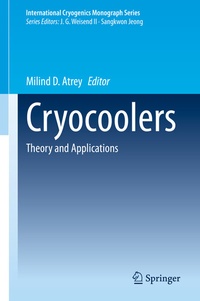
Cryocoolers
Description

This book serves as an introduction to cryocooler technology and describes the principle applications of cryocoolers across a broad range of fields. It covers the specific requirements of these applications, and describes how the advantages and disadvantages of different cryocooler systems are taken into consideration. For example, Stirling coolers tend to be used only in space applications because of their high coefficient of performance, low weight and proven reliability, whilst Gifford-McMahon coolers are used for ground applications, such as in cryopumps and MRI shield cooling applications. Joule-Thomson cryocoolers are used in missile technology because of the fast cool down requirements. The cryocooler field is fast developing and the number of applications are growing because of the increasing costs of the cryogens such as Helium and Neon.
The first chapter of the book introduces the different types of cryocoolers, their classification, working principles, and their design aspects, and briefly mentions some of the applications of these systems. This introductory chapter is followed by a number of contributions from prominent international researchers, each describing a specific field of application, the cooling requirements and the cryocooler systems employed. These areas of application include gas liquefaction, space technology, medical science, dilution refrigerators, missile systems, and physics research including particle accelerators. Each chapter describes the cooling requirements based on the end use, the approximate cooling load calculations, the criteria for cryocooler selection, the arrangement for cryocooler placement, the connection of the cooler to the object to be cooled, and includes genuine case studies.
Intended primarily for researchers working on cryocoolers, the book will also serve as an introduction to cryocooler technology for students, and a useful reference for those using cryocooler systems in any area of application.
More details
Other editions
Additional editions
Person
Professor Milind Atrey is currently Dean (Research and Development) and Chair Professor at IIT Bombay, India. A Mechanical Engineering graduate of VNIT Nagpur, he obtained his Doctorate from IIT Bombay in 1991. He works in the area of refrigeration and cryogenic engineering in the Department of Mechanical Engineering, IIT Bombay.
Prof. Atrey's experience in the area of cryogenic engineering is a unique blend of corporate research, work in government research laboratories and academia. Following a brief stint with the Tata Research Design and Development Centre, Pune, after completing his doctorate, he worked on the 3 stage Stirling Cryocooler and 4K G-M Coolers for his post-doctoral research at the University of Giessen, Germany. Subsequently, he worked at the Raja Ramanna Centre for Advanced Technology (RRCAT, Department of Atomic Energy, Govt of India) for 5 years on a project aimed at the indigenization of a cryogenic technology. Prof. Atrey returned to corporate research once again, joining the Technical Development group at Oxford Instruments Superconductivity, Oxford, UK. His body of work included NMR/MRI cryogenic technology, cold probe technology for NMR and the development of 4K Pulse Tube Cryocoolers. The cold probe technology developed by his group proved to be path-breaking for NMR researchers while the group could demonstrate, for the first time in the world, a Helium recondensing technology on an NMR superconducting magnet. At IIT Bombay, Prof. Atrey has developed various Pulse Tube Cryocoolers, Mixed-Refrigerant Joule Thomson cryocoolers, thermoacoustic coolers etc. His recent research includes cryogenic two phase flow, pulsating heat pipe, heat exchangers, cryosurgery etc.
