

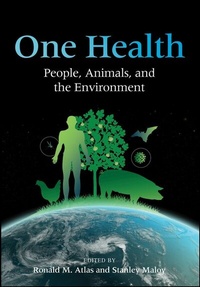
One Health
Description

Emerging infectious diseases are often due to environmental disruption, which exposes microbes to a different niche that selects for new virulence traits and facilitates transmission between animals and humans. Thus, health of humans also depends upon health of animals and the environment - a concept called One Health. This book presents core concepts, compelling evidence, successful applications, and remaining challenges of One Health approaches to thwarting the threat of emerging infectious disease.
Written by scientists working in the field, this book will provide a series of "stories" about how disruption of the environment and transmission from animal hosts is responsible for emerging human and animal diseases.
- Explains the concept of One Health and the history of the One Health paradigm shift.
- Traces the emergence of devastating new diseases in both animals and humans.
- Presents case histories of notable, new zoonoses, including West Nile virus, hantavirus, Lyme disease, SARS, and salmonella.
- Links several epidemic zoonoses with the environmental factors that promote them.
- Offers insight into the mechanisms of microbial evolution toward pathogenicity.
- Discusses the many causes behind the emergence of antibiotic resistance.
- Presents new technologies and approaches for public health disease surveillance.
- Offers political and bureaucratic strategies for promoting the global acceptance of One Health.
More details
Other editions
Additional editions
Content
Contributors
Preface
One Health: What Is It and Why Is It Important?
1. Combating the Triple Threat: The Need for a One Health Approach
2. The Value of the One Health Approach: Shifting from Emergency Response to Prevention of Zoonotic Disease Threats at Their Source
3. The Human-Animal Interface
4. Ecological Approaches to Studying Zoonoses
5. Emerging Infectious Diseases of Wildlife and Species Conservation
Zoonotic and Environmental Drivers of Emerging Infectious Diseases
6. RNA Viruses: A Case Study of the Biology of Emerging Infectious Diseases
7. Factors Impacting the Control of Rabies
8. Emergence of Influenza Viruses and Crossing the Species Barrier
9. One Health and Food-Borne Disease: Salmonella Transmission between Humans, Animals, and Plants
10. Cholera: Environmental Reservoirs and Impact on Disease Transmission
11. White-Nose Syndrome: Human Activity in the Emergence of an Extirpating Mycosis One Health and Antibiotic Resistance
12. Antibiotic Resistance in and from Nature
Disease Surveillance
13. Public Health Disease Surveillance Networks
14. Web-Based Surveillance Systems for Human, Animal, and Plant Diseases
15. Genomic and Metagenomic Approaches for Predicting Pathogen Evolution
16. Surveillance of Wildlife Diseases: Lessons from the West Nile Virus Outbreak Making One Health a Reality
17. Defining the Future of One Health
18. Making One Health a Reality-Crossing Bureaucratic Boundaries
19. One Health: Lessons Learned from East Africa
20. The Future of One Health
Index
CONTRIBUTORS
Kyle Adair Centre for Immunity, Infection & Evolution, and Ashworth Laboratories, University of Edinburgh, Edinburgh EH9 3JT, United Kingdom
Salvador Almagro-Moreno Department of Microbiology and Immunology, Geisel School of Medicine at Dartmouth, Hanover, NH 03755
Ronald M. Atlas Department of Biology, University of Louisville, Louisville, KY 40292-0001
Hazel A. Barton Department of Biology, University of Akron, Akron, OH 44325-3809
Liam Brierley Centre for Immunity, Infection & Evolution, and Ashworth Laboratories, University of Edinburgh, Edinburgh EH9 3JT, United Kingdom
Edmundo Calva Departamento de Microbiología Molecular, Instituto de Biotecnología, Universidad Nacional Autónoma de México, Cuernavaca, Morelos 62210, Mexico
Veronica Casas Center for Microbial Sciences, San Diego State University, San Diego, CA 92182
David W. Chapman Department of Organizational Leadership, Policy, and Development, University of Minnesota-Twin Cities, Minneapolis, MN 55455
Edward E. Clark Wildlife Center of Virginia, Waynesboro, VA 22980
Peter Daszak EcoHealth Alliance, New York, NY 10001
Julian Davies Department of Microbiology and Immunology, Life Science Centre, University of British Columbia, Vancouver, BC V6T 1Z3, Canada
John Deen Department of Veterinary Population Medicine, University of Minnesota College of Veterinary Medicine, St. Paul, MN 55108
Matthew Dixon The Centre on Global Health Security, Chatham House, The Royal Institute of International Affairs, London SW1Y 4LE, United Kingdom
Bernadette Dunham Center for Veterinary Medicine, U.S. Food and Drug Administration, Rockville, MD 20855
Julie C. Ellis Tufts University, Cummings School of Veterinary Medicine, North Grafton, MA 01536
Macdonald W. Farnham Department of Veterinary Population Medicine, University of Minnesota College of Veterinary Medicine, St. Paul, MN 55108
John R. Fischer Southeastern Cooperative Wildlife Disease Study, College of Veterinary Medicine, University of Georgia, Athens, GA 30602
Richard French University of New Hampshire, New Hampshire Veterinary Diagnostic Laboratory, Durham, NH 03824
Carolyn Garcia School of Nursing, University of Minnesota-Twin Cities, Minneapolis, MN 55455
Colin M. Gillin Wildlife Health and Population Lab, Oregon Department of Fish and Wildlife, Corvallis, OR 97330
Duncan Hannant Department of Applied Immunology, School of Veterinary Medicine and Science, University of Nottingham Sutton Bonington Campus, Nottingham LE12 5RD, United Kingdom
David L. Heymann The Centre on Global Health Security, Chatham House, The Royal Institute of International Affairs, London SW1Y 4LE, United Kingdom, and Department of Infectious Disease Epidemiology, London School of Hygiene and Tropical Medicine, London WC1E 7HT, United Kingdom
Megan K. Hines Wildlife Data Integration Network, Department of Surgical Sciences, University of Wisconsin School of Veterinary Medicine, Madison, WI 53706
Parviez R. Hosseini EcoHealth Alliance, New York, NY 10001
William D. Hueston Department of Veterinary Population Medicine, University of Minnesota College of Veterinary Medicine, St. Paul, MN 55108
Martyn Jeggo Geelong Centre for Emerging Infectious Diseases, Deakin University, Waurn Ponds Campus, Geelong, Victoria VIC 3220, Australia
Jeremy C. Jones Department of Infectious Diseases, Division of Virology, St. Jude Children's Research Hospital, Memphis, TN 38105
William B. Karesh EcoHealth Alliance, New York, NY 10001
Lonnie J. King College of Veterinary Medicine, Ohio State University, Columbus, OH 43210
Zeynep A. Koçer Department of Infectious Diseases, Division of Virology, St. Jude Children's Research Hospital, Memphis, TN 38105
Richard Kock Department of Pathology & Infectious Diseases, The Royal Veterinary College, North Mymms, Hatfield, Hertfordshire AL9 7TA, United Kingdom
Meggan E. Kraft Department of Veterinary Population Medicine, University of Minnesota College of Veterinary Medicine, St. Paul, MN 55108
Annie Li City University of Hong Kong, Department of Biology and Chemistry, Kowloon Tong, Kowloon, Hong Kong
Elizabeth H. Loh EcoHealth Alliance, New York, NY 10001
John S. Mackenzie Curtin University, Perth, Western Australia WA 6012, Australia, and Burnet Institute, Melbourne, Victoria VIC 3004, Australia
Lawrence C. Madoff ProMED-mail, University of Massachusetts Medical School, Massachusetts Department of Public Health, Jamaica Plain, MA 02130
Michael Mahero Department of Veterinary Population Medicine, University of Minnesota College of Veterinary Medicine, St. Paul, MN 55108
Stanley Maloy Center for Microbial Sciences, San Diego State University, San Diego, CA 92182-1010
Cris Marsh Wildlife Data Integration Network, Department of Surgical Sciences, University of Wisconsin School of Veterinary Medicine, Madison, WI 53706
Patrick P. Martin New York State Department of Environmental Conservation Wildlife Health Unit, Albany, NY 12233-4752
Robert G. McLean Division of Biology, Kansas State University, Manhattan, KS 66506
Tracey S. McNamara Western University of Health Sciences, Pomona, CA 91766
Dave McRuer Wildlife Center of Virginia, Waynesboro, VA 22980
G. Medina-Vogel Facultad de Ecología y Recursos Naturales, Universidad Andrés Bello, República 440, Santiago, Chile
Stephen S. Morse Department of Epidemiology, Mailman School of Public Health, Columbia University, New York, NY 10032
Lawrence Mugisha Department of Wildlife and Resource Management, Makerere University College of Veterinary Medicine, Animal Resources and Biosecurity, Kampala, Uganda
Kris A. Murray EcoHealth Alliance, New York, NY 10001
Louis H. Nel Department of Microbiology and Plant Pathology, Faculty of Natural and Agricultural Sciences, University of Pretoria, Pretoria, 0001, South Africa
Felicia B. Nutter Department of Biomedical Sciences, Cummings School of Veterinary Medicine, Tufts University, North Grafton, MA 01536
Serge Nzietchueng Department of Veterinary Population Medicine, University of Minnesota College of Veterinary Medicine, St. Paul, MN 55108
Debra Olson School of Public Health, University of Minnesota-Twin Cities, Minneapolis, MN 55455
Albert D. M. E. Osterhaus Department of Viroscience, Erasmus Medical Centre, 3000 CA Rotterdam, The Netherlands, and Artemis Research Institute for Wildlife Health in Europe, 3584 CK Utrecht, The Netherlands
Amy Pekol Department of Organizational Leadership, Policy, and Development, University of Minnesota-Twin Cities, Minneapolis, MN 55455
Katharine M. Pelican Department of Veterinary Population Medicine, University of Minnesota College of Veterinary Medicine, St. Paul, MN 55108
Leslie A. Reperant Department of Viroscience, Erasmus Medical Centre, 3000 CA Rotterdam, The Netherlands
Hannah T. Reynolds Department of Biology, University of Akron, Akron, OH 44325-3809
Cheryl Robertson School of Nursing, University of Minnesota-Twin Cities, Minneapolis, MN 55455
Melinda K. Rostal EcoHealth Alliance, New York, NY 10001
Carol Rubin ...
