

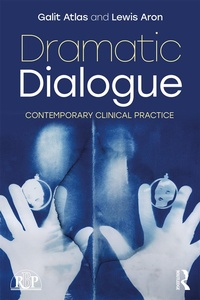
Dramatic Dialogue
Contemporary Clinical Practice
Published on 22. November 2017
194 pages
978-1-351-36859-9 (ISBN)
Description

In Dramatic Dialogue, Atlas and Aron develop the metaphors of drama and theatre to introduce a new way of thinking about therapeutic action and therapeutic traction. This model invites the patient's many self-states and the numerous versions of the therapist's self onto the analytic stage to dream a mutual dream and live together the past and the future, as they appear in the present moment. The book brings together the relational emphasis on multiple self-states and enactment with the Bionian conceptions of reverie and dreaming-up the patient.
The term Dramatic Dialogue originated in Ferenczi's clinical innovations and refers to the patient and therapist dramatizing and dreaming-up the full range of their multiple selves. Along with Atlas and Aron, readers will become immersed in a Dramatic Dialogue, which the authors elaborate and enact, using the contemporary language of multiple self-states, waking dreaming, dissociation, generative enactment, and the prospective function.
The book provides a rich description of contemporary clinical practice, illustrated with numerous clinical tales and detailed examination of clinical moments. Inspired by Bion's concept of "becoming-at-one" and "at-one-ment," the authors call for a return of the soul or spirit to psychoanalysis and the generative use of the analyst's subjectivity, including a passionate use of mind, body and soul in the pursuit of psychoanalytic truth. Dramatic Dialogue will be of great interest to all psychoanalysts and psychotherapists.
The term Dramatic Dialogue originated in Ferenczi's clinical innovations and refers to the patient and therapist dramatizing and dreaming-up the full range of their multiple selves. Along with Atlas and Aron, readers will become immersed in a Dramatic Dialogue, which the authors elaborate and enact, using the contemporary language of multiple self-states, waking dreaming, dissociation, generative enactment, and the prospective function.
The book provides a rich description of contemporary clinical practice, illustrated with numerous clinical tales and detailed examination of clinical moments. Inspired by Bion's concept of "becoming-at-one" and "at-one-ment," the authors call for a return of the soul or spirit to psychoanalysis and the generative use of the analyst's subjectivity, including a passionate use of mind, body and soul in the pursuit of psychoanalytic truth. Dramatic Dialogue will be of great interest to all psychoanalysts and psychotherapists.
Reviews / Votes
'In this brilliant book, Atlas and Aron have done nothing less than shift the ground under our feet. In one fell swoop, the commodious metaphor of "dramatic dialogue," adopted from Ferenczi and then turned to wider use, makes it possible for the authors to see and describe commonalities among clinical and intellectual contributions that have often been considered incommensurable. In illuminating a whole new approach to the problem of psychoanalytic pluralism, and in a lucid, clinically rich text that covers an enormous range of ideas, Atlas and Aron are opening ?a door to the psychoanalysis of the future.'-Donnel Stern, Ph.D., Training and Supervising Analyst, William Alanson White Institute, Clinical Consultant and Faculty, NYU Postdoctoral Program in Psychotherapy and Psychoanalysis.'Immensely compelling and clinically useful, Dramatic Dialogue beautifully demonstrates the necessary integration of the enacted relationship and its symbolic contents. Brilliantly argued, this book is both an exciting revision of psychoanalysis and a renewal of its foundations as a practice of desire: one in which revelations of the past are nothing less than harbingers of transformation, in which we find the interactive dimension of shared feeling to be a continual wellspring of healing.'-Jessica Benjamin, author of Beyond Doer and Done To.
More details
Series
Language
English
Place of publication
London
United Kingdom
Publishing group
Taylor & Francis Ltd
Target group
Professional and scholarly
Product notice
Reflowable
File size
0,37 MB
ISBN-13
978-1-351-36859-9 (9781351368599)
Copyright in bibliographic data and cover images is held by Nielsen Book Services Limited or by the publishers or by their respective licensors: all rights reserved.
Schweitzer Classification
Other editions
Additional editions

Book
12/2017
Routledge
Unfortunately, price unknown
Available (delivery time upon request)
Book
11/2017
1st Edition
Routledge
€185.70
Shipment within 10-20 days
Book
11/2017
1st Edition
Routledge
€65.00
Shipment within 10-20 days
Persons
Galit Atlas, Ph.D., is on the faculty of the New York University Postdoctoral Program in Psychotherapy and Psychoanalysis, and at the Four-Year Adult and National Training Programs at the National Institute for the Psychotherapies. She is the author of The Enigma of Desire: Sex, Longing and Belonging in Psychoanalysis (Routledge, 2015). Her New York Times article "A Tale of Two Twins" was the winner of 2016 Gradiva award.
Lewis Aron, Ph.D., is the director of the New York University Postdoctoral Program in Psychotherapy and Psychoanalysis. He is the author and editor of numerous articles and books on psychotherapy and psychoanalysis, including A Meeting of Minds, and co-editor of the Relational Perspectives Book Series. He is well known for his study and reading groups around the world.
Lewis Aron, Ph.D., is the director of the New York University Postdoctoral Program in Psychotherapy and Psychoanalysis. He is the author and editor of numerous articles and books on psychotherapy and psychoanalysis, including A Meeting of Minds, and co-editor of the Relational Perspectives Book Series. He is well known for his study and reading groups around the world.
Content
Chapter 1: Generative Enactments Chapter 2: The Prospective Function Chapter 3: Dramatic Dialogues Chapter 4: Therapeutic Action and Therapeutic Traction Chapter 5: The Truth of the Session Chapter 6: Theatrical Engagement Chapter 7: At-one-ment, Mutual Vulnerability, and Co-Suffering Chapter 8: The Prequel
