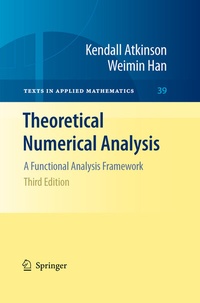
Theoretical Numerical Analysis
Description

This textbook prepares graduate students for research in numerical analysis/computational mathematics by giving to them a mathematical framework embedded in functional analysis and focused on numerical analysis. This helps the student to move rapidly into a research program. The text covers basic results of functional analysis, approximation theory, Fourier analysis and wavelets, iteration methods for nonlinear equations, finite difference methods, Sobolev spaces and weak formulations of boundary value problems, finite element methods, elliptic variational inequalities and their numerical solution, numerical methods for solving integral equations of the second kind, and boundary integral equations for planar regions. The presentation of each topic is meant to be an introduction with certain degree of depth. Comprehensive references on a particular topic are listed at the end of each chapter for further reading and study.
Because of the relevance in solving real world problems, multivariable polynomials are playing an ever more important role in research and applications. In this third editon, a new chapter on this topic has been included and some major changes are made on two chapters from the previous edition. In addition, there are numerous minor changes throughout the entire text and new exercises are added.
Review of earlier edition:
"...the book is clearly written, quite pleasant to read, and contains a lot of important material; and the authors have done an excellent job at balancing theoretical developments, interesting examples and exercises, numerical experiments, and bibliographical references."
R. Glowinski, SIAM Review, 2003
Reviews / Votes
From the reviews of the third edition:
"Overall, the book is clearly written, quite pleasant to read, and contains a lot of important material; and the authors have done an excellent job at balancing theoretical developments, interesting examples and exercises, numerical experiments, and bibliographical references." (SIAM)
"This is the third edition, based on a graduate course taught by the authors at the University of Iowa for many years. . There are tons and tons of well chosen explicit examples. . it can be used for reading courses in functional analysis for strong senior undergraduates that aren't quite ready for a graduate analysis course, and it can be used as a reference for analysts of all stripes. I got a lot from reading it and so will you." (Andrew Locascio, The Mathematical Association of America, October, 2010)
More details
Other editions
Additional editions
Previous edition