

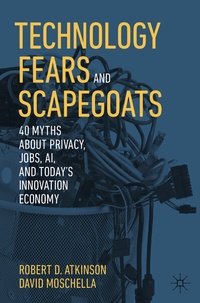
Technology Fears and Scapegoats
Description

Technologies and tech companies are routinely accused of creating many societal problems. This book exposes these charges as mostly myths, falsehoods, and exaggerations.
Technology Fears and Scapegoats debunks 40 widespread myths about Big Tech, Big Data, AI, privacy, trust, polarization, automation, and similar fears, while exposing the scapegoating behind these complaints. The result is a balanced and positive view of the societal impact of technology thus far.
The book takes readers through the steps and mindset necessary to restore the West's belief in technological progress. Each individual chapter provides a cogent and often controversial rebuttal to a common tech accusation. The resulting text will inspire conversations among tech insiders, policymakers, and the general public alike.
Reviews / Votes
"To build a better future, we have to believe in a better future. This means reversing today's anti-tech mindset and restoring America's faith in scientific advancement. This book does both." (Marc Andreessen, Founder of Netscape and Cofounder of Andreessen-Horowitz)
"Atkinson and Moschella deliver a much-needed reminder that technology, data and innovation can be critical ingredients for solving society's biggest problems - from accelerating a clean energy revolution, delivering a more equitable healthcare system, to a more open and dynamic economy that rewards entrepreneurship." (Aneesh Chopra, President of CareJourney, former US Chief Technology Officer, and author of Innovative State )
"Debates over AI and digital media swing between utopian (technology will cure everything!) and dystopian (too many uncontrollable harms!). Luckily, this insightful new book helps experts and the public alike find the research-based middleground beyond the hype at both extremes: how to embrace the opportunities while reducing the hazards . " (Rosabeth Moss Kanter, Ernest L. Arbuckle Professor of Business Administration at Harvard Business School and author of Think Outside the Building )
"This is an excellent collection of essays on U.S. technology actions, policies, and proposals. I strongly endorse this book. It is ideal for wide audiences, and I believe universities and high schools will greatly benefit from the chapters included." (Albert N. Link, Virginia Batte Phillips Distinguished Professor of Economics at University of North Carolina at Greensboro, Series Editor of Palgrave Advances in the Economics of Innovation and Technology, and coauthor of Innovative Activity in Minority-Owned and Women-Owned Business )
"It's odd that we need a book defending technology and debunking today's many myths. Odd because so much good comes from advances in science and technology. But there are so many complaints about tech these days that debunk we must, and Rob and David do it very well." (Bob Metcalfe, inventor of Ethernet and Winner of the 2022 Turing Award)
"Technological progress is our best hope for a future of peace and prosperity, especially in changing the trajectory of climate change. Fortunately, there are a wide array of technologies that can help people achieve those hopes. Unfortunately, there are also a large number of myths that diminish public support for those technologies. Atkinson and Moschella take these myths head on. Technology Fears and Scapegoats is a profound antidote to pessimism about the future and opens the door to a brighter day." (Peter Schwartz, Chief Future Officer at Salesforce and author of The Art of the Long View )
"Atkinson and Moschella have written an important book on something that should matter to every American: success and innovation in our tech industry. They tackle hard questions head on and provide deep insight." (Dan Scheinman, technology executive, investor, and advisor)
"Throughout history, emerging technologies have been blamed for societal ills. Recently, we've seen the shift from Techlash around social media to hysteria over 'human extinction from AI.' Making sweeping negative generalizations based on inconclusive evidence is easy. Adding scary media narratives on top of it is even easier. The hard task is debunking them. Technology Fears and Scapegoats does an excellent job of battling well-known misconceptions. It's, therefore, a must-read for policymakers." (Nirit Weiss-Blatt, author of The Techlash and Tech Crisis Communication )
More details
Other editions
Additional editions
Persons
Robert D. Atkinson is the founder and president of the Information Technology and Innovation Foundation (ITIF), the science and technology policy think tank. His previous books include Big is Beautiful (The MIT Press, 2018), Innovation Economics (Yale, 2012), Supply-Side Follies (Rowman Littlefield, 2007), and The Past and Future of America's Economy (Edward Elgar, 2005).
David Moschella is a nonresident senior fellow at ITIF, in charge of its "Defending Digital" project. For more than a decade, Moschella was Head of Worldwide Research for IDC. His previous books include Seeing Digital (DXC Technology, 2018), Customer-Driven IT (Harvard Business School Press, 2003), and Waves of Power (AMACOM, 1997). He has lectured and consulted on technology trends and strategies in more than 30 countries.
Content
- Introduction. The roots and risks of today's techno-mythologies.- 1. Technology is changing the world as never before.- 2. Technology is destroying individual privacy.- 3. Social media is polarizing America.- 4. Technology is driving today's societal distrust.- 5. AI's arrival is an atomic bomb moment.- 6. Social media is the leading source of misinformation.- 7. Your data is gold.- 8. Digital technology is dangerously "addictive".- 9. The internet is extinguishing local languages.- 10. Social media is an existential threat to democracy.- 11. The pace of technology change is accelerating.- 12. Technology increases societal biases.- 13. Big Tech faces no competition.- 14. Silicon Valley doesn't value diversity.- 15. Facial recognition is inherently biased.- 16. Big Tech should be arbiters of "the truth".- 17. Digital technology is increasingly disruptive.- 18. Strong privacy regulations spur digital adoption.- 19. Big Tech practices "data imperialism" in emerging markets.- 20. BigData systems can't protect individual privacy.- 21. Data is the new oil.- 22. Productivity gains no longer benefit U.S. workers.- 23. Corporate profits are at an all-time high.- 24. Technology is wiping out the middle class.- 25. AI will lead to the end of work.- 26. Digital copying is victimless.- 27. U.S. broadband lags behind other developed nations.- 28. The internet is destroying journalism.- 29. Market concentration is at an all-time high.- 30. Big Pharma is driving high health care costs.- 31. Small businesses create most new Jobs and innovations.- 32. We have all the technology we need to fight climate change.- 33. China has invented a new form of capitalism.- 34. American manufacturing is roaring back.- 35. India will save the west from China.- 36. The EU's digital rules are a model for the world.- 37. Antitrust actions are needed to curb Big Tech.- 38. Federal R&D crowds out private R&D.- 39. Industrial policy is not the American way.- 40. Industrial policy doesn't work.- Conclusion. Returning to a pro-innovation American agenda.
