

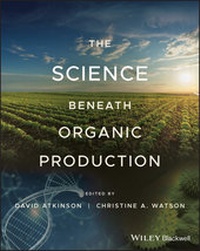
The Science Beneath Organic Production
Description

With contributions from noted experts in the field, Organic Agriculture explores the cultural context of food production and examines the historical aspects, economic implications, and key scientific elements that underpin organic crop production. The book shows how a science-based approach to organic farming is grounded in history and elements of the social sciences as well as the more traditional areas of physics, chemistry and biology.
Organic Agriculture offers a detailed explanation of the differences between organic systems and other approaches, answering questions about crop production and protection, crop rotations, soil health, biodiversity and the use of genetic resources. The authors identify current gaps in our understanding of the topic and discuss how organic farming research may be better accomplished in the future. This important book:
* Explores the science that underpins organic farming
* Contains illustrative case studies from around the world
* Examines organic agriculture's philosophical roots and its socio-economic context
Written for scientists and students of agriculture and horticulture, this book covers the issues linked to the use of science by organic producers and identifies key elements in the production of food.
More details
Other editions
Additional editions

Persons
ABOUT THE EDITORS
DAVID ATKINSON was formerly Vice Principal at the Scottish Agricultural College and Chair of Falkland Rural Enterprises, an organic farming company. He continues to study the ethical implications of emerging biotechnologies.
CHRISTINE A. WATSON leads soil science research at SRUC. She has extensive experience of research in organic farming and is involved in managing and teaching SRUC's postgraduate course in Organic Farming.
Content
List of Contributors xi
Preface xiii
1 Science and Organic Agriculture: An Introduction 1 David Atkinson and Christine A. Watson
1.1 What is the Role of this Volume? 1
1.2 What is Organic Agriculture? 2
1.3 So What is Distinctive About its Science Base? 5
1.4 The Ecological Roots of Organic Production 6
1.5 Key Elements in the Science Context of Organic Agriculture 8
1.6 Some Areas of Different Science 10
1.7 Production Systems Compared 13
1.8 A Science Base for All Production 15
1.9 The Changing Context of Farming 18
References 21
2 Science, Research and Organic Farming 25 Lawrence Woodward
2.1 Introduction 25
2.2 The Roots of the Approach 25
2.2.1 Is it a philosophical or political movement and cannot therefore be scientific? 26
2.2.2 Does it lack coherence except as a marketing exercise? 27
2.2.3 Is it inherently unscientific because it is based on concepts that are not explicable in rational scientific terms? 28
2.3 Agricultural Science: Some Reflections 30
2.4 Conclusion 32
References 32
3 Framing and Farming: Putting Organics in a Societal Context 33 Pete Ritchie
3.1 Introduction 33
3.2 The Origin of Organics 34
3.3 The Argument from Economics: Is More Better? 35
3.4 The Argument from the Environment: Externalities Matter 37
3.5 The Argument from Ethics: There's Something Wrong with the System 37
3.5.1 What is the Place of Humans in Nature? 38
3.5.2 What is Farming For, and What Makes for Good Farming? 40
3.5.3 How can the way we produce food promote social justice? 41
3.6 Aligning Organics with Social Justice 42
3.7 Conclusion 43
References 43
Further Reading 43
4 Soil Health and Its Management for Organic Farming 45 Elizabeth A. Stockdale, Tony C. Edwards and Christine A. Watson
4.1 Introduction 45
4.2 Soil Components 47
4.2.1 Soil Parent Material and Profile Formation 47
4.2.2 Soil Organic Matter 48
4.2.3 Soil Organisms 48
4.3 Key Soil Processes in Agricultural Systems 51
4.3.1 Decomposition 51
4.4 Soil Structure Formation and Stabilisation 53
4.5 Below-Ground Ecological Interactions 54
4.6 Nutrient Cycling and Management 56
4.6.1 Potassium (K) and Other Cations (Mg, Ca) 56
4.6.2 Nitrogen (N) 57
4.6.3 Phosphorus (P) 59
4.7 Impact of Agricultural Management Practices on Soil Function and Health 61
4.8 Cropping Systems 63
4.9 Intensive Grassland 65
4.10 Conclusion 66
References 68
5 Cropping Systems and Crop Choice 79 Robin L. Walker
5.1 Farming Systems 79
5.2 Land Capability and Cropping System Choice 81
5.2.1 Rainfall 81
5.2.2 Temperature 81
5.2.3 Altitude and Topography 82
5.2.4 Soil 83
5.2.5 Markets 83
5.2.6 Traditions 83
5.2.7 Government Policy 84
5.3 How Land Capability is Used in Practice 84
5.4 Conclusion 85
References 85
6 Crop Rotations: The Core of Organic Production 87 David Atkinson and Robin L. Walker
6.1 Introduction 87
6.2 The History of Crop Rotations 88
6.3 Rotations in Organic Production 91
6.4 The Ecological Science Base of Organic Production 94
6.5 Impact of Rotations on Soil Properties 95
6.5.1 Impact of Rotations on Soil Condition 95
6.5.2 Impact of Rotations on Nutrient Availability 98
6.5.3 Nitrogen Supply in Rotations 99
6.5.4 Phosphorus Supply in Rotations 100
6.6 Impact of Rotations on Crop Protection 103
6.7 Stockless Rotations 105
6.8 Conclusion 105
References 107
7 What Can Organic Farming Contribute to Biodiversity Restoration? 111 Ruth E. Feber, Paul J. Johnson and David W. Macdonald
7.1 Why Conserve Farmland Biodiversity? 111
7.2 What Can Organic Farming Contribute to Biodiversity Conservation? 116
7.3 Effects of Organic Farming Vary with Taxa 118
7.4 How Rapid is the Effect of Conversion to Organic on Biodiversity? 120
7.5 Landscape Context and Species Traits 121
7.6 Wider Considerations 123
Acknowledgements 126
References 126
8 Optimising Crop Production in Organic Systems 133 David Atkinson and Robin L. Walker
8.1 Introduction 133
8.2 Basic Issues 134
8.3 Light Interception: The Basis of All Production 136
8.3.1 Energy Capture 136
8.3.2 Canopy Duration 137
8.3.3 Stomatal Functioning 138
8.3.4 Crop Species 138
8.3.5 Crop Growth and Resource Partitioning 140
8.3.6 Soil-Related Factors 141
8.3.7 Consequences 142
8.4 What Current Issues Affect Choice of Crop Production System? 142
8.5 What Options Exist for Regulating Yields? 144
8.6 How Different are Conventional and Organic Yields? 145
8.7 The Environmental Impact of Organic Systems 147
8.8 Conclusion 148
References 148
9 Crop Production: Meeting the Nutrient Needs 151 David Atkinson and Robin L. Walker
9.1 Introduction 151
9.2 Getting Nutrients into Organic Crops 152
9.3 What is the Impact of Differences in Soil Nutrient Supply? 154
9.4 Organic Manures: Recycling of Nutrient Sources 155
9.5 Crop Rotations 157
9.6 Cover Crops 158
9.7 Legumes 158
9.8 Soil Microbial Populations and Inoculation 159
9.9 The Impact of Different Soil Nutrients 160
9.9.1 Nitrogen: How Much N Does a Crop Need? 160
9.9.2 Phosphorus 162
9.9.3 Potassium 163
9.9.4 Sulphur 164
9.10 Conclusion 164
References 165
10 Crop Attributes Facilitating the Use of Soil Resources 169 David Atkinson
10.1 Introduction 169
10.2 Nutrient Capture and Utilisation 171
10.2.1 Basic Issues 171
10.2.2 Nutrient Availability 172
10.3 The Functional Requirements of a Root System 172
10.3.1 Basic Issues 172
10.3.2 Relation of Root Activity to Soil Processes 172
10.3.3 The Impact of Root System Form 174
10.3.4 Variation Between Crop Species 175
10.3.5 Variation Within Crop Species 178
10.4 Case Studies 180
10.4.1 Case Study 1: Betula pendula 180
10.4.2 Case Study 2: Spring Barley 182
10.5 Root Dynamics and Carbon Inputs to the Soil 183
10.5.1 Root Dynamics 183
10.5.2 Root Longevity 184
10.6 Variation in Root Systems in Practice 185
10.6.1 Variation in Root Systems with Functional Significance 185
10.6.2 The Ability of the Crop Plant to Extract Nutrients from the Soil 188
10.7 Case Study 3: Apple 188
10.8 So How Much Root Does a Plant Need? 191
10.9 Conclusion 192
References 193
11 Mycorrhizal Activity, Resource and Microbial Cycles 199 David Atkinson
11.1 Introduction 199
11.2 Mycorrhizal Establishment 199
11.3 Mycorrhizal Effects 201
11.4 The AMF Association 202
11.5 Effects on Plant Nutrition: Basic Mechanisms 203
11.6 Impact on Crop Nutrition 204
11.7 The Impact of AMF on Soil Structure 204
11.8 Carbon Flows into the Soil 204
11.9 The Impact of AMF on Adaptation to the Soil Physical Environment 205
11.10 The Impact of AMF on Plant Pathogens 206
11.11 Impact of AMF on Roots 206
11.12 Arbuscular Mycorrhizal Fungi and the Management of Soils 209
11.13 Conclusions: AMF and Root Functioning 209
References 209
12 Crop Protection and Food Quality: Challenges and Answers 213 David Atkinson and Robin L. Walker
12.1 Introduction 213
12.2 Crop Protection Against Pests, Weeds and Diseases 214
12.3 Weed Control 215
12.4 Living with Crop Diseases 219
12.4.1 The Impact of AMF on Plant Pathogens 220
12.4.2 Plant Varietal-Based Resistance 222
12.5 Pest Control 224
12.6 The Quality of Organic Crops and Crop-Based Foods 226
12.6.1 Varietal Selection 227
12.6.2 The Production System 228
12.6.3 Inputs Used as Part of the Cultural System 228
12.6.4 Inherent Attributes 230
12.6.5 Microbial Content and Chemical Contamination 231
12.7 Conclusion 231
References 232
13 Plant Breeding and Genetics in Organic Agriculture 237 Thomas F. Döring and Martin S. Wolfe
13.1 Introduction 237
13.2 Plant Diversity in Agro-Ecosystems 238
13.2.1 Genetic Diversity 239
13.2.2 Species and Ecosystem Diversity 241
13.2.3 Effects of Crop Diversity: Types of Mechanisms 242
13.3 Crop Genetics in Complex and Dynamic Environments 244
13.3.1 The Organic Principle of Ecology 244
13.3.2 The Ecology of G × E Interactions 244
13.3.3 Implications of G × E Interactions for Testing Varieties for Organic Agriculture 245
13.3.4 Genetic Properties of Crops for Suitability in Organic Systems 248
13.3.5 Crop Genetics for Ecological Cropping Systems Design 249
13.3.6 Limitations of Crop Genetics and the Role of Plant Genetic Diversity 250
13.4 Crop Genetics for Health 250
13.4.1 The Organic Principle of Health 250
13.4.2 What is Health? 251
13.4.3 Connections Between Crop Genetics and Health 251
13.4.4 The Role of Plant Genetic Diversity for Health 256
13.5 Socioeconomics, Policies and Regulations 257
13.5.1 The Organic Principle of Fairness 257
13.5.2 Traditional Landraces and the Protection of Plant Genetic Resources 258
13.5.3 Sharing the Costs and Benefits of Plant Breeding 259
13.5.4 Hybrid Varieties in Organic Farming 259
13.6 Indeterminism and Crop Genetics 260
13.6.1 The Organic Principle of Care 260
13.6.2 Implications of the Care Principle for Crop Breeding 260
13.6.3 The Role of Plant Genetic Diversity for the Care Principle 261
13.7 Conclusion 261
References 262
14 Exploring the Systems Concept in Contemporary Organic Farming Research 273 Christine A. Watson and Bruce D. Pearce
14.1 Introduction 273
14.2 The Importance of the Systems Concept in Organic Farming 274
14.3 How are Systems Reflected in Regulation? 275
14.4 Applying the Systems Concept to Organic Production 275
14.5 How is the Systems Concept Reflected in Organic Farming Research? 277
14.5.1 Example 1. Comparison of Production Systems 280
14.5.2 Example 2. Food Quality and Its Relation to Production Systems 281
14.5.3 Example 3. Weed Control 282
14.5.4 Example 4. Plant Breeding 282
14.6 Cautionary Tales 283
14.7 Are the Research Needs of Organic Farming Different from Conventional Farming? 283
References 284
15 Science Base of Organic Agriculture: Some Conclusions 289 David Atkinson and Christine A. Watson
15.1 Introduction 289
15.2 Increasing the Contribution of Organic Agriculture to Global Food Production 291
15.3 Challenges to Organic Production 295
15.4 Conclusion 297
References 297
Index 299
Preface
There are many books dealing with organic farming so why another one? Agriculture is a major business in most countries of the world and a total global activity. Agricultural products are traded globally and so they need to be defined in relation to provenance, identity, composition and quality. This has resulted in many rules and regulations which influence what can be sold in what market and the prices of the various commodities. This all makes agriculture very political and means that the science base which informs how crops and farm animals are grown is shaped by issues beyond mere science. The ways in which crops are produced inevitably interact with all these political issues, leading to acrimony between those who produce in different ways.
While the production of any given crop can differ in a range of ways, much recent tension has arisen between those who farm in a way that allows their produce to carry an organic certified label and those who use a range of chemical inputs such as inorganic fertilisers and pesticides. The introduction of genetically modified crops increased the level of disagreement between producers in a debate which at times became an argument between what were being stereotyped as traditional farming and scientific farming. The former was characterised as being a relic of the past while the latter was seen as being more progressively logical and based on clear science. The advent of gene editing and the use of CRISPR/Cas9 and related technologies have reignited this debate.
Discussion around the place of these approaches commonly and rapidly moves to a consideration of the relative crop yields produced per unit area of land. The ability of the approaches to feed an expanding global population is then linked to such yields as if this were the sole criterion for something as economically and socially complex as world food production. In no other part of global endeavour is a simple interpretation of production the basis of how a major enterprise should be effected. Profitability and its social setting, part of social science, are always important issues. Food production involves much of the world's population and therefore it has many cultural links. Behind all of this lies an inherent suggestion that, unlike modern forms of agriculture, organic production is centred on folk lore and is a continuation of outdated methods. Agriculture is a major global source of greenhouse gases and so viewing different approaches to agriculture is important as part of current discussions about the amelioration of the impact of global climate change.
So is organic production scientific? In the sense that the question is most commonly asked, the answer is an unequivocal 'yes'. When the debate over food production methods in the UK reignited at the end of World War II, the organic movement was at pains to point out the distinguished scientific qualifications of its pioneers like Sir Albert Howard and Sir Robert McCarrison. These people had worked from a starting point in agricultural or the physical sciences to the conclusion that an ecological approach to food production was likely to be most sustainable. Organic production has thus always had a strong basis in science. However, the science which informs organic production is different from that underpinning current western food production. This difference means that it has benefited to only a small extent from much of the agricultural research done over the past half century. The emphasis of much of that research has been on the use of fertilisers to supply mineral nutrients and on chemicals and genetic modification to provide crop protection. Development of the explicitly organic farming science base has been limited.
Much of the science base is, however, shared by all forms of agriculture. For growth, all crops need to intercept light and absorb nutrients from the soil. Agricultural systems need to provide these basic resources and how effectively that is done inexorably affects yields. Data on how agricultural practice influences these aspects of production are of value to all producers, including those who produce to organic standards. There are, of course, significant differences in how these basic needs are met, which inevitably link back to why organic crops are being produced in a way which is distinct from other approaches to food production. The scientific information which is used in any form of production at any time depends on its underlying production aims and its perceived values. This results in the science important to organic production being selected by reference to a different sociological and economic model to that which informs other types of farming.
There is a distinctive element in the science base of organic production. Does this mean that information from other forms of agriculture cannot be used in evaluating the working of organic systems? No! Basic information is valid in a range of situations although the selection of what is most relevant may differ. In this volume, we detail science that is shared with other forms of production and that which is different and central to organic production.
The chapters in this volume have a number of authors. Farming is complex and few have a total overview of all elements. In respect of organic production, elements of social science are critical to the aims and objectives of producers. History is important to an understanding of how we reached this point and so we review the development of organic farming as a distinctive approach. History and social science determine the parts of the total science base which are pertinent. In editing this volume, our aim has been not only to detail key elements of the science which lies behind crop production but also to give an insight into why this approach to the use of science is important. Why producers elect to produce in accord with organic standards is a key question. Its answer lies as much in the cultural context as in mere economics. In a world of global climate change, global resource use, shifting populations and a digital revolution which systematically aims to reduce the need for human labour, such questions require a broad study of science.
Inevitably, this takes us beyond mere considerations of which approach can produce the largest yield per unit area. It also goes beyond how many could be fed were the approach to be replicated on a global scale. It asks questions about sustainability, preservation of our restricted reserve of soil, use and management of genetic resources and our use of people as both producers and consumers. It asks questions about the cultural context of food production on a global scale. Scientific facts may be absolute but their use and interpretation are culturally driven. The acquisition of new knowledge is a cultural phenomenon and commonly driven by economic forces. Where there is an absence of an industrial link, new research information is restricted. This has been an issue for organic production and so the authors of chapters in this volume, as well as summarising what is known about the various elements which make up organic crop production, have attempted to identify current gaps in understanding and future research needs.
While we have dealt with the production of crops and of forage, we have not discussed organic animal production other than in terms of the return of animal wastes to the soil system. Organic animal husbandry involves issues centred on animal health, care and husbandry which require a treatment as substantial as those covered here for crops and so we have chosen to leave that for others to discuss. Nevertheless, we believe that here we have covered many of the key issues linked to the use of science by organic producers and have identified a distinctive way of looking at the production of food and the science upon which it depends.
Looking ahead requires consideration not just of gaps in our information base but also of how that information needs to be obtained. All of agriculture is dominated by interactions which is why approaches which work well in models or in laboratory or controlled environment settings may either fail to work under field conditions or more commonly may fail to work consistently or reliably across a very diverse globe. Approaches devised to study the impact of inputs may not work for complex situations in which it is necessary to define the nature of such variation and, more importantly, what can be done to manage it. Here, we discuss how research related to organic production might best be carried out in future.
This volume has had a long gestation. During the period over which it was written, the ways in which people both obtain and use information have changed more profoundly than over any comparable period since the invention of printing. The digital revolution and the use of international databases such as Google have changed fundamentally how we work. Initially, we had aimed to produce an encyclopaedia. The increase in new publications (a single conference run by the International Society for Horticultural Science in 2010 gave rise to 89 new papers) made this approach impossible even when being selective. We had then hoped to pull together key themes in the available literature. Finally we concluded that to be of real and lasting value, what was needed in the current climate was a volume which would provide enough information to help its readers interact with the internet and to be able to use Google and similar information systems in a critical way, so enhancing knowledge and understanding.
Asking questions of Google is easy. Asking questions formulated in such a way that real information is produced is much harder. In this book, we have aimed to help readers ask better...
