

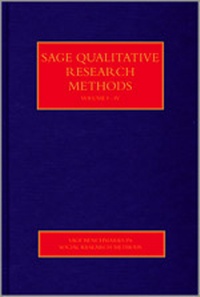
SAGE Qualitative Research Methods
Published on 17. November 2010
1616 pages
978-1-4462-7570-2 (ISBN)
Available for download
Description

SAGE has been a major force shaping the field of qualitative methods, not just in its specialist methods journals like Qualitative Inquiry but in the 'empirical' journals such as Social Studies of Science. Delving into SAGE's deep backlist of qualitative research methods journals, Paul Atkinson and Sara Delmont, editors of Qualitative Research, have selected over 70 articles to represent SAGE's distinctive contribution to methods publishing in general and qualitative research in particular. This collection includes research from the past four decades and addresses key issues or controversies, such as: explanations and defences of qualitative methods; ethics; research questions and foreshadowed problems; access; first days in the field; field roles and rapport; practicalities of data collection and recording; data analysis; writing and (re) presentation; the rise of auto-ethnography; life history, narrative and autobiography; CA and DA; and alternatives to the logocentric (such as visual methods).
More details
Series
Edition
Four-Volume Set
Language
English
Place of publication
London
United Kingdom
Target group
Professional and scholarly
ISBN-13
978-1-4462-7570-2 (9781446275702)
Copyright in bibliographic data and cover images is held by Nielsen Book Services Limited or by the publishers or by their respective licensors: all rights reserved.
Schweitzer Classification
Other editions
Additional editions
Paul Atkinson | Sara Delamont
SAGE Qualitative Research Methods
Book
11/2010
1st Edition
SAGE Publications Ltd
€1,002.77
Shipment within 15-20 days
Persons
Paul Atkinson is Emeritus Professor of Sociology at Cardiff University. Recent publications include For Ethnography (SAGE 2014) and Thinking Ethnographically (SAGE 2017). The fourth book in his quartet will be Crafting Ethnography, also for SAGE. The fourth edition of Hammersley and Atkinson Ethnography: Principles in Practice was published by Routledge in 2019. He is a Fellow of the Academy of Social Sciences and of the Learned Society of Wales.
Dr Sara Delamont, DSc Econ, AcSS. read Social Anthropology at Girton College Cambridge, did her PhD at Edinburgh, and lectured at Leicester before moving to Cardiff in 1976. She was the first woman to be President of BERA (the British Education Research Association) and the first woman Dean of Social Sciences at Cardiff. She has done ethnographies in schools, and other settings where teaching and learning take place such as operatic master classes and martial arts studios. With Paul Atkinson she is the Founding Editor of Qualitative Research, and is the author of fourteen books.
Dr Sara Delamont, DSc Econ, AcSS. read Social Anthropology at Girton College Cambridge, did her PhD at Edinburgh, and lectured at Leicester before moving to Cardiff in 1976. She was the first woman to be President of BERA (the British Education Research Association) and the first woman Dean of Social Sciences at Cardiff. She has done ethnographies in schools, and other settings where teaching and learning take place such as operatic master classes and martial arts studios. With Paul Atkinson she is the Founding Editor of Qualitative Research, and is the author of fourteen books.
Content
VOLUME ONE
Editorial Introduction - Paul Atkinson and Sara Delamont
A Stranger at the Gate - Nels Anderson
The Past and the Future of Ethnography - Patricia Adler and Peter Adler
Ethnography: Post, Past and Present - Paul Atkinson, Amanda Coffey and Sara Delamont
The Interactional Study of Organisation - Robert Dingwall and Phil Strong
Linking Data (extract) - Nigel Fielding and Jane Fielding
Towards A Peopled Ethnography - Gary Alan Fine
Beyond Groups - Japonica Brown-Saracino, Jessica Thurk and Gary Alan Fine
Participant Observation in the Era of 'Ethnography' - Herbert Gans
On Fieldwork - Erving Goffman
Erving Goffman's Sociological Legacies - John Lofland
Analyzing Field Reality (extract) - Jaber Gubrium
Accessing, waiting, plunging in, and writing: retrospective sense-making of fieldwork - Peter Magolda
Exchange and Access in Field Work - Paul Gray
From How to Why: On Luminous Description Pt 1 - Jack Katz
From How to Why: On Luminous Description Pt 2 - Jack Katz
Reminiscences of Classic Chicago: The Blumer-Hughes Talk - Lyn Lofland
Towards a Critical Ethnography: A re-examination of the Chicago legacy - Jim Thomas
Everett C. Hughes and the Development of Fieldwork in Sociology - Jean-Michel Chapoulie
A Meta-Ethnographic Approach and The Freeman Refutation of Mead - George Noblit and R. Dwight Hare
VOLUME TWO
Stability and Flexibility - Patricia Adler and Peter Adler
Ethnographic Evidence - Michael Agar
The Hired Hand and the Lone Wolf: Issues in the use of Observers in Large-Scale Program Evaluation - Carl Florez and George Kelling
Four Ways to Improve the Craft of Fieldwork - Robert Emerson
'Deja Entendu': The Liminal Qualities of Anthropological Fieldnotes - Jean Jackson
Photostudy - Alan Radley and Diane Taylor
Educational Ethnography as Performance Art: Towards a Sensuous Feeling and Knowing - Carl Bagley
Discipline and the Material Form of Images - Michael Lynch
Understanding Urban Life: The Chicago legacy - Lyn Lofland
Street Phenomenology: The Go-Along as Ethnographic Research Tool - Margarethe Kusenbach
"Just another Native?" Soundscapes, Chorasters, and Borderlands in Edmonton, Alberta, Canada - Brett Lashua
Doing Research in Cyberspace - David Jacobson
How I Learned What a Crock Was - Howard Becker
Ten Lies of Ethnography: Moral Dilemmas of Field Research - Gary Alan Fine
Problems in the Field: Participant Observation and the Assumption of Neutrality - Jeffrey Cohen
Collecting Data from Elites and Ultra-Elites - Neil Stephens
The Ubiquity of Ambiguity in Research Interviewing: An Exemplar - Cynthia Cannon Poindexter
Referencing as Persuasion - Nigel Gilbert
Contradictions of Feminist Methods - Sherry Gorelick
Jurors' Use of Judges' Instructions - James Holstein
VOLUME THREE
Notes on the Nature and Development of General Theories - Anselm Strauss
Grounded Theory Method - Merilyn Annells
Analytic Ordering for Theoretical Purposes - Juliet Corbin and Anselm Strauss
Rediscovering Glaser - Kath Melia
Grounded Theory: Evolving Methods - Linda Robrecht
Premises, Principles and Practices in Qualitative Research: Revisiting the Foundations - Kathy Charmaz
Two Cases of Ethnography: Grounded Theory and the Extended Case Method - Iddo Tavory and Stefan Timmermans
Five Misunderstandings about Case-Study Research - Bent Flyberrg
The Personal is Political - Sherryl Kleinman
Qualitative Data Analysis - Amanda Coffey, Beverly Holbrook and Paul Atkinson
A Comment on Coffey et al - Raymond Lee and Neil Fielding
The Art(fulness) of Open-Ended Interviewing: Some Consdiderations on Analysing Interviews - Timothy John Rapley
Doing Narrative Analysis - Catherine Riessman
Narrative Turn or Blind Alley? - Paul Atkinson
Narrative in Social Work: A Critical Review - Catherin Kohler Riessman and Lee Quinney
The Use of Discovery Accounts - S. W. Woolgar
Beyond the 'Fetichism of Words': Considerations on the use of the Interview to Gather Chronic Illness Narratives - Nathan Miczo
'When Discourse is Torn from Reality': Bakhtin and the Principle of Chronotopicity - Stuart Allan
Having, and Being had by, "Experience": Or, "Experience in the Social Sciences after the Discursive/Poststructuralist Turn" - Bronwyn Davies and Cristyn Davies
Immersion vs. Analytic Ideals and Appendix - Sherryl Kleinman and Martha Copp
(No) Trial (but) Tribulations: When Courts and Ethnography Conflict - Rik Scarce
VOLUME FOUR
Whose Side Was Becker On? - Martyn Hammersley
Handing IRB an Unloaded Gun - Carol Rambo
Ethics and the Practice of Qualitative Research - Ian Shaw
'Becoming Participant': Problematizing 'Informed Consent' in Participatory Research with Young People in Care - Emma Renold, Sally Holland, Nicola Ross, and Alexandra Hillman
Researching Researchers: Lessons for Research Ethics - Rose Wiles, Vikki Charles, Graham Crow and Sue Heath
Reembodying Qualitative Inquiry - Margarete Sandelowski
Gender, Disembodiment and Vocation: Exploring the Unmentionables of British Academic Life - David Mills and Mette Louise Berg
Ethnographying Public Memory: The Commemorative Genre for the Victims of Terrorism in Italy - Anna Lisa Tota
Unsettling Engagements - Charles Fruehling Springwood and C. Richard King
Data Presentation and the Audience - Carol Warren
Can We Re-Use Qualitative Data Via Secondary Analysis? Notes on some Terminological and Substantive Issues - Martyn Hammersley
(Re)Using Qualitative Data? - Niamh Moore
Whose Cornerville is it, anyway? - Norman Denzin
Trash on the Corner - Laurel Richardson
The Gold Coast and the Slum Revisited: Paradoxes in Replication Research and the Study of Social Change - Albert Hunter
Methods of Writing Patriarchy - Dorothy Smith
Analytic Autoethnography - Leon Anderson
Comments on Setting Criteria for Experimental Writing - Patricia Ticineto Clough
Knowing your Place: Gender and Reflexivity in two Ethnographies - Fiona Gill and Catherine Maclean
Storying Schools: Issues around Attempts to Create a Sense of Feel and Place in Narrative Research Writing - Pat Sikes
Feminist Ethnography: Storytelling that Makes a Difference - Patricia McNamara
Quality Issues in Qualitative Inquiry - Clive Seale
Emerging Criteria for Quality in Qualitative and Interpretive Inquiry - Yvonna Lincoln
New Methods, Old Problems: A Sceptical View of Innovation in Qualitative Research - Max Travers
Editorial Introduction - Paul Atkinson and Sara Delamont
A Stranger at the Gate - Nels Anderson
The Past and the Future of Ethnography - Patricia Adler and Peter Adler
Ethnography: Post, Past and Present - Paul Atkinson, Amanda Coffey and Sara Delamont
The Interactional Study of Organisation - Robert Dingwall and Phil Strong
Linking Data (extract) - Nigel Fielding and Jane Fielding
Towards A Peopled Ethnography - Gary Alan Fine
Beyond Groups - Japonica Brown-Saracino, Jessica Thurk and Gary Alan Fine
Participant Observation in the Era of 'Ethnography' - Herbert Gans
On Fieldwork - Erving Goffman
Erving Goffman's Sociological Legacies - John Lofland
Analyzing Field Reality (extract) - Jaber Gubrium
Accessing, waiting, plunging in, and writing: retrospective sense-making of fieldwork - Peter Magolda
Exchange and Access in Field Work - Paul Gray
From How to Why: On Luminous Description Pt 1 - Jack Katz
From How to Why: On Luminous Description Pt 2 - Jack Katz
Reminiscences of Classic Chicago: The Blumer-Hughes Talk - Lyn Lofland
Towards a Critical Ethnography: A re-examination of the Chicago legacy - Jim Thomas
Everett C. Hughes and the Development of Fieldwork in Sociology - Jean-Michel Chapoulie
A Meta-Ethnographic Approach and The Freeman Refutation of Mead - George Noblit and R. Dwight Hare
VOLUME TWO
Stability and Flexibility - Patricia Adler and Peter Adler
Ethnographic Evidence - Michael Agar
The Hired Hand and the Lone Wolf: Issues in the use of Observers in Large-Scale Program Evaluation - Carl Florez and George Kelling
Four Ways to Improve the Craft of Fieldwork - Robert Emerson
'Deja Entendu': The Liminal Qualities of Anthropological Fieldnotes - Jean Jackson
Photostudy - Alan Radley and Diane Taylor
Educational Ethnography as Performance Art: Towards a Sensuous Feeling and Knowing - Carl Bagley
Discipline and the Material Form of Images - Michael Lynch
Understanding Urban Life: The Chicago legacy - Lyn Lofland
Street Phenomenology: The Go-Along as Ethnographic Research Tool - Margarethe Kusenbach
"Just another Native?" Soundscapes, Chorasters, and Borderlands in Edmonton, Alberta, Canada - Brett Lashua
Doing Research in Cyberspace - David Jacobson
How I Learned What a Crock Was - Howard Becker
Ten Lies of Ethnography: Moral Dilemmas of Field Research - Gary Alan Fine
Problems in the Field: Participant Observation and the Assumption of Neutrality - Jeffrey Cohen
Collecting Data from Elites and Ultra-Elites - Neil Stephens
The Ubiquity of Ambiguity in Research Interviewing: An Exemplar - Cynthia Cannon Poindexter
Referencing as Persuasion - Nigel Gilbert
Contradictions of Feminist Methods - Sherry Gorelick
Jurors' Use of Judges' Instructions - James Holstein
VOLUME THREE
Notes on the Nature and Development of General Theories - Anselm Strauss
Grounded Theory Method - Merilyn Annells
Analytic Ordering for Theoretical Purposes - Juliet Corbin and Anselm Strauss
Rediscovering Glaser - Kath Melia
Grounded Theory: Evolving Methods - Linda Robrecht
Premises, Principles and Practices in Qualitative Research: Revisiting the Foundations - Kathy Charmaz
Two Cases of Ethnography: Grounded Theory and the Extended Case Method - Iddo Tavory and Stefan Timmermans
Five Misunderstandings about Case-Study Research - Bent Flyberrg
The Personal is Political - Sherryl Kleinman
Qualitative Data Analysis - Amanda Coffey, Beverly Holbrook and Paul Atkinson
A Comment on Coffey et al - Raymond Lee and Neil Fielding
The Art(fulness) of Open-Ended Interviewing: Some Consdiderations on Analysing Interviews - Timothy John Rapley
Doing Narrative Analysis - Catherine Riessman
Narrative Turn or Blind Alley? - Paul Atkinson
Narrative in Social Work: A Critical Review - Catherin Kohler Riessman and Lee Quinney
The Use of Discovery Accounts - S. W. Woolgar
Beyond the 'Fetichism of Words': Considerations on the use of the Interview to Gather Chronic Illness Narratives - Nathan Miczo
'When Discourse is Torn from Reality': Bakhtin and the Principle of Chronotopicity - Stuart Allan
Having, and Being had by, "Experience": Or, "Experience in the Social Sciences after the Discursive/Poststructuralist Turn" - Bronwyn Davies and Cristyn Davies
Immersion vs. Analytic Ideals and Appendix - Sherryl Kleinman and Martha Copp
(No) Trial (but) Tribulations: When Courts and Ethnography Conflict - Rik Scarce
VOLUME FOUR
Whose Side Was Becker On? - Martyn Hammersley
Handing IRB an Unloaded Gun - Carol Rambo
Ethics and the Practice of Qualitative Research - Ian Shaw
'Becoming Participant': Problematizing 'Informed Consent' in Participatory Research with Young People in Care - Emma Renold, Sally Holland, Nicola Ross, and Alexandra Hillman
Researching Researchers: Lessons for Research Ethics - Rose Wiles, Vikki Charles, Graham Crow and Sue Heath
Reembodying Qualitative Inquiry - Margarete Sandelowski
Gender, Disembodiment and Vocation: Exploring the Unmentionables of British Academic Life - David Mills and Mette Louise Berg
Ethnographying Public Memory: The Commemorative Genre for the Victims of Terrorism in Italy - Anna Lisa Tota
Unsettling Engagements - Charles Fruehling Springwood and C. Richard King
Data Presentation and the Audience - Carol Warren
Can We Re-Use Qualitative Data Via Secondary Analysis? Notes on some Terminological and Substantive Issues - Martyn Hammersley
(Re)Using Qualitative Data? - Niamh Moore
Whose Cornerville is it, anyway? - Norman Denzin
Trash on the Corner - Laurel Richardson
The Gold Coast and the Slum Revisited: Paradoxes in Replication Research and the Study of Social Change - Albert Hunter
Methods of Writing Patriarchy - Dorothy Smith
Analytic Autoethnography - Leon Anderson
Comments on Setting Criteria for Experimental Writing - Patricia Ticineto Clough
Knowing your Place: Gender and Reflexivity in two Ethnographies - Fiona Gill and Catherine Maclean
Storying Schools: Issues around Attempts to Create a Sense of Feel and Place in Narrative Research Writing - Pat Sikes
Feminist Ethnography: Storytelling that Makes a Difference - Patricia McNamara
Quality Issues in Qualitative Inquiry - Clive Seale
Emerging Criteria for Quality in Qualitative and Interpretive Inquiry - Yvonna Lincoln
New Methods, Old Problems: A Sceptical View of Innovation in Qualitative Research - Max Travers
