

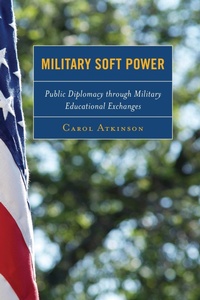
Military Soft Power
Public Diplomacy Through Military Educational Exchanges
1st Edition
Published on 26. June 2014
1 pages
979-8-216-21061-0 (ISBN)
Description

The military has long been associated with hard power, yet it is engaged in public diplomacy as it represents the U.S. abroad and facilitates the diffusion of ideas. Military Soft Power examines one such aspect of U.S. public diplomacy: how the United States extends its influence or "soft power" worldwide through military educational exchange programs hosted by the United States' elite military schools, its war and staff colleges. The presence of international officers at U.S. military schools is substantial, yet very little is known about the long-term impacts of these exchanges. This study shows how the exchanges build personal and professional networks that then serve as important conduits of ideas between the United States and other countries. These networks help to improve interoperability between the U.S. military and its partner nations and to extend U.S. influence through military soft power rather than through hard power.
This is an alternative bottom-up view of how military organizations can influence political processes and decisions through the development of cross-border communities of military professionals. This involves a two-step model of socialization. First, individuals (military officers) are socialized by a large political institution (the U.S. through its war and staff colleges). Second, these individuals function as idea entrepreneurs, bringing new ideas, beliefs, and practices home with them. There is a need for policies and programs that help countries successfully transition from authoritarian governance to democratic rule as well as countries undergoing democratic revolutions and those seeking more gradual change. Exchange programs are one pathway, in which an important group of citizens (military officers and their families) can experience the everyday functioning of democratic practices and institutions.
This unique survey provides timely insights into the important political impacts of military exchange programs and how military institutions and their personnel influence international politics beyond simply being used as an instrument of coercion.
This is an alternative bottom-up view of how military organizations can influence political processes and decisions through the development of cross-border communities of military professionals. This involves a two-step model of socialization. First, individuals (military officers) are socialized by a large political institution (the U.S. through its war and staff colleges). Second, these individuals function as idea entrepreneurs, bringing new ideas, beliefs, and practices home with them. There is a need for policies and programs that help countries successfully transition from authoritarian governance to democratic rule as well as countries undergoing democratic revolutions and those seeking more gradual change. Exchange programs are one pathway, in which an important group of citizens (military officers and their families) can experience the everyday functioning of democratic practices and institutions.
This unique survey provides timely insights into the important political impacts of military exchange programs and how military institutions and their personnel influence international politics beyond simply being used as an instrument of coercion.
More details
Edition
1. Auflage
Language
English
Place of publication
United States
Publishing group
Bloomsbury Publishing Plc
Illustrations
26 b/w photos; 17 tables
ISBN-13
979-8-216-21061-0 (9798216210610)
Copyright in bibliographic data and cover images is held by Nielsen Book Services Limited or by the publishers or by their respective licensors: all rights reserved.
Schweitzer Classification
Other editions
Additional editions
Book
06/2014
Rowman & Littlefield Publishers
€133.90
Shipment within 10-20 days
Person
Carol Atkinson is a retired military officer who is now a Fulbright Fellow in Sofia, Bulgaria at the Rakovski National Defence Academy. As of spring 2014, she will be Professor of the Practice of International Relations at the University of Southern California. While in the military, she served in a wide range of operational assignments in the fields of intelligence, targeting, and combat assessment. She is a veteran of Operation Desert Storm (1991) where she served on the Central Command Headquarters' staff in Riyadh, and on the contingency planning staff in Dhahran/Khobar, Saudi Arabia. Her research interest in military-to-military exchange programs stems from her experiences working with foreign military officers both abroad and in the United States. She has taught at the U.S. Air Force Academy, U.S. Air Force Command and Staff College, University of Southern California, Stanford University, and Vanderbilt University.
Content
Chapter 1: Military Soft Power in American Foreign Policy
PART I: THEORY AND ARGUMENT
Chapter 2: Political Socialization and Educational Exchanges
Chapter 3: Building Military Soft Power
PART II: IMPACT OF MILITARY EDUCATIONAL EXCHANGES ON PARTICIPANTS
Chapter 4: The History of Educational Exchanges at U.S. War and Staff Colleges
Chapter 5: Backgrounds, Social Integration, and Promotion Potential of the Exchange Officers
Chapter 6: Perspectives and Opinions of the Exchange Officers
PART III: IMPACT OF MILITARY EDUCATIONAL EXCHANGES ON DEMOCRATIC TRENDS
Chapter 7: Impact on the Development of Democratic Institutions
Chapter 8: Impact on Democratic Practices
Chapter 9: Conclusion and Policy Implications
References
PART I: THEORY AND ARGUMENT
Chapter 2: Political Socialization and Educational Exchanges
Chapter 3: Building Military Soft Power
PART II: IMPACT OF MILITARY EDUCATIONAL EXCHANGES ON PARTICIPANTS
Chapter 4: The History of Educational Exchanges at U.S. War and Staff Colleges
Chapter 5: Backgrounds, Social Integration, and Promotion Potential of the Exchange Officers
Chapter 6: Perspectives and Opinions of the Exchange Officers
PART III: IMPACT OF MILITARY EDUCATIONAL EXCHANGES ON DEMOCRATIC TRENDS
Chapter 7: Impact on the Development of Democratic Institutions
Chapter 8: Impact on Democratic Practices
Chapter 9: Conclusion and Policy Implications
References
