

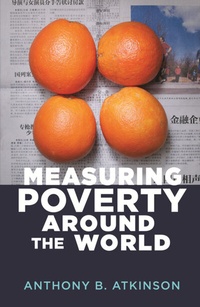
Measuring Poverty around the World
1st Edition
Published on 20. May 2019
464 pages
978-0-691-19189-8 (ISBN)
Description

The final book from a towering pioneer in the study of poverty and inequality-a critically important examination of poverty around the world
In this, his final book, economist Anthony Atkinson, one of the world's great social scientists and a pioneer in the study of poverty and inequality, offers an inspiring analysis of a central question: What is poverty and how much of it is there around the globe? The persistence of poverty-in rich and poor countries alike-is one of the most serious problems facing humanity. Better measurement of poverty is essential for raising awareness, motivating action, designing good policy, gauging progress, and holding political leaders accountable for meeting targets. To help make this possible, Atkinson provides a critically important examination of how poverty is-and should be-measured.
Bringing together evidence about the nature and extent of poverty across the world and including case studies of sixty countries, Atkinson addresses both financial poverty and other indicators of deprivation. He starts from first principles about the meaning of poverty, translates these into concrete measures, and analyzes the data to which the measures can be applied. Crucially, he integrates international organizations' measurements of poverty with countries' own national analyses.
Atkinson died before he was able to complete the book, but at his request it was edited for publication by two of his colleagues, John Micklewright and Andrea Brandolini. In addition, François Bourguignon and Nicholas Stern provide afterwords that address key issues from the unfinished chapters: how poverty relates to growth, inequality, and climate change.
The result is an essential contribution to efforts to alleviate poverty around the world.
In this, his final book, economist Anthony Atkinson, one of the world's great social scientists and a pioneer in the study of poverty and inequality, offers an inspiring analysis of a central question: What is poverty and how much of it is there around the globe? The persistence of poverty-in rich and poor countries alike-is one of the most serious problems facing humanity. Better measurement of poverty is essential for raising awareness, motivating action, designing good policy, gauging progress, and holding political leaders accountable for meeting targets. To help make this possible, Atkinson provides a critically important examination of how poverty is-and should be-measured.
Bringing together evidence about the nature and extent of poverty across the world and including case studies of sixty countries, Atkinson addresses both financial poverty and other indicators of deprivation. He starts from first principles about the meaning of poverty, translates these into concrete measures, and analyzes the data to which the measures can be applied. Crucially, he integrates international organizations' measurements of poverty with countries' own national analyses.
Atkinson died before he was able to complete the book, but at his request it was edited for publication by two of his colleagues, John Micklewright and Andrea Brandolini. In addition, François Bourguignon and Nicholas Stern provide afterwords that address key issues from the unfinished chapters: how poverty relates to growth, inequality, and climate change.
The result is an essential contribution to efforts to alleviate poverty around the world.
All prices
More details
Language
English
Place of publication
Princeton, NJ
United States
Publishing group
De Gruyter
Target group
Professional and scholarly
Edition type
Digital original
Product notice
Reflowable
Illustrations
80 b/w illus. 8 tables.
File size
9,99 MB
ISBN-13
978-0-691-19189-8 (9780691191898)
Schweitzer Classification
Other editions
Additional editions
Anthony B. Atkinson
Measuring Poverty around the World
Book
06/2025
Princeton University Press
€22.50
Shipment within 10-20 days
Anthony B. Atkinson
Measuring Poverty around the World
Book
06/2019
Princeton University Press
€31.50
Shipment within 10-20 days
Person
Anthony B. Atkinson (1944-2017) was a Fellow of Nuffield College, University of Oxford, and Centennial Professor at the London School of Economics. His many books include Inequality: What Can Be Done?, Public Economics in Action, Lectures on Public Economics (with Joseph E. Stiglitz) (Princeton), and The Economics of Inequality.
Content
- Cover
- Contents
- Detailed Chapter Contents
- List of Figures, Tables, and Boxes
- Foreword
- Preface
- CHAPTER 1. Introduction
- CHAPTER 2. What Do We Mean by Poverty?
- CHAPTER 3. Clarifying Concepts
- CHAPTER 4. The Key Role of Data
- CHAPTER 5. Global Poverty and the Sustainable Development Goals
- CHAPTER 6. Poverty in Asia and the Pacific
- CHAPTER 7. Africa: Diversity of Experience
- CHAPTER 8. Poverty in Latin America and the Caribbean
- CHAPTER 9. Poverty in Rich Countries and a Global Measure of Poverty
- CHAPTER 10. Conclusions: Beyond $1.90 a Day
- AFTERWORD. Growth, Inequality, and Poverty Reduction
- AFTERWORD. Poverty and Climate Change
- National Reports for Sixty Countries
- National Report References
- Bibliography
- Index of Names
- Index of Subjects

