

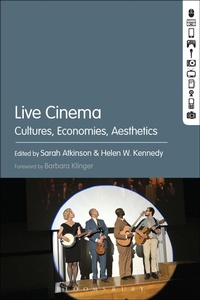
Live Cinema
Cultures, Economies, Aesthetics
1st Edition
Published on 28. December 2017
336 pages
978-1-5013-2486-4 (ISBN)
Description

Live Cinema is a term used to capture a diverse range of experiences that incorporate a 'live' element in relation to a film's exhibition. The live augmentation of cinema screenings is not a new phenomenon, indeed this tendency is present throughout the entire history of cinema in the form of live musical accompaniments to silent screenings, showmanship practices, and cult film audience behaviours. The contemporary revival of experiential cinema captured within this volume presents instances where the live transcends the mediated and escapes beyond the boundaries of the auditorium. Our contributors investigate film exhibition practices that include synchronous live performance, site specific screenings, technological intervention, social media engagement, and all manner of simultaneous interactive moments including singing, dancing, eating and drinking.
These investigations reveal new cultures of reception and practice, new experiential aesthetics and emergent economies of engagement. This collection brings together fifteen contributions that together trace the emergence of a vivid new area of study. Drawing on rich, diverse and interdisciplinary fields of enquiry, this volume encapsulates a broad range of innovative methodological approaches, offers new conceptual frameworks and new critical vocabularies through which to describe and analyse the emergent phenomena of Live Cinema.
These investigations reveal new cultures of reception and practice, new experiential aesthetics and emergent economies of engagement. This collection brings together fifteen contributions that together trace the emergence of a vivid new area of study. Drawing on rich, diverse and interdisciplinary fields of enquiry, this volume encapsulates a broad range of innovative methodological approaches, offers new conceptual frameworks and new critical vocabularies through which to describe and analyse the emergent phenomena of Live Cinema.
Reviews / Votes
The delightfully paradoxical topic of the 'liveness' of cinema gets excellent airing in this collection of essays drawn from Atkinson & Kennedy's important Live Cinema project. Here, in all their complex glory, are case studies on popup cinema, secret cinema, event cinema, rural cinema, street food cinema, classic pier cinema, film festivals, and more - all of them attesting that different kinds of audience participation are nothing new, even if they are currently taking a whole variety of startling revitalised forms. The editors, their contributing researchers and practitioners offer us not just a rich array of kinds of liveness, but also some vital analytic tools we need to make sense of the range of experiences these offer audiences. * Martin Barker, Emeritus Professor, Aberystwyth University, UK and author of Live To Your Local Cinema (2013) * This is a terrific edited collection! It brings together an impressive range of perspectives on recent developments in contemporary cinema and the nature of live experience - a very timely and compelling subject for anyone interested in cinema and media audiences more broadly. * Karina Aveyard, Senior Lecturer, University of East Anglia, UK * Live Cinema: Cultures, Economies, Aesthetics successfully addresses a significant gap in knowledge that existed around the experience of immersive, participatory film screening in spaces outside cinema ... each chapter contains some valuable perspectives. * Alphaville *More details
Edition
1. Auflage
Language
English
Place of publication
New York
United States
Publishing group
Bloomsbury Publishing PLC (Digital)
Target group
Professional and scholarly
Illustrations
40 bw illus
ISBN-13
978-1-5013-2486-4 (9781501324864)
Copyright in bibliographic data and cover images is held by Nielsen Book Services Limited or by the publishers or by their respective licensors: all rights reserved.
Schweitzer Classification
Other editions
Additional editions
Book
08/2019
Bloomsbury Academic USA
€62.08
Shipment within 15-20 days
Book
12/2017
Bloomsbury Academic USA
€177.00
Shipment within 15-20 days
Persons
Sarah Atkinson is Senior Lecturer in Digital Cultures at King's College London, UK.
Helen W. Kennedy is Head of the School of Media at the University of Brighton, UK.
Helen W. Kennedy is Head of the School of Media at the University of Brighton, UK.
Content
FOREWORD Barbara Klinger (Barbara Klinger, Indiana University, USA)
INTRODUCTION (Sarah Atkinson, King's College, London, UK & Helen W. Kennedy, University of Brighton, UK)
Section 1: Spaces
Section Introduction (Sarah Atkinson, King's College, London, UK & Helen W. Kennedy, University of Brighton, UK)
1. Nostalgia and place making at Los Angeles' Outdoor Movies (Linda Levitt, Stephen F. Austin State University, US)
2. Beyond the Metropolis: Immersive cinema in a rural context (Emma Pett, UEA, UK)
3. Pop(-up)ular Culture at the Seaside: The British Pleasure Pier as Screening Space (Lavinia Brydon, University of Kent , UK and Olu Jenzen, University of Brighton, UK)
4. Encountering Urban Space Live at the Floating Cinema (Ella Harris, Royal Holloway, University of London, UK)
Section 2: Temporalities
Section Introduction (Sarah Atkinson, King's College, London, UK & Helen W. Kennedy, University of Brighton, UK)
1. 'Beyond Film' Experience: Festivalising Practices and Shifting Spectatorship at Glasgow Film Festival (Lesley Ann Dickson, University of Stirling, UK)
2. Maps, grids, instructions: Pop-up cinema going and tourist performance (Maria Antonia Velez Serna, University of Glasgow, UK)
3. Never seen a shot like that before! Playfulness and participatory audiences in San Sebastian Horror and Fantasy Film Festival, (Rosana Vivar, University of Granada, Spain)
Section 3: Audiences
Section Introduction (Sarah Atkinson, King's College, London, UK & Helen W. Kennedy, University of Brighton, UK)
1. The opera virgins project: operatic event cinema as new cultural experience (Joseph Attard, King's College London, UK)
2. Against Participation: Cinephilia, Nostalgia, and the Pleasures of Attending an 'Alternative' Cinema Space (Richard McCulloch, Regents University, UK & Virginia Crisp Coventry University, UK)
3. Funfear Attractions: the playful affects of carefully managed terror in immersive 28 days later live experiences (Helen W. Kennedy, University of Brighton, UK)
4. Living cinema memories: Restaging the past at the pictures (Matthew Jones, De Montfort University, UK)
Section 4: Creative & Artistic Practices
Section Introduction (Sarah Atkinson, King's College, London, UK & Helen W. Kennedy, University of Brighton, UK)
1. Pseudo Soundtracks: Reconsidering the Rescore (Philip Brophy, RMIT University, Melbourne, Australia)
2. The Aesthetics of Immersion in Punchdrunk's The Drowned Man: A Hollywood Fable (Josephine Machon, Middlesex University, UK)
3. Eating with your eyes: Edible Cinema and participatory synaesthesia (Brendan Wocke, University of Perpignan, France)
4. Hangmen Rehanged - A playful replay of the play (Sarah Atkinson, King's College, London)
AFTERWORD (Sarah Atkinson, King's College, London, UK & Helen W. Kennedy, University of Brighton, UK)
INTRODUCTION (Sarah Atkinson, King's College, London, UK & Helen W. Kennedy, University of Brighton, UK)
Section 1: Spaces
Section Introduction (Sarah Atkinson, King's College, London, UK & Helen W. Kennedy, University of Brighton, UK)
1. Nostalgia and place making at Los Angeles' Outdoor Movies (Linda Levitt, Stephen F. Austin State University, US)
2. Beyond the Metropolis: Immersive cinema in a rural context (Emma Pett, UEA, UK)
3. Pop(-up)ular Culture at the Seaside: The British Pleasure Pier as Screening Space (Lavinia Brydon, University of Kent , UK and Olu Jenzen, University of Brighton, UK)
4. Encountering Urban Space Live at the Floating Cinema (Ella Harris, Royal Holloway, University of London, UK)
Section 2: Temporalities
Section Introduction (Sarah Atkinson, King's College, London, UK & Helen W. Kennedy, University of Brighton, UK)
1. 'Beyond Film' Experience: Festivalising Practices and Shifting Spectatorship at Glasgow Film Festival (Lesley Ann Dickson, University of Stirling, UK)
2. Maps, grids, instructions: Pop-up cinema going and tourist performance (Maria Antonia Velez Serna, University of Glasgow, UK)
3. Never seen a shot like that before! Playfulness and participatory audiences in San Sebastian Horror and Fantasy Film Festival, (Rosana Vivar, University of Granada, Spain)
Section 3: Audiences
Section Introduction (Sarah Atkinson, King's College, London, UK & Helen W. Kennedy, University of Brighton, UK)
1. The opera virgins project: operatic event cinema as new cultural experience (Joseph Attard, King's College London, UK)
2. Against Participation: Cinephilia, Nostalgia, and the Pleasures of Attending an 'Alternative' Cinema Space (Richard McCulloch, Regents University, UK & Virginia Crisp Coventry University, UK)
3. Funfear Attractions: the playful affects of carefully managed terror in immersive 28 days later live experiences (Helen W. Kennedy, University of Brighton, UK)
4. Living cinema memories: Restaging the past at the pictures (Matthew Jones, De Montfort University, UK)
Section 4: Creative & Artistic Practices
Section Introduction (Sarah Atkinson, King's College, London, UK & Helen W. Kennedy, University of Brighton, UK)
1. Pseudo Soundtracks: Reconsidering the Rescore (Philip Brophy, RMIT University, Melbourne, Australia)
2. The Aesthetics of Immersion in Punchdrunk's The Drowned Man: A Hollywood Fable (Josephine Machon, Middlesex University, UK)
3. Eating with your eyes: Edible Cinema and participatory synaesthesia (Brendan Wocke, University of Perpignan, France)
4. Hangmen Rehanged - A playful replay of the play (Sarah Atkinson, King's College, London)
AFTERWORD (Sarah Atkinson, King's College, London, UK & Helen W. Kennedy, University of Brighton, UK)
