

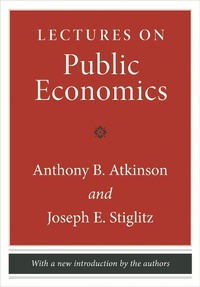
Lectures on Public Economics
Description

The definitive textbook on public finance-now back in print for the first time in years
This classic introduction to public finance remains the best advanced-level textbook on the subject ever written. First published in 1980, Lectures on Public Economics still tops reading lists at many leading universities despite the fact that the book has been out of print for years. This new edition makes it readily available again to a new generation of students and practitioners in public economics.
The lectures presented here examine the behavioral responses of households and firms to tax changes. Topics include the effects of taxation on labor supply, savings, risk-taking, the firm, debt, and economic growth. The book then delves into normative questions such as the design of tax systems, optimal taxation, public sector pricing, and public goods, including local public goods.
Written by two of the world's preeminent economists, this edition of Lectures on Public Economics features a new introduction by Anthony Atkinson and Joseph Stiglitz that discusses the latest developments in the field and areas for future research.
- The definitive advanced-level textbook on public economics
- Examines the effects of taxation on households and firms
- Covers tax system design, optimal taxation, public sector pricing, and more
- Includes suggestions for further reading
- Additional resources available online
More details
Other editions
Additional editions
Person
Content
- Cover
- Title
- Copyright
- Contents
- Introduction
- Preface
- Introductory Note to the 1980 Edition
- PART ONE THE ANALYSIS OF POLICY
- Lecture 1 Introduction: Public Economics
- 1-1 Introduction
- 1-2 Role of the Government
- 1-3 Guide to the Lectures
- Note: The Public Sector-Statistical Background
- Lecture 2 Household Decisions, Income Taxation, and Labour Supply
- 2-1 Introduction
- 2-2 Income Taxation and Labour Supply
- 2-3 Broader Models of Labour Supply
- 2-4 Empirical Evidence on Labour Supply
- 2-5 Concluding Comments
- Note on the Expenditure Function
- Reading
- Lecture 3 Taxation, Savings, and Decisions over Time
- 3-1 Intertemporal Decisions and Taxation
- 3-2 The Basic Intertemporal Model
- 3-3 Developments of the Model and Alternative Views
- 3-4 Empirical Evidence-Taxation and the Interest Elasticity of Savings
- 3-5 Concluding Comments
- Reading
- Lecture 4 Taxation and Risk-Taking
- 4-1 Risk-Taking and Portfolio Allocation
- 4-2 Effects of Taxation
- 4-3 Special Provisions of the Tax System
- 4-4 Generalization of Results
- 4-5 Concluding Comments
- Note on Risk Aversion
- Reading
- Lecture 5 Taxation and the Firm
- 5-1 Taxes and the Firm
- 5-2 Corporation Tax and the Cost of Capital
- 5-3 Taxation and Investment
- 5-4 A Wider View of Investment
- 5-5 Empirical Investigation of Taxation and Investment
- 5-6 Concluding Comments
- Reading
- Lecture 6 Tax Incidence: Simple Competitive Equilibrium Model
- 6-1 Introduction: Tax Incidence
- 6-2 Static Two-Sector Model
- 6-3 Incidence of Corporation Tax
- 6-4 General Tax Incidence
- 6-5 Incidence in a Two-Class Economy
- 6-6 Numerical Applications of the Model
- 6-7 Concluding Comments
- Note on the Cost Function
- Reading
- Lecture 7 Tax Incidence: Departures from the Standard Model
- 7-1 Introduction
- 7-2 Market Imperfections
- 7-3 Monopolistic Competition
- 7-4 Structure of Production
- 7-5 Non-Market-Clearing
- 7-6 Concluding Comments
- Reading
- Lecture 8 Taxation and Debt in a Growing Economy
- 8-1 Introduction
- 8-2 An Aggregate Model of Equilibrium Growth
- 8-3 Growth and Taxation
- 8-4 Taxation in a Life-Cycle Model
- 8-5 Burden of the National Debt
- 8-6 Concluding Comments
- Reading
- Lecture 9 Distributional Effect of Taxation and Public Expenditure
- 9-1 Taxation, Spending, and Redistribution
- 9-2 Modelling the Distribution of Income
- 9-3 Distributional Incidence
- 9-4 Empirical Studies of the Redistributive Impact of the Government Budget
- 9-5 Concluding Comments
- Reading
- Lecture 10 Theories of the State and Public Economics
- 10-1 Introduction
- 10-2 Voting and Decisions
- 10-3 Administration and Bureaucracies
- 10-4 Power, Interest Groups, and Marxist Theories
- 10-5 Empirical Studies of Public Expenditure
- Reading
- PART TWO THE DESIGN OF POLICY
- Lecture 11 Introduction to Part Two: Normative Analysis
- 11-1 Introduction
- 11-2 Normative Theories of the State
- 11-3 Pareto Efficiency and Welfare Economics
- 11-4 Standard Public Finance Objectives
- 11-5 Range of Government Instruments
- Note on the Measurement of Income Inequality
- Reading
- Lecture 12 The Structure of Indirect Taxation
- 12-1 Introduction
- 12-2 The Ramsey Tax Problem
- 12-3 Application of the Ramsey Results
- 12-4 Partial Welfare Improvements and Tax Reform
- 12-5 Optimal Taxation in a Many-Person Economy
- 12-6 Concluding Comments
- Reading
- Lecture 13 The Structure of Income Taxation
- 13-1 Introduction
- 13-2 A Simple Model
- 13-3 Linear Income Tax
- 13-4 General Income Tax
- 13-5 Concluding Comments
- Reading
- Lecture 14 A More General Treatment of the Optimal Tax Problem
- 14-1 Introduction
- 14-2 Indirect Taxes and Linear Direct Taxation
- 14-3 Nonlinear Tax Schedules and Tax Exemptions
- 14-4 Taxation of Savings
- 14-5 Externalities in Consumption and Corrective Taxes
- 14-6 Concluding Comments
- Reading
- Lecture 15 Public Sector Pricing and Production
- 15-1 Introduction
- 15-2 Departures from Marginal Cost Pricing
- 15-3 Choice of Technique and Production Efficiency
- 15-4 Cost-Benefit Analysis and Social Rate of Discount
- 15-5 Concluding Comments
- Reading
- Lecture 16 Public Goods and Publicly Provided Private Goods
- 16-1 Introduction
- 16-2 Optimum Provision of Pure Public Goods-Efficiency
- 16-3 Optimum Provision of Pure Public Goods-Distribution
- 16-4 Publicly Provided Private Goods
- 16-5 Equilibrium Levels of Public Expenditure
- 16-6 Revelation of Preferences
- Reading
- Lecture 17 Local Public Goods
- 17-1 Introduction
- 17-2 Optimum Provision of Local Public Goods
- 17-3 Market Equilibria and Optimality: Identical Individuals
- 17-4 Market Equilibria and Optimality: Heterogeneous Individuals
- 17-5 Fiscal Federalism
- Reading
- Lecture 18 Public Economics: Theory and Policy
- 18-1 On the Sources of Disagreement in Policy Analysis
- 18-2 Thinking about Policy: Taxation
- 18-3 Thinking about Policy: Expenditures
- 18-4 Policy Reform and Political Economy
- Bibliography
- Author Index
- Subject Index
