

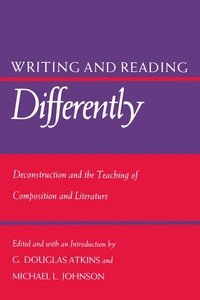
Writing and Reading Differently
Description

This is the first book to explore the opportunities deconstruction opens up for the teaching of both composition and literature. It is a unique and timely response to crucial issues facing teachers of composition and literature at all levels: high school, college, and university.
?The critical rage? (and likely to remain so), deconstruction is the most controversial and arguably the most promising critical-theoretical movement of recent decades. It has proven to be enormously influential as a strategy of textual analysis, thanks in large part to the enterprise of such critics as J. Hillis Miller, Geoffrey H. Hartman, Barbara E. Johnson, and Gayatri Chakravorty Spivak, all of whom are contributors to this collection. The implications of deconstruction for the teaching of both writing and reading are just now being explored, however. These groundbreaking essays exemplify and assess that potential.
The scope of consideration is wide. The essays all discuss deconstruction, treat its pedagogical implications, and evaluate its impact upon the teaching of composition and literature. In doing so, the contributors address specific questions concerning ?the literary crisis? and ?the crisis in literary studies? and offer a reasoned, balanced, and provocative account of the usefulness of deconstruction in solving at least some of the problems that beset the profession.
More details
Other editions
Additional editions
Content
Preface, G. Douglas Atkins
Introduction, G. Douglas Atkins and Michael L. Johnson
Part 1: Deconstruction and Teaching
1. Deconstruction and Pedagogy, Vincent B. Leitch
2. Reading the World: Literary Studies in the 1980s, Gayatri Chakravorty Spivak
3. Textshop for Post(e)pedagogy, Gregory L. Ulmer
Part 2: Deconstruction and the Teaching of Composition
4. To Write Is to Read Is to Write, Right?, David Kaufer and Gary Waller
5. The Two Rhetorics: George Eliot's Bestiary, J. Hillis Miller
6. Heuristics and Beyond: Deconstruction/Inspiration and the Teaching of Writing Invention, Paul Northam
7. A Release from Weak Specifications: Liberating the Student Reader, Nancy R. Comley
Part 3: Deconstruction and the Teaching of Literature
8. Teaching Deconstructively, Barbara Johnson
9. Understanding Criticism, Geoffrey H. Hartman
10. New Criticism and Deconstruction: Two Attitudes in Teaching Poetry, Andrew P. Debicki
11. Plot, Character, or Theme? Lear and the Teacher, Jasper Neel
Contributors
Index
