

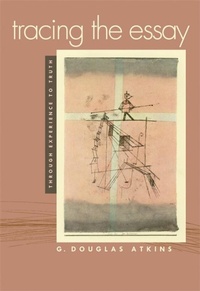
Tracing the Essay
Description

The essay, as a notably hard form of writing to pin down, has inspired some unflattering descriptions: It is a "greased pig," for example, or a "pair of baggy pants into which nearly anything and everything can fit." In Tracing the Essay, G. Douglas Atkins embraces the very qualities that have moved others to accord the essay second-class citizenship in the world of letters.
Drawing from the work of Montaigne and Bacon and recent practitioners such as E. B. White and Cynthia Ozick, Atkins shows what the essay means-and how it comes to mean. The essay, related to assaying (attempting), mines experience for meaning, which it then carefully weighs. It is a via media creature, says Atkins, born of and embracing tension. It exists in places between experience and meaning, literature and philosophy, self and other, process and product, form and formlessness. Moreover, as a literary form the essay is inseparable from a way of life requiring wisdom, modesty, and honesty. "The essay was, historically," notes Atkins, "the first form to take the experience of the individual and make it the stuff of literature."
Atkins also considers the essay's basis in Renaissance (and Reformation) thinking and its participation in voyages of exploration and discovery of that age. Its concern is "home-cosmography," to use a term from seventeenth-century writer William Habington. Responding to influential critiques of the essay's supposed self-indulgence, lack of irony, and absence of form, Atkins argues that the essay exhibits a certain "sneakiness" as it proceeds in, through, and by means of the small and the mundane toward the spiritual and the revelatory.
More details
Other editions
Additional editions
Person
Content
- Intro
- Contents
- Preface
- Introduction
- Irony or Sneakiness: On the Essay's Second-Class Citizenship
- Home-Cosmography: The Renaissance Basis of the Essay
- The Most Self-Centered of Forms?: Distinguishing the Essay
- Assaying Experience: Time, Meaning, and the Essay
- Paradox Abounding: Tension and the Via Media Nature of the Essay
- Form and Meaning: The Essay's Immanent Purposiveness
- In-Betweenness: The Burden of the Essay
- Notes
- Index
- A
- B
- C
- D
- E
- F
- G
- H
- I
- J
- K
- L
- M
- N
- O
- P
- Q
- R
- S
- T
- U
- V
- W
- Z
