

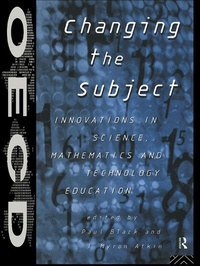
Changing the Subject
Innovations in Science, Maths and Technology Education
Published on 1. November 2005
240 pages
978-1-134-75779-4 (ISBN)
Description

Change in education is too often a process which enthusiasts, ranging from top policy makers to groups of teachers, plan and drive forward, but in which they all find unexpected pitfalls. Every innovation depends on the commitment of schools and teachers to make it work. But often that commitment is lacking, or is less than total, or it turns to fustration as events develop.
This book is based on a set of stories from teachers and education professionals in thirteen OECD countries. Twenty-three case studies of educational innovation in science, mathematics and technology have involved school teachers, inspectors, academics (both subject specialists and educational researchers), policy makers and advisors. The case studies come from Australia, Canada, France, Germany, Ireland, Japan, the Netherlands, Norway, Scotland, Spain, Switzerland and the USA.
Drawing on this rich variety of material the authors concentrate on the origins and purposes of innovation within and across the science, mathematics and technology curricula. They consider the conceptions of the three subjects, along with issues of teaching, learning and assessment, and explore the involvement of both teachers and students. They reflect on the various strategies adopted to cope with or bring about change, and offer valuable insights to advisors, developers, policy makers and practitioners, both in schools and outside.
The writing team includes Paul Black, King's College London; Mike Atkin, Stanford University; Raymond Duval, University of Lille; Edwyn James, Consultant, OECD; John Olson, Queen's University of Kingston, Ontario; Dieter Pevsner, Consultant, London; Senta Raizen, National Centre for Improving Science Education, Washington; Maria Saez, University of Valladolid, Spain; and Helen Simons, Southampton University.
Published in association with the OECD
This book is based on a set of stories from teachers and education professionals in thirteen OECD countries. Twenty-three case studies of educational innovation in science, mathematics and technology have involved school teachers, inspectors, academics (both subject specialists and educational researchers), policy makers and advisors. The case studies come from Australia, Canada, France, Germany, Ireland, Japan, the Netherlands, Norway, Scotland, Spain, Switzerland and the USA.
Drawing on this rich variety of material the authors concentrate on the origins and purposes of innovation within and across the science, mathematics and technology curricula. They consider the conceptions of the three subjects, along with issues of teaching, learning and assessment, and explore the involvement of both teachers and students. They reflect on the various strategies adopted to cope with or bring about change, and offer valuable insights to advisors, developers, policy makers and practitioners, both in schools and outside.
The writing team includes Paul Black, King's College London; Mike Atkin, Stanford University; Raymond Duval, University of Lille; Edwyn James, Consultant, OECD; John Olson, Queen's University of Kingston, Ontario; Dieter Pevsner, Consultant, London; Senta Raizen, National Centre for Improving Science Education, Washington; Maria Saez, University of Valladolid, Spain; and Helen Simons, Southampton University.
Published in association with the OECD
More details
Language
English
Place of publication
London
United Kingdom
Publishing group
Taylor & Francis Ltd
Target group
College/higher education
File size
1,72 MB
ISBN-13
978-1-134-75779-4 (9781134757794)
Copyright in bibliographic data and cover images is held by Nielsen Book Services Limited or by the publishers or by their respective licensors: all rights reserved.
Schweitzer Classification
Other editions
Additional editions
J. Myron Atkin | Paul Black
Changing the Subject
Innovations in Science, Maths and Technology Education
Book
04/1996
Routledge
€262.10
Shipment within 15-20 days
J. Myron Atkin | Paul Black
Changing the Subject
Innovations in Science, Maths and Technology Education
Book
04/1996
Routledge
€74.40
Shipment within 15-20 days
Content
Foreword, Introduction, 1 What drives reform?, 2 Changing the subject, 3 Teaching and learning, 4 Assessment, 5 Teachers and change, 6 Changing students-changing classrooms, 7 Unique configurations, 8 Where now?, Appendix: summaries of the 23 case studies, The writing team of OECD consultants, Index
