

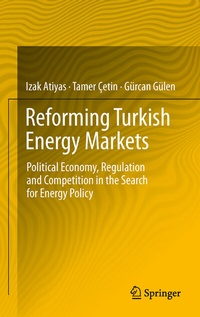
Reforming Turkish Energy Markets
Description

Turkey has been reforming its energy markets since the 1980s, culminating in two major bills in the early 2000s. The country has restructured electricity and natural gas markets, establishing an independent regulatory agency (EMRA) and passed legislation on renewable and nuclear energy. With these regulatory reforms, Turkey, as a candidate country for accession to the European Union (EU), has aimed to direct the energy markets to a more competitive environment in parallel with EU energy directives. This book contains an analysis of regulatory reforms in Turkish energy markets (electricity, natural gas, renewable and nuclear energy), the impact of these reforms on country's energy portfolio and role in global energy trade, especially between the EU, the Caspian, Caucasus, and Central Asia. Finally, the book concludes with recommendations for Turkish energy policy.
The authors are expert scholars who have written extensively on Turkish regulatory reform and energy economics and who have broad knowledge of global energy market dynamics. The book will be a unique guide for those concerned with the different areas of the Turkish economy and international audiences interested in energy markets of Turkey and surrounding regions, making the book of interest to not only researchers in academia but also industry practitioners, regulators and policy makers as well.
More details
Other editions
Additional editions
Content
- Intro
- Reforming Turkish EnergyMarkets
- Acknowledgement
- Contents
- 1 Introduction
- 1.Energy Sector RestructuringRestructuring
- 1.1 Role of Economic Crises
- 1.2 Role of European UnionEuropean Union
- 2.RenewablesRenewables
- 3.NuclearNuclear
- 4.An Accounting of RestructuringRestructuring Efforts
- 4.1 Electricity
- 4.2 Natural Gas
- 5.Energy Security
- 6.Turkey as a Transit Country
- 7.Looking Ahead to a Dynamic Energy Scene
- 2 Regulatory Reform and CompetitionCompetition in the Turkish Electricity Industry
- 1.The Structure of the Electricity Industry
- 1.1 Demand, Capacity, and Production
- 1.2 The Problem of Distribution Losses
- 2.Historical Background and the Road to Reform
- 3.Market Structure and Regulation Under the EMLEML
- 4.Implementation Strategy
- 5.Developments and Issues Under the New Regime
- 5.1 Progress with PrivatizationPrivatization
- 5.1.1 The PrivatizationPrivatization Model for Electricity DistributionDistribution
- 5.1.2 Tariffs Structures for Distribution and Retail Companies
- 5.1.3 Investment Requirements
- 5.1.4 Vested ContractsVested Contracts for Distribution Companies
- 5.1.5 Outcomes of Privatization of Electricity Distribution
- 5.1.6 PrivatizationPrivatization of Generation Companies
- 5.1.7 PrivatizationPrivatization: An Assessment
- 5.2 Private Investment Response
- 5.3 Tariffs
- 5.4 Vertical Unbundling
- 5.5 Development of the WholesaleWholesale Market
- 5.5.1 Evolution of the Balancing Market
- 5.5.2 Evolution of the Bilateral Contracts Market
- 5.6 CompetitionCompetition Issues
- 5.7 Resource AdequacyResource adequacy
- 5.8 Prospects for Retail Supply
- 5.9 Distributional Concerns
- 5.10 Institutional Issues
- 6.Electricity Restructuring: An Assessment
- References
- 3 The Reform of Natural Gas Market in Turkey
- 1.Introduction
- 2.Historical Background of Natural Gas Market: The Road to the Reform
- 3.The Role of Natural Gas in Turkey
- 4.Natural Gas Market Law
- 4.1 The Regulatory Features of the 2001 Law
- 4.2 The Regulatory Authorities of EPDKEPDK in the Natural Gas Market
- 5.Gas Release Program: Contracts and Stranded Costs
- 6.UnbundlingUnbundling
- 6.1 Production and Supply
- 6.2 DistributionDistribution: PrivatizationPrivatization and Tenders
- 6.3 TransmissionTransmission Developments: The Role of BOTAScedilBOTAScedil as a Natural Monopoly
- 6.4 Import and ExportExport
- 6.5 WholesaleWholesale
- 6.6 Eligible Consumers and Market Opening
- 6.7 StorageStorage
- 7.Price Regulation of Natural Gas
- 8.The Role of Turkey as a Conduit of Natural Gas
- 8.1 Current and Planned Projects
- 8.1.1 The South Caucasus Project (The Baku--Tbilisi--Erzurum pipeline or Shah Sea Project)
- 8.1.2 The Southern Europe Gas Ring Project (Turkey--Greece--Italy Natural Gas Project)
- 8.1.3 Bypassing RussiaRussia: The NabuccoNabucco Project
- 8.1.4 Transcaspian Turkmenistan--Turkey--Europe Natural Gas PipelinePipeline Project
- 8.2 New Developments
- 8.2.1 Trans-Anatolia Project
- 8.2.2 Egypt--Turkey Natural Gas PipelinePipeline Project
- 8.2.3 Iraq--Turkey Natural Gas PipelinePipeline Project
- 9.Conclusion
- References
- 4 Alternative Energy Options for Turkey
- 1.Introduction
- 2.Renewable Energy
- 2.1 Resources
- 2.1.1 Hydro
- 2.1.2 WindWind
- 2.1.3 SolarSolar
- 2.1.4 GeothermalGeothermal
- 2.1.5 BiomassBiomass and Biofuels
- 2.2 Legal and Regulatory Framework for RenewablesRenewables
- 2.2.1 Chronology of RenewablesRenewables Support in Turkey
- 2.3 Technologies, Costs, and Implications
- 2.3.1 GenerationGeneration Costs in Turkey
- 2.3.2 System Impacts
- 2.4 Assessment of Renewable Energy Developments in Turkey
- 2.4.1 Challenges Facing Hydro
- 2.4.2 Fallacy of RenewablesRenewables-Based Economic Development
- 2.4.3 Unintended Consequences of Biofuels
- 3.Energy Efficiency
- 3.1 Current State of Energy Efficiency in Turkey
- 3.2 Legal and Regulatory Framework for Energy Efficiency
- 3.3 Assessment of Energy Efficiency Developments in Turkey
- 3.3.1 International Funding
- 4.Nuclear Energy
- 4.1 History of NuclearNuclear Power in Turkey
- 4.2 Legal and Regulatory Framework for NuclearNuclear
- 4.3 Assessment of NuclearNuclear Energy Developments in Turkey
- 5 Policy Recommendations for Turkish Energy Future
- 1.The Need for a Cohesive Long-Term Energy Policy
- 2.Improving CompetitionCompetition and Efficiency in Energy Markets
- 2.1 Institutional Measures
- 2.2 CompetitionCompetition
- 2.3 Resource Adequacy
- 2.4 Tariffs and Distributional Concerns
- 3.Diversification Strategies
- 3.1 Natural Gas: A Central Fuel
- 3.2 Hydro: Potential and Risks
- 3.3 WindWind and SolarSolar: Expansion Aware of Their Shortcomings
- 3.4 NuclearNuclear: Only when Institutionally Ready
- 3.5 CoalCoal: Constrained and Lower Emission Use
- 3.6 Transportation: Biofuels, Electricity, and Natural Gas as Alternatives to Oil
- 4.Energy Efficiency
- 5.Conclusion
- References
- Glossary
- Index
