

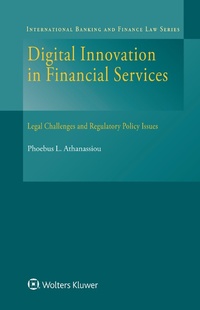
Digital Innovation in Financial Services
Legal Challenges and Regulatory Policy Issues
Published on 24. April 2016
288 pages
978-90-411-8782-6 (ISBN)
Description

Consumer behaviour is rapidly trending towards the use of digital devices as instruments through which to transact day-to-day business. This original and timely book shows how this trend creates new opportunities not only for retail consumers but also for financial service providers, regulators and central banks. The author offers a comprehensive overview of these opportunities and their countervailing legal and regulatory challenges.
The author describes and analyses in unprecedented detail the application of digital financial innovation (FinTech), and some of its core manifestations, including virtual currencies, Blockchain and distributed ledger technologies to the delivery of financial services, in areas such as:
- - payments;
- - securities clearing and settlement;
- - central banking;
- - real-time access to financial information;
- - instant completion of core financial transactions;
- - data validation and reconciliation processes; and
- - digital contracting (smart contracts).
Also clarified are the legal and other barriers to be overcome - including cybersecurity and risks to privacy - before any widespread adoption of digital innovation in the highly regulated financial sector context can occur.
As an informed assessment of the legal merits and risks of technological innovation for financial service providers and central banks, and as a contribution to establishing a conceptual framework within which to analyse and better understand the applications of digital innovation to the financial sector, this practical work is bound to be welcomed by legal practitioners and legal scholars alike with an interest in financial services. Policymakers and regulators will also appreciate its guidance on how to temper the less benevolent aspects of FinTech with targeted, risk-focused regulation, so as to promote innovation and preserve the potential benefits for financial markets and their participants alike.
The author describes and analyses in unprecedented detail the application of digital financial innovation (FinTech), and some of its core manifestations, including virtual currencies, Blockchain and distributed ledger technologies to the delivery of financial services, in areas such as:
- - payments;
- - securities clearing and settlement;
- - central banking;
- - real-time access to financial information;
- - instant completion of core financial transactions;
- - data validation and reconciliation processes; and
- - digital contracting (smart contracts).
Also clarified are the legal and other barriers to be overcome - including cybersecurity and risks to privacy - before any widespread adoption of digital innovation in the highly regulated financial sector context can occur.
As an informed assessment of the legal merits and risks of technological innovation for financial service providers and central banks, and as a contribution to establishing a conceptual framework within which to analyse and better understand the applications of digital innovation to the financial sector, this practical work is bound to be welcomed by legal practitioners and legal scholars alike with an interest in financial services. Policymakers and regulators will also appreciate its guidance on how to temper the less benevolent aspects of FinTech with targeted, risk-focused regulation, so as to promote innovation and preserve the potential benefits for financial markets and their participants alike.
More details
Other editions
Additional editions
Phoebus Athanassiou
Digital Innovation in Financial Services
Legal Challenges and Regulatory Policy Issues
Book
02/2018
Kluwer Law International
€184.21
Shipment within 10-20 days
Content
- Intro
- About the Author
- Preface
- List of Abbreviations and Acronyms
- Acknowledgements
- CHAPTER 1Introduction: Digital Innovation in Financial Services - An Overview of Risks, Benefits and
- §1.01 FinTech and Its Promises
- [A] The Consumer Perspective
- [B] The Financial Institutions' and Service Providers' Perspective
- [C] The Regulators' and Supervisors' Perspective
- §1.02 FinTech: Risks and Challenges
- [A] Headline Consumer and Investor Risks
- [B] Headline Risks for Financial Institutions and Service Providers
- [C] Regulatory Challenges: Highlights
- §1.03 Headline Use Cases of FinTech: An Introduction
- [A] Clearing and Settlement of Payments
- [B] Securities Issuance, Trading and Post-trading
- [C] Information Sharing
- §1.04 Final Remarks and Scope of This Study
- CHAPTER 2DLTs, Blockchain and Distributed Ledgers: Scope, Definitions and Headline Legal and Regulat
- §2.01 DLTs and Blockchain: Definitions, Possible Areas of Application and Key Strengths
- [A] Prefatory Remarks
- [B] Blockchain: The Archetypal DLT
- [C] DLTs: Strengths, Weaknesses and Practical Limitations
- §2.02 Distributed Ledgers
- [A] Ledgers and Their Significance for the Contemporary Financial System
- [B] Financial Intermediaries and Their Function in Modern Financial Markets
- [C] Distribution
- [D] Consensus Protocols and Security Features
- §2.03 Recapitulative Remarks
- §2.04 DLTs and Distributed Ledgers: High-Level Legal and Regulatory Issues
- [A] Why, How and When to Regulate and Supervise DLTs and Distributed Ledgers
- [1] Why Regulate DLTs and Distributed Ledgers?
- [2] How to Regulate DLTs and Distributed Ledgers?
- [3] When to Regulate DLTs and Distributed Ledgers?
- [B] Legal and Regulatory Implications of the Use of DLTs for the Holding of Funds, the Issuance and
- [1] Legal Status of Assets Issued and Transactions Performed in a DLT Environment
- [2] Asset Identification, Issuance and Segregation
- [3] Settlement Finality in a DLT Environment
- [4] Conflict of Laws
- [5] Insolvency Proceedings
- [6] Access to Central Bank Accounts and Liquidity
- [7] Compliance with Legal and Regulatory Requirements
- [C] Protection of Transactional and Other Data in a DLT Environment
- [D] Legal Limits to Decentralisation
- §2.05 Closing Remarks
- CHAPTER 3Cash and Cash Alternatives as Retail Payment Media: State of Play and Scope for Digital Inn
- §3.01 Traditional Payment Media and Rails: Strengths and Weaknesses
- [A] Cash
- [B] Account-Linked Credit and Debit Cards
- [C] Electronic Fund Transfers (Credit Transfers and Direct Debits)
