

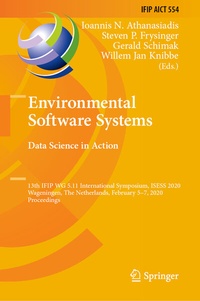
Environmental Software Systems. Data Science in Action
13th IFIP WG 5.11 International Symposium, ISESS 2020, Wageningen, The Netherlands, February 5-7, 2020, Proceedings
Published on 29. January 2020
XIII, 272 pages
978-3-030-39815-6 (ISBN)
Description

This book constitutes the refereed proceedings of the 13th IFIP WG 5.11 International Symposium on Environmental Software Systems, ISESS 2020, held in Wageningen, The Netherlands, in February 2020.
The 22 full papers and 3 short papers were carefully reviewed and selected from 29 submissions. The papers cover a wide range of topics on environmental informatics, including data mining, artificial intelligence, high performance and cloud computing, visualization and smart sensing for environmental, earth, agricultural and food applications.
More details
Series
Language
English
Place of publication
Cham
Switzerland
Publishing group
Springer International Publishing
Target group
Professional and scholarly
Product notice
Reflowable
Illustrations
XIII, 272 p. 95 illus., 86 illus. in color.
File size
33,76 MB
ISBN-13
978-3-030-39815-6 (9783030398156)
DOI
10.1007/978-3-030-39815-6
Schweitzer Classification
Other editions
Additional editions
Ioannis N. Athanasiadis | Steven P. Frysinger | Gerald Schimak
Environmental Software Systems. Data Science in Action
13th IFIP WG 5.11 International Symposium, ISESS 2020, Wageningen, The Netherlands, February 5-7, 2020, Proceedings
Book
01/2020
Springer
€90.94
Shipment within 7-9 days
Content
- Intro
- Preface
- Organization
- Engaging Users: How to Make Decision Support Systems Relevant to Real Environmental Decision Makers (Abstract of Invited Talk)
- Contents
- Unsupervised Learning of Robust Representations for Change Detection on Sentinel-2 Earth Observation Images
- Abstract
- 1 Introduction
- 2 Related Work
- 3 Methodology
- 3.1 Change Detection Service
- 3.2 Framework
- 3.3 Approach and Implementation
- 4 Experiments
- 4.1 Data Description
- 4.2 Settings
- 4.3 Results
- 5 Conclusion
- Acknowledgements
- References
- Dietary Intake Assessment: From Traditional Paper-Pencil Questionnaires to Technology-Based Tools
- Abstract
- 1 Assessing Dietary Intake: Why?
- 2 Assessing Dietary Intake: How?
- 2.1 Methods of Recall
- 2.2 Methods of Real-Time Monitoring
- 2.3 Nutrient and Food Calculations
- 3 True vs. Measured Diet: Sources of Measurement Error
- 4 Assessing Dietary Intake: Which Method to Use?
- 5 Innovations
- 5.1 Compl-eatTM
- 5.2 Traqq
- 5.3 The Dutch FFQ-TOOLTM
- 5.4 Eetscore
- 5.5 Sensor-Based Wearable Dietary Assessment Methods
- 5.6 Biomarkers
- 6 Conclusion
- References
- Computational Infrastructure of SoilGrids 2.0
- 1 Introduction
- 2 General Framework
- 3 HPC Infrastructure
- 4 Parallelisation of Global Scale Geo-Spatial Computations
- 5 Resources Management with (sub-)tiling
- 6 Assemblage of Prediction Files
- 7 Reproducibility and Portability
- References
- Defining and Classifying Infrastructural Contestation: Towards a Synergy Between Anthropology and Data Science
- Abstract
- 1 Introduction
- 2 The Case Study and Beyond
- 3 Mapping Infrastructural Contestation
- 3.1 Method
- 3.2 Sources
- 4 Modes of Infrastructural Contestation
- 4.1 Contestation of Labour and Working Conditions
- 4.2 Contestation for the Right to Access
- 4.3 Ownership and Governance Contestation
- 4.4 Contesting Infrastructural Effects
- 4.5 Contestation as Remodification of Infrastructure
- 4.6 Transfigurative Contestation
- 5 Open Data and Digital Visualisation
- 6 Preliminary Findings from the Data Visualization
- 7 Remarks and Observations
- 8 Conclusions
- References
- Automated Processing of Sentinel-2 Products for Time-Series Analysis in Grassland Monitoring
- Abstract
- 1 Introduction
- 2 Methodology
- 2.1 Study Area
- 2.2 Sentinel-2 Satellite Data
- 2.3 Harvesting Sentinel-2 Data with Sentinelsat API
- 2.4 Atmospheric Correction with Sen2cor Processing Tool
- 2.5 Extracting Data Based on Field Boundaries
- 2.6 Calculation and Visualization of Vegetation Indices
- 3 Results
- 4 Discussion
- 5 Conclusions
- 6 Further Research
- Acknowledgements
- References
- CLARITY Screening Service for Climate Hazards, Impacts and Effects of the Adaptation Options
- Abstract
- 1 Introduction/Methodology
- 1.1 Introduction
- 1.2 CLARITY and the EU-GL Methodology
- 1.3 Screening Methodology: Simplifications and the Data Preparation
- 2 CSIS Screening Workflow Implementation
- 2.1 CSIS Overview
- 2.2 Prior to a Study: System Configuration and Data Management
- 2.3 Starting a New Study
- 2.4 Study Workspace
- 2.5 Data Visualization
- 2.6 Screening Model Calibration and Validation
- 2.7 Adaptation Options
- 2.8 The Future
- 3 Conclusion
- Acknowledgement
- References
- Diet Modelling: Combining Mathematical Programming Models with Data-Driven Methods
- 1 Introduction
- 2 Current Diet Modelling Paradigms
- 2.1 Nutrient Importance and Consumer Preferences
- 3 Data-Driven Approaches to Diet Modelling
- 3.1 Inferring Function Weights
- 3.2 Inferring Consumer Preferences
- 4 Conclusion
- References
- AGINFRA PLUS: Running Crop Simulations on the D4Science Distributed e-Infrastructure
- Abstract
- 1 Introduction
- 2 Methods
- 2.1 D4Science Cloud Computing e-Infrastructure
- 2.2 The Web Processing Service Standard
- 2.3 WOFOST-WISS
- 2.4 AgroDataCube
- 2.5 Functional Programming and the Actor Framework
- 3 Results
- 4 Conclusions
- Acknowledgment
- References
- Redefining Agricultural Insurance Services Using Earth Observation Data. The Case of Beacon Project
- Abstract
- 1 Introduction
- 2 Materials and Methods
- 2.1 Hail and Storms Damage Assessment
- 2.2 Flood Damage Spatial Distribution
- 2.3 Wildfires Damage Mapping
- 2.4 Drought Damage Detection
- 3 Results and Discussion
- 3.1 SAR and Optical Data for Hail and Storms Damage Assessment
- 3.2 Flood Duration Identification
- 3.3 Wildfires Damage Assessment
- 3.4 Drought Damage Assessment
- 4 Summary and Conclusions
- Acknowledgments
- References
- Producing Mid-Season Nitrogen Application Maps for Arable Crops, by Combining Sentinel-2 Satellite Images and Agrometeorological Data in a Decision Support System for Farmers. The Case of NITREOS
- Abstract
- 1 Introduction
- 2 Materials and Methods
- 3 Results and Discussion
- 4 Summary and Conclusions
- Acknowledgments
- References
- Using Virtual Research Environments in Agro-Environmental Research
- Abstract
- 1 Introduction
- 2 Virtual Research Environments
- 3 Virtual Research for Agro-Climatic Modelling in AGINFRA+
- 3.1 AGINFRA+ and the Agro-Climatic User Community
- 3.2 Use Case - Crop Growth Modelling
- 4 Conclusions and Recommendations
- Acknowledgment
- References
- Can We Use the Relationship Between Within-Field Elevation and NDVI as an Indicator of Drought-Stress?
- Abstract
- 1 Introduction
- 2 Materials and Methods
- 2.1 Data from Akkerweb
- 2.2 Publicly Available Data
- 2.3 Descriptive Statistics on the Retrieved Dataset
- 3 Results
- 4 Discussion
- 5 Limitations of This Study
- 6 Conclusion
- Acknowledgements
- References
- Predicting Nitrogen Excretion of Dairy Cattle with Machine Learning
- Abstract
- 1 Introduction
- 2 Materials and Methods
- 2.1 Dataset
- 2.2 Machine Learning Models
- 3 Results and Discussion
- 4 Conclusions
- Acknowledgements
- References
- Investigation of Common Big Data Analytics and Decision-Making Requirements Across Diverse Precision Agriculture and Livestock Farming Use Cases
- Abstract
- 1 Introduction
- 2 Methods and Approach
- 2.1 Overall Approach
- 2.2 Interviews
- 2.3 User Scenarios Co-design Process
- 2.4 An Example of a User Scenario
- 2.5 Requirements Elicitation and Ranking
- 3 Interview Results Per Use Case
- 3.1 Organic Soya Yield and Protein-Content Prediction
- 3.2 Climate-Smart Predictive Models for Viticulture
- 3.3 Climate Services for Organic Fruit Production
- 3.4 Autonomous Robotic Systems Within Arable Frameworks
- 3.5 Optimizing Computations for Crop Yield Forecasting
- 3.6 Pig Weighing Optimisation
- 3.7 Sustainable Pig Production
- 3.8 Open Sea Fishing
- 3.9 Aquaculture Monitoring and Feeding Optimisation
- 4 Derived Common Requirements from All Use Cases
- 5 Conclusions and Future Work
- Acknowledgements
- References
- Quantifying Uncertainty for Estimates Derived from Error Matrices in Land Cover Mapping Applications: The Case for a Bayesian Approach
- Abstract
- 1 Introduction
- 2 Terminology and Formulating the Problem
- 3 A Motivating Example: Georgian Deforestation
- 4 Methods of Uncertainty Quantification
- 5 Analysis of Methods
- 6 Discussion and Future Work
- 7 Conclusion
- Appendix
- Appendix
- References
- Machine Learning Algorithms for Food Intelligence: Towards a Method for More Accurate Predictions
- 1 Introduction
- 2 The Big Data Platform
- 3 Towards a Method for More Accurate Predictions: The Case of Food Price Prediction
- 3.1 Data Preparation Process
- 3.2 Execution and Evaluation Process
- 3.3 Designing a Prediction Experimentation Panel
- 4 Conclusions and Next Steps
- References
- Interoperability of Solutions in a Crisis Management Environment Showcased in Trial-Austria
- Abstract
- 1 Introduction/Trial/Scenario
- 1.1 Introduction
- 2 Trial Guidance Methodology
- 2.1 Test-Bed
- 3 Benefits of Carrying Out Trials
- 3.1 Trial-Austria
- 3.2 Solutions in the Trial
- 3.2.1 CrowdTasker
- 3.2.2 Airborne Terrestrial Situational Awareness
- 3.2.3 vieWTerra Evolution
- 3.2.4 ASIGN
- 3.2.5 PFA - Psychological First Aid
- 3.3 Solutions Connected, Monitored and Evaluated via the Test-Bed Technical Infrastructure
- 4 Conclusion
- Acknowledgement
- ELFIE - The OGC Environmental Linked Features Interoperability Experiment
- Abstract
- 1 Introduction
- 2 Problem Statement
- 3 Proposed Solution
- 4 Issues and Future Work
- Acknowledgements
- References
- Real-Time Visualization of Methane Emission at Commercial Dairy Farms
- Abstract
- 1 Introduction
- 1.1 Background
- 1.2 Objectives
- 2 Materials and Methods
- 2.1 Infrastructure
- 3 Results and Discussion
- 3.1 Methane Visualization
- 3.2 Integration with Additional Data Streams
- 4 Conclusion
- Acknowledgement(s)
- References
- Design of a Web-Service for Formal Descriptions of Domain-Specific Data
- 1 Introduction
- 2 Related Work
- 3 Concept and Architecture
- 3.1 Domain Model
- 3.2 Versioning Concept
- 3.3 Modularisation
- 3.4 Prototype Architecture
- 4 Evaluation
- 5 Conclusion
- References
- Models in the Cloud: Exploring Next Generation Environmental Software Systems
- 1 Introduction
- 2 Methodology
- 3 Qualitative Phase
- 3.1 Opportunities for Abstraction
- 4 Experimental Phase
- 4.1 WRF
- 4.2 Configuration and Collaboration
- 4.3 Cloud Deployment of WRF
- 4.4 Mechanisms for Cloud Computing Configuration
- 4.5 Experimental System
- 5 Reflections
- 6 Conclusion
- References
- An Environmental Sensor Data Suite Using the OGC SensorThings API
- 1 What Is the OGC SensorThings API
- 1.1 REST as Architectural Style
- 1.2 Data Model
- 1.3 HTTP (REST) Interface
- 1.4 MQTT Interface
- 1.5 Extensions
- 2 Architecture: From Sensor to Display
- 2.1 Components
- 2.2 Added Properties
- 3 Projects
- 3.1 BRGM and French Water Information System Hub'Eau
- 3.2 beAWARE
- 3.3 HERACLES
- 3.4 INSPIRE
- 3.5 AutoInspect
- 4 Conclusions
- References
- WISS a Java Continuous Simulation Framework for Agro-Ecological Modelling
- Abstract
- 1 Introduction
- 2 WISS Approach to Agro-Ecological Modelling
- 3 Time Steps and Integration
- 4 WISS Model Components
- 5 Implementation Aspects
- 6 Availability
- 7 Real World Application
- 8 Future
- References
- Mathematical Estimation of Particulate Air Pollution Levels by Multi-angle Imaging
- 1 Introduction
- 2 Monte-Carlo Simulation
- 3 Preliminary Results
- 4 Conclusions
- References
- Interpolation of Data Measured by Field Harvesters: Deployment, Comparison and Verification
- Abstract
- 1 Introduction
- 2 Materials and Methods
- 2.1 Study Site
- 2.2 Sensor Measurement and Processing
- 2.3 Interpolation Methods
- 2.4 Verification Methods
- 3 Results
- 4 Discussion
- 5 Conclusions and Future Work
- Acknowledgments
- References
- Author Index
