

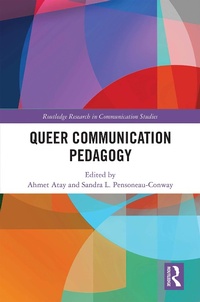
Queer Communication Pedagogy
1st Edition
Published on 17. October 2019
240 pages
978-1-351-65875-1 (ISBN)
Description

This book addresses queer issues and current events from a communication perspective to articulate a queer communication pedagogy. Through putting communication pedagogy and queer studies into dialogue, the book investigates how queer theory and critical communication pedagogy intersect in pedagogical spaces.
The chapters identify institutional and educational barriers, oppressions, and issues pertaining to queer lives in the context of higher education. Using a variety of critical methodological approaches (including dialogic methods, autoethnography, performative writing, and visual methods), each chapter theorizes a queer communication pedagogy, and offers a path toward and innovative ideas about materializing queer communication pedagogy as a disciplinary endeavor.
This book will be of interest to scholars, graduate students, and upper-level undergraduate students in Communication Studies, Critical Communication Pedagogy, Intercultural Communication, Higher Education, Public Pedagogy, and Queer Studies, and Critical/Cultural Studies.
The chapters identify institutional and educational barriers, oppressions, and issues pertaining to queer lives in the context of higher education. Using a variety of critical methodological approaches (including dialogic methods, autoethnography, performative writing, and visual methods), each chapter theorizes a queer communication pedagogy, and offers a path toward and innovative ideas about materializing queer communication pedagogy as a disciplinary endeavor.
This book will be of interest to scholars, graduate students, and upper-level undergraduate students in Communication Studies, Critical Communication Pedagogy, Intercultural Communication, Higher Education, Public Pedagogy, and Queer Studies, and Critical/Cultural Studies.
Reviews / Votes
"The great benefit of this work is its attention to the ways in which critical communication pedagogy and queer theory can be unified to create a new pedagogical paradigm, a responsive pedagogy about communication, difference, and praxis." --David H. Kahl, Jr. Penn State Erie, The Behrend CollegeMore details
Series
Edition
1. Auflage
Language
English
Place of publication
London
United Kingdom
Publishing group
Taylor & Francis Ltd
Target group
College/higher education
Illustrations
3 Halftones, black and white
ISBN-13
978-1-351-65875-1 (9781351658751)
Copyright in bibliographic data and cover images is held by Nielsen Book Services Limited or by the publishers or by their respective licensors: all rights reserved.
Schweitzer Classification
Other editions
Additional editions
Ahmet Atay | Sandra L. Pensoneau-Conway
Queer Communication Pedagogy
Book
08/2022
1st Edition
Routledge
€67.30
Shipment within 10-20 days
Ahmet Atay | Sandra L. Pensoneau-Conway
Queer Communication Pedagogy
Book
10/2019
1st Edition
Routledge
€207.60
Shipment within 10-20 days
Persons
Ahmet Atay (Ph.D. Southern Illinois University- Carbondale) is Associate Professor of Communication at the College of Wooster. His research revolves around cultural studies, media studies, and critical intercultural communication. In particular, he focuses on diasporic experiences and cultural identity formations of diasporic individuals; political and social complexities of city life, such as immigrant and queer experiences; the usage of new media technologies in different settings; and the notion of home. He is the author of Globalization's Impact on Identity Formation: Queer Diasporic Males in Cyberspace (2015) and the co-editor of 9 books. His scholarship appeared in number of journals and edited books.
Sandra L. Pensoneau-Conway (Ph.D. Southern Illinois University- Carbondale) is an Associate Professor of Communication Studies at Southern Illinois University Carbondale. Her teaching and research interests include critical communication pedagogy, communication and identity, and automethods. Recent publications include a co-edited book, Doing Autoethnography, a co-edited special issue of Communication Teacher (critical communication pedagogy) and essays in QED: A Journal of GLBTQ Worldmaking, Critical Education, and the book The Discourse of Disability in Higher Education.
Sandra L. Pensoneau-Conway (Ph.D. Southern Illinois University- Carbondale) is an Associate Professor of Communication Studies at Southern Illinois University Carbondale. Her teaching and research interests include critical communication pedagogy, communication and identity, and automethods. Recent publications include a co-edited book, Doing Autoethnography, a co-edited special issue of Communication Teacher (critical communication pedagogy) and essays in QED: A Journal of GLBTQ Worldmaking, Critical Education, and the book The Discourse of Disability in Higher Education.
Content
Chapter 1 Queer Pedagogy: Story of a Course Chapter 2 Bi and Bi: Exploring the Transgressive Potential of the Bisexual-Biracial Identity in the Queer Classroom Chapter 3 Disrupting Public Pedagogies of Bisexuality Chapter 4 Celebration, Resistance and Change: Queer Gender Performers of Color as Public Pedagogues Chapter 5 Transnational Queer Communication Pedagogy Chapter 6 Transing Communication Education: A Chorus of Voices Chapter 7 Creative Practice as Queer Media Pedagogy Chapter 8 The Queer Act of Talking Sex: Pedagogical Challenges in a Communication Course on Pornography Chapter 9 Fostering an Emerging Queer Consciousness Chapter 10 Hesitant to Walk: Affective Interventions in Queer Communication Pedagogy Chapter 11 Disclosing Lives, Reading Bodies: A Duo-autoethnography of Queerness in the Classroom
