

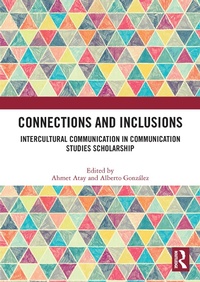
Connections and Inclusions
Intercultural Communication in Communication Studies Scholarship
1st Edition
Published on 26. August 2020
132 pages
978-1-000-08197-8 (ISBN)
Description

This book presents different aspects of intercultural communication research as they connect to and intersect with sub-disciples such as media studies, communication education, international communication, rhetorical studies, gender and sexuality studies, popular culture, and organizational communication.
Intercultural communication (IC) scholars in the CSCA region have often been questioned, and sometimes challenged, by scholars who have claimed that the Midwest is not an ideal locale for studying communication across cultures and among people from varying cultural backgrounds. However, over the years, scholars have established that intercultural communication is an important area of scholarship in the Midwest (and beyond), and that the region offers plenty of opportunities for studying the intersections of cultural perspectives in communication, ranging from racial and ethnic discrimination to the adaptation process of international students and from immigrant experiences to issues in queer cultures.
Because IC research does not exist in isolation, and it is always connected to larger frameworks or theoretical approaches within communication studies, the contributors in this book address how IC scholarship informs other areas of research and how IC scholars use the concepts and theoretical lenses of IC research to examine issues outside of IC. Although the focus is mainly on IC scholarship within the CSCA region, the scope of the book extends beyond this regional boundary as well.
This book was originally published as a special issue of Communication Studies.
Intercultural communication (IC) scholars in the CSCA region have often been questioned, and sometimes challenged, by scholars who have claimed that the Midwest is not an ideal locale for studying communication across cultures and among people from varying cultural backgrounds. However, over the years, scholars have established that intercultural communication is an important area of scholarship in the Midwest (and beyond), and that the region offers plenty of opportunities for studying the intersections of cultural perspectives in communication, ranging from racial and ethnic discrimination to the adaptation process of international students and from immigrant experiences to issues in queer cultures.
Because IC research does not exist in isolation, and it is always connected to larger frameworks or theoretical approaches within communication studies, the contributors in this book address how IC scholarship informs other areas of research and how IC scholars use the concepts and theoretical lenses of IC research to examine issues outside of IC. Although the focus is mainly on IC scholarship within the CSCA region, the scope of the book extends beyond this regional boundary as well.
This book was originally published as a special issue of Communication Studies.
More details
Edition
1. Auflage
Language
English
Place of publication
London
United Kingdom
Publishing group
Taylor & Francis Ltd
Target group
College/higher education
Product notice
Reflowable
ISBN-13
978-1-000-08197-8 (9781000081978)
Copyright in bibliographic data and cover images is held by Nielsen Book Services Limited or by the publishers or by their respective licensors: all rights reserved.
Schweitzer Classification
Other editions
Additional editions
Ahmet Atay | Alberto Gonzalez
Connections and Inclusions
Intercultural Communication in Communication Studies Scholarship
Book
09/2023
1st Edition
Routledge
€49.51
Shipment within 15-20 days
Ahmet Atay | Alberto Gonzalez
Connections and Inclusions
Intercultural Communication in Communication Studies Scholarship
Book
08/2020
1st Edition
Routledge
€122.50
Shipment within 15-20 days
Persons
Ahmet Atay (Ph.D. Southern Illinois University- Carbondale) is Associate Professor of Communication at the College of Wooster. His research revolves around media studies and critical intercultural communication. He is the author of Globalization's Impact on Identity Formation: Queer Diasporic Males in Cyberspace (2015) and the co-editor of 10 books.
Alberto Gonzalez (PhD, The Ohio State University) is Distinguished University Professor in the School of Media and Communication at Bowling Green State University. He is a co-editor of The Rhetorical Legacy of Wangari Maathai: Planting the Future (2018) and Our Voices: Essays in Culture, Ethnicity, and Communication, 6th Edition (2016).
Alberto Gonzalez (PhD, The Ohio State University) is Distinguished University Professor in the School of Media and Communication at Bowling Green State University. He is a co-editor of The Rhetorical Legacy of Wangari Maathai: Planting the Future (2018) and Our Voices: Essays in Culture, Ethnicity, and Communication, 6th Edition (2016).
Content
Introduction: Intercultural Studies within Central States
1. Intercultural Communication: Taking Stock of the Domain
2. Interiority as Epistemology: Situating Myself in the Central States Communication Association
3. Intercultural Communication Scholarship in the U.S. Heartland
4. A Methodological Nomad and an Accidental Scholar
5. Intercultural Communication and the Central States Region
6. Crossing Paths: Intercultural Collaborations
7. Rethinking "Difficult" Conversations in Communication Instruction From an Intercultural Lens: Pedagogical Strategies for "SWAP-ping" the Communication Classroom
8. Identifying Dominant Group Communication Strategies: A Phenomenological Study
9. A Feminist Postsocialist Approach to the Intercultural Communication of Rape at the ICTY
10. Can Detroiters Dream Again? The Imagined Dialectics of Urban Decline in Anthony Bourdain's Parts Unknown-Detroit
11. Sensemaking in Turbulent Contexts: African Student Leadership in a Postcolonial Context
1. Intercultural Communication: Taking Stock of the Domain
2. Interiority as Epistemology: Situating Myself in the Central States Communication Association
3. Intercultural Communication Scholarship in the U.S. Heartland
4. A Methodological Nomad and an Accidental Scholar
5. Intercultural Communication and the Central States Region
6. Crossing Paths: Intercultural Collaborations
7. Rethinking "Difficult" Conversations in Communication Instruction From an Intercultural Lens: Pedagogical Strategies for "SWAP-ping" the Communication Classroom
8. Identifying Dominant Group Communication Strategies: A Phenomenological Study
9. A Feminist Postsocialist Approach to the Intercultural Communication of Rape at the ICTY
10. Can Detroiters Dream Again? The Imagined Dialectics of Urban Decline in Anthony Bourdain's Parts Unknown-Detroit
11. Sensemaking in Turbulent Contexts: African Student Leadership in a Postcolonial Context
