

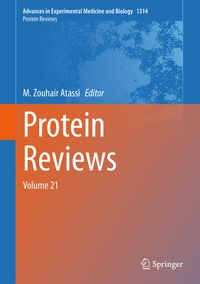
Protein Reviews
Description

The Protein Reviews series serves as a publication vehicle for reviews that focus on crucial contemporary and vital aspects of protein structure, function, evolution and genetics. Volumes are published online first, prior to publication in a printed book. Chapters are selected according to their importance to the understanding of biological systems, relevance to the unravelling of issues associated with health and disease, or impact on scientific or technological advances and developments.
Volume 21 presents eight review chapters authored by experts in the related fields. The first chapter covers the enzyme squalene monooxygenase and lipid levels and its relevance in health and disease. Chapter two presents a systematic analysis of the structural and functional aspects of heteromeric solute carriers. The third chapter provides a review of the role of CI- in type IV collagen assembly, function, and disease, including future directions for studies. This is followed by a summary in chapter four about the recent progress on defining the roles of the Slit-Robo signaling in bone metabolism and the possible roles of the interaction between Robo and neural epidermal growth factor-like proteins. Chapter five discusses recent data about the evolutionary aspects on structural differences between humans and the nematode in relation to previous knowledge of core proteins and GAG-attachment sites in Chn and CS proteoglycans of C.elegans and humans. The sixth chapter summarizes the immunochemical character of the IGHV1-69 -derived RFs and the recognition mechanism of the IGHV1-69 -derived RFs. Chapter seven covers regulated alternative translocation and its role as an emerging mechanism to regulate transmembrane proteins. Finally, chapter eight reviews current progress on IL-36 protein and biology and novel investigative tools. This volume is intended for research scientists, clinicians, physicians and graduate students in the fields of biochemistry, cell biology, molecular biology, immunology and genetics.More details
Other editions
Additional editions
Person
M. Zouhair Atassi is the emeritus Robert A. Welch chair of chemistry, professor of biochemistry and molecular biology, and professor of pathology and immunology at Baylor College of Medicine, Houston, Texas. Previously, he was professor of biochemistry and immunology at Mayo Medical School and Mayo Clinic, Rochester, Minnesota. He was president of the International Symposium of the Immunobiology of Proteins and the Institute of Immunology; founding editor and editor-in-chief of Critical Reviews in Immunology , Protein Journal , and Protein Reviews ; and served on the editorial boards of nine other peer-reviewed journals. Professor Atassi is the editor or co-editor of 33 books; author or co-author of over 470 articles in peer-reviewed journals on protein structure, biological function, and molecular and cellular immune recognition; and has received several distinguished awards, medals, and prizes in these fields.
