

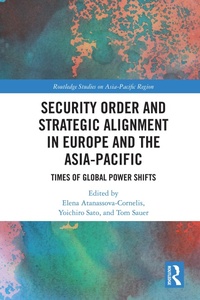
Security Order and Strategic Alignment in Europe and the Asia-Pacific
Times of Global Power Shifts
Published on 18. March 2025
186 pages
978-1-040-32996-2 (ISBN)
Description

Elena Atanassova-Cornelis, Yoichiro Sato, Tom Sauer, and their contributors examine the implications of the shifts in power for the regional security order, as the longterm relative decline of the US standing in the global hierarchy of power is more pronounced than ever due to the challenges it faces from the rising China in Asia and the reviving Russia in Europe.
The world is in disarray, and the balance of power is shifting, which results in enhanced tensions and wars, including on the territory of Europe. The complexity of the international order that prevails today possibly misleads us toward viewing everything in terms of a bipolar competition, as predicted by systemic-level realism. While membership of the multilateral NATO Alliance expands in Europe in light of the ongoing Russian invasion of Ukraine, China's assertive behavior in Asia has produced numerous strategic alignments that are short of a formal alliance involving Asian states, the US, and European countries. 'Hedging' strategies are commonly found in Asian states' approaches to security, working against the bifurcation of powers. Contrarily, European entries into alignments in the 'Indo-Pacific' have demonstrated the inseparability of security in Asia from security in Europe through the shared thread of 'engaging the US'. Whether China defines its challenge against the US in regional or global terms also has differing implications for the evolution of the international system. This book, with contributions by Asian, European, and North American experts, provides an overview of the two regions' differing alignment paths in comparative and inter-regional perspectives.
The book is a valuable resource for academics, researchers, practitioners, and policy analysts interested in European and Asia-Pacific security, as well as international and regional security issues.
The world is in disarray, and the balance of power is shifting, which results in enhanced tensions and wars, including on the territory of Europe. The complexity of the international order that prevails today possibly misleads us toward viewing everything in terms of a bipolar competition, as predicted by systemic-level realism. While membership of the multilateral NATO Alliance expands in Europe in light of the ongoing Russian invasion of Ukraine, China's assertive behavior in Asia has produced numerous strategic alignments that are short of a formal alliance involving Asian states, the US, and European countries. 'Hedging' strategies are commonly found in Asian states' approaches to security, working against the bifurcation of powers. Contrarily, European entries into alignments in the 'Indo-Pacific' have demonstrated the inseparability of security in Asia from security in Europe through the shared thread of 'engaging the US'. Whether China defines its challenge against the US in regional or global terms also has differing implications for the evolution of the international system. This book, with contributions by Asian, European, and North American experts, provides an overview of the two regions' differing alignment paths in comparative and inter-regional perspectives.
The book is a valuable resource for academics, researchers, practitioners, and policy analysts interested in European and Asia-Pacific security, as well as international and regional security issues.
More details
Series
Language
English
Place of publication
London
United Kingdom
Publishing group
Taylor & Francis Ltd
Target group
College/higher education
Professional and scholarly
File size
0,75 MB
ISBN-13
978-1-040-32996-2 (9781040329962)
Copyright in bibliographic data and cover images is held by Nielsen Book Services Limited or by the publishers or by their respective licensors: all rights reserved.
Schweitzer Classification
Other editions
Additional editions
Elena Atanassova-Cornelis | Yoichiro Sato | Tom Sauer
Security Order and Strategic Alignment in Europe and the Asia-Pacific
Times of Global Power Shifts
Book
approx. 07/2026
1st Edition
Routledge
€57.50
Not yet published
Elena Atanassova-Cornelis | Yoichiro Sato | Tom Sauer
Security Order and Strategic Alignment in Europe and the Asia-Pacific
Times of Global Power Shifts
Book
04/2025
1st Edition
Routledge
€207.30
Shipment within 10-20 days
Persons
Elena Atanassova-Cornelis is Professor of International Politics of the Asia-Pacific at the University of Antwerp and the Universite Catholique de Louvain, both in Belgium. She is also a nonresident research fellow at the International Center for Defence and Security in Tallinn, Estonia. Her research interests and expertise include international relations, security, and strategic studies, with a focus on Asia and the Indo-Pacific region, as well as Asia-Europe relations.
Yoichiro Sato is Professor at Ritsumeikan Asia Pacific University, Japan. He has published more than ten books, including The US-Japan Security Alliance (coedited with Takashi Inoguchi and G. John Ikenberry, 2011), Regional Institutions, Geopolitics, and Economics in the Asia-Pacific (coedited with Steve Rothman and Utpal Vyas, 2017), and Re-Rising Japan (co-edited with Hidekazu Sakai, 2017). His commentaries have appeared in various global media, including Time, Newsweek, Al Jazeera, Agence Presse Francais, and Nikkei Asian Review.
Tom Sauer is Professor of International Politics and spokesman for the Research Group of International Politics in the Department of Politics at Universiteit Antwerpen, Belgium. He is an expert on international security, particularly on nuclear arms control. Sauer is a former research fellow at the BCSIA at the Kennedy School of Government, Harvard University (US). He received the Rotary International Alumni Global Service Award in 2019.
Yoichiro Sato is Professor at Ritsumeikan Asia Pacific University, Japan. He has published more than ten books, including The US-Japan Security Alliance (coedited with Takashi Inoguchi and G. John Ikenberry, 2011), Regional Institutions, Geopolitics, and Economics in the Asia-Pacific (coedited with Steve Rothman and Utpal Vyas, 2017), and Re-Rising Japan (co-edited with Hidekazu Sakai, 2017). His commentaries have appeared in various global media, including Time, Newsweek, Al Jazeera, Agence Presse Francais, and Nikkei Asian Review.
Tom Sauer is Professor of International Politics and spokesman for the Research Group of International Politics in the Department of Politics at Universiteit Antwerpen, Belgium. He is an expert on international security, particularly on nuclear arms control. Sauer is a former research fellow at the BCSIA at the Kennedy School of Government, Harvard University (US). He received the Rotary International Alumni Global Service Award in 2019.
Content
Introduction 1. Alliances, Partnerships, and Alignments: Concepts and Definitions 2. The West's Collective Defense Institutions in Asia and Europe: A Geopolitical Perspective 3. Europe and Geopolitical Spillover Effects from the Asia-Pacific 4. A Concerned Believer: Poland and the credibility of U.S. security guarantees 5. Same but Different: NATO after its Nordic enlargement 6. Concerts and Collective Security: A More Stable Security Order Than Balance of Power 7. U.S. Grand Strategies from the Obama to the Biden Administrations: Their Impact on American Alliances and Alignments in the Indo-Pacific Region 8. Japan-US alliance "Plus": Evolving Perspectives on Alignment Cooperation in the Indo-Pacific 9. International Alliances: Chinese Views and Responses 10.Assessing Alternative Alignments: China's Reception of the Quad
