

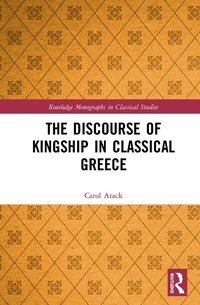
The Discourse of Kingship in Classical Greece
1st Edition
Published on 11. October 2019
252 pages
978-0-429-55712-5 (ISBN)
Description

This book examines how ancient authors explored ideas of kingship as a political role fundamental to the construction of civic unity, the use of kingship stories to explain the past and present unity of the polis and the distinctive function or status attributed to kings in such accounts.
It explores the notion of kingship offered by historians such as Herodotus, as well as dramatists writing for the Athenian stage, paying particular attention to dramatic depictions of the unique capabilities of Theseus in uniting the city in the figure of the 'democratic king'. It also discusses kingship in Greek philosophy: the Socratics' identification of an 'art of kingship', and Xenophon and Isocrates' model of 'virtue monarchy'. In turn, these allow a rereading of explorations of kingship and excellence in Plato's later political thought, seen as a critique of these models, and also in Aristotle's account of total kingship or pambasileia, treated here as a counterfactual device developed to explore the epistemic benefits of democracy.
This book offers a fascinating insight into the institution of monarchy in classical Greek thought and society, both for those working on Greek philosophy and politics, and also for students of the history of political thought.
It explores the notion of kingship offered by historians such as Herodotus, as well as dramatists writing for the Athenian stage, paying particular attention to dramatic depictions of the unique capabilities of Theseus in uniting the city in the figure of the 'democratic king'. It also discusses kingship in Greek philosophy: the Socratics' identification of an 'art of kingship', and Xenophon and Isocrates' model of 'virtue monarchy'. In turn, these allow a rereading of explorations of kingship and excellence in Plato's later political thought, seen as a critique of these models, and also in Aristotle's account of total kingship or pambasileia, treated here as a counterfactual device developed to explore the epistemic benefits of democracy.
This book offers a fascinating insight into the institution of monarchy in classical Greek thought and society, both for those working on Greek philosophy and politics, and also for students of the history of political thought.
Reviews / Votes
"Atack's elegant and clever book situates itself amid recent discussions of kingship, from Graeber and Sahlins to Strathern. It focuses on texts from Herodotus to Aristotle, between the Homeric king and the late Hellenistic period of Philodemus. The focus is Greek even when speaking of foreign kings, and notwithstanding Atack's impressive awareness of the huge literature on external kings in their own contexts (and bibliography in general)... [The book] works on at least two levels. First, it offers astute readings of some well-known texts, and succeeds without any doubt in reconceptualizing the Greek discourse of kingship (and kingliness) in the fifth and fourth centuries BCE, in Athens especially. Second, it asks challenging methodological questions about sole rule and regality, which make the book of a wider interest. Atack's framework might work interestingly in relation to the Roman emperor, for example. The argument is concise and clear, and should provoke debate at the same level of seriousness and intellectual ambition with which it is written." - Bryn Mawr Classical ReviewMore details
Series
Edition
1. Auflage
Language
English
Place of publication
London
United Kingdom
Publishing group
Taylor & Francis Ltd
Target group
College/higher education
Product notice
Reflowable
ISBN-13
978-0-429-55712-5 (9780429557125)
Copyright in bibliographic data and cover images is held by Nielsen Book Services Limited or by the publishers or by their respective licensors: all rights reserved.
Schweitzer Classification
Other editions
Additional editions
Carol Atack
The Discourse of Kingship in Classical Greece
Book
12/2021
1st Edition
Routledge
€68.00
Shipment within 10-20 days
Carol Atack
The Discourse of Kingship in Classical Greece
Book
11/2019
Routledge
Unfortunately, price unknown
Available (delivery time upon request)
Carol Atack
The Discourse of Kingship in Classical Greece
Book
10/2019
1st Edition
Routledge
€206.50
Shipment within 15-20 days
Person
Carol Atack works on classical Greek political thought and intellectual history. She is currently a fellow of the Center for Hellenic Studies, Washington DC, and a bye-fellow and associate tutor at Newnham College, University of Cambridge. She holds a PhD in Classics from the University of Cambridge (2014), and undergraduate degrees in Classics (Cambridge) and Government (London School of Economics). Carol has held teaching positions in ancient history and classical literature at the University of Warwick and St Hugh's College, University of Oxford, and was recently a postdoctoral researcher on the Anachronism and Antiquity project at Oxford, contributing to the monograph Anachronism and Antiquity (written with Tim Rood and Tom Phillips; forthcoming) and preparing a monograph on the temporality of Platonic dialogue. Carol has published several articles and book chapters on topics in Greek political thought, including political thought in the pseudo-Platonic letters, Aristotle's thought on kingship, and Foucault on Plato on frank speech. She serves as associate editor for Greek political thought for the journal Polis. Her current research continues her work on fourth-century Greek political thought, with a particular focus on the political and ethical thought of Plato and Xenophon.
Content
Introduction 1. King and Cosmos in Herodotus 2. Monarchy on the Democratic Stage 3. The Discourse of Kingship in Classical Athenian Thought 4. Kingship and Socratic Thought 5. Virtue and Monarchy 6. Kingship in Plato's Later Political Thought 7. 'Total Kingship' and the Rule of Law 8. Conclusion: the Imaginary King and the Metaphysics of Political Unity
