

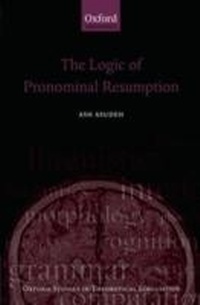
Logic of Pronominal Resumption
1st Edition
Published on 19. January 2012
486 pages
978-0-19-163249-5 (ISBN)
Description

This book is a cross-linguistic investigation of resumptive pronouns and related resumption phenomena. The author proposes a new theory of resumption based on the use of a resource logic for semantic composition and the typologically robust observation that resumptive pronouns are ordinary pronouns in their morphological and lexical properties.
More details
Other editions
Additional editions
Ash Asudeh
The Logic of Pronominal Resumption
Book
01/2012
Oxford University Press
€136.30
Shipment within 15-20 days
Ash Asudeh
The Logic of Pronominal Resumption
Book
01/2012
Oxford University Press
€100.80
Shipment within 15-20 days
Content
- Cover
- Contents
- General Preface
- Preface
- List of Figures
- List of Tables
- List of Symbols, Glosses, and Abbreviations
- 1. Introduction
- 1.1 Outline of the Book
- Part I: Background
- 2. Resumption
- 2.1 Resumptive Pronouns in Unbounded Dependencies
- 2.2 Processing-Based Resumptive Pronouns
- 2.3 Copy Raising
- 2.4 Conclusion
- 3. Lexical-Functional Grammar
- 3.1 Grammatical Architecture
- 3.2 Constituent Structure
- 3.3 Functional Structure
- 3.4 Semantic Structure
- 3.5 Templates
- 3.6 Anaphora and Syntax
- 3.7 Unbounded Dependencies
- 3.8 Raising
- 4. Glue Semantics
- 4.1 Composition and Interpretation
- 4.2 Anaphora
- 4.3 Scope
- Part II: Theory
- 5. The Resource Sensitivity Hypothesis
- 5.1 Substructural Logics and Linguistic Theory
- 5.2 Logical and Linguistic Resource Sensitivity
- 5.3 Resource Sensitivity and Linguistic Theory
- 5.4 Conclusion
- 6. The Resource Management Theory of Resumption
- 6.1 The Problem of Resumptives as Resource Surplus
- 6.2 Manager Resources
- 6.3 Integrating Resource Management in LFG
- 6.4 Syntactically Inactive Resumptive Pronouns
- 6.5 Conclusion
- Part III: Syntactically Active Resumptives
- 7. Irish
- 7.1 Irish Clausal Structure
- 7.2 Unbounded Dependencies in Irish
- 7.3 Analysis of Core Patterns
- 7.4 Analysis of Mixed Chains
- 7.5 Summary
- 7.6 Discussion
- 7.7 Conclusion
- 8. Hebrew
- 8.1 Resumptive Pronouns in Hebrew
- 8.2 Licensing Resumptives Lexically
- 8.3 Analysis
- 8.4 Conclusion
- Part IV: Syntactically Inactive Resumptives
- 9. Swedish
- 9.1 Resumptive Pronouns in Swedish
- 9.2 Licensing and Integrating Syntactically Inactive Resumptives
- 9.3 Analysis
- 9.4 Discussion
- 9.5 Conclusion
- 10. Vata
- 10.1 Resumptive Pronouns in Vata
- 10.2 Analysis
- 10.3 Conclusion
- Part V: Other Kinds of Resumption
- 11. Resumption and Processing
- 11.1 The Processing Model
- 11.2 Production
- 11.3 Parsing and Interpretation
- 11.4 Conclusion
- 12. Copy Raising
- 12.1 English Copy Raising
- 12.2 Unifying Copy Raising and Resumption
- 12.3 Analysis
- 12.4 Capturing Variation Lexically
- 12.5 Further Consequences: Copy Raising and Scope
- 12.6 Conclusion
- 13. Conclusion
- 13.1 Predictions of the Resource Management Theory and the Processing Theory
- 13.2 Alternative Approaches
- 13.3 Apparent Challenges to Resource Sensitivity
- 13.4 Directions for Future Work
- Part VI: Appendices
- A. Glue Semantics with Limited Multiplicative Intuitionistic Linear Logic
- A.1 The Glue Logic
- A.2 Proof Rules for MILL[sub(l)]
- A.3 Meaning Language Term Assignments for MILL[sub(l)]
- B. A Fragment of Irish
- B.1 C-structure Rules
- B.2 Templates
- B.3 Lexicon
- B.4 Examples
- C. A Fragment of Swedish
- C.1 C-structure Rules
- C.2 Templates
- C.3 Lexicon
- C.4 Example
- Bibliography
- Author Index
- A
- B
- C
- D
- E
- F
- G
- H
- J
- K
- L
- M
- N
- O
- P
- R
- S
- T
- U
- V
- W
- X
- Z
- Subject Index
- A
- B
- C
- D
- E
- F
- G
- H
- I
- J
- K
- L
- M
- N
- O
- P
- Q
- R
- S
- T
- U
- V
- W
- X
- Y
